
How to choose an office furniture manufacturer in China: what commercial buyers should verify before placing an order
You have the project. You have the budget. What you don't have is certainty that the factory on the other side of the world will deliver what they promise.
You have the project. You have the budget. What you don't have is certainty that the factory on the other side of the world will deliver what they promise.
That uncertainty is the single biggest barrier in office furniture sourcing from China. Not price. Not logistics. Not lead times. The risk of choosing wrong.
This article is about reducing that risk to something you can manage: what to verify when evaluating an office furniture manufacturer in China, what red flags to watch for, and how to separate a factory that can execute your project from one that will become your next problem.
If you're a furniture dealer looking for an OEM partner, a procurement manager outfitting a corporate headquarters, or an importer building a product line, the framework below applies directly.
Why China, and why Guangzhou specifically
China accounts for roughly 40% of global furniture exports. Within China, the Pearl River Delta region, and Guangzhou in particular, concentrates the largest cluster of office furniture manufacturers in the country.
There's a reason for this concentration:
Complete supply chains. MDF, particleboard, steel tubes, hardware, laminates, fabrics, all sourced within 100 km. Short supply chains mean lower costs, faster sampling, and tighter quality control over raw materials.
Export infrastructure. Nansha Port and Huangpu Port handle container shipping to the Middle East, Southeast Asia, Africa, Europe, and the Americas. Freight forwarders, customs brokers, packing workshops, the logistics ecosystem is mature.
Manufacturing expertise. Decades of production for export markets have built a workforce and management layer that understands international quality standards, BIFMA requirements, and market-specific compliance.
When buyers search for a Guangzhou office furniture supplier, they're tapping into this ecosystem. The location is not incidental. It's a structural advantage that affects lead times, cost, and quality consistency.
The evaluation framework: five dimensions that separate real manufacturers from trading companies
Many companies presenting themselves as "manufacturers" are trading companies. They outsource production to unknown workshops. The distinction matters because trading companies cannot control quality, lead times, or pricing with the same reliability as a factory that owns its production.
Here are the five dimensions that reveal whether you're dealing with a genuine manufacturer.
1. Factory size and production capacity
A real manufacturer can tell you their floor space, workforce, and production capacity in specific terms, not vague superlatives.
What to ask for:
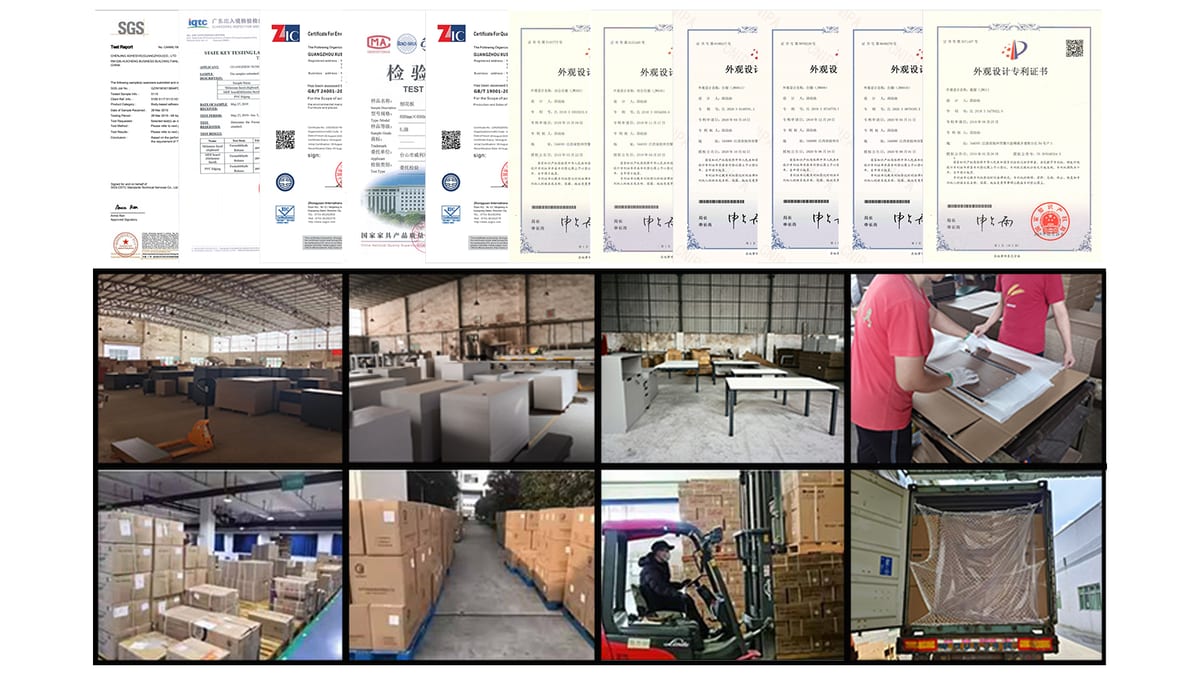
Total production area. A facility of 30,000 to 50,000+ sqm indicates genuine manufacturing capability; below 10,000 sqm suggests a workshop or assembler.
Number of production workers, not including sales and admin.
Monthly container output.
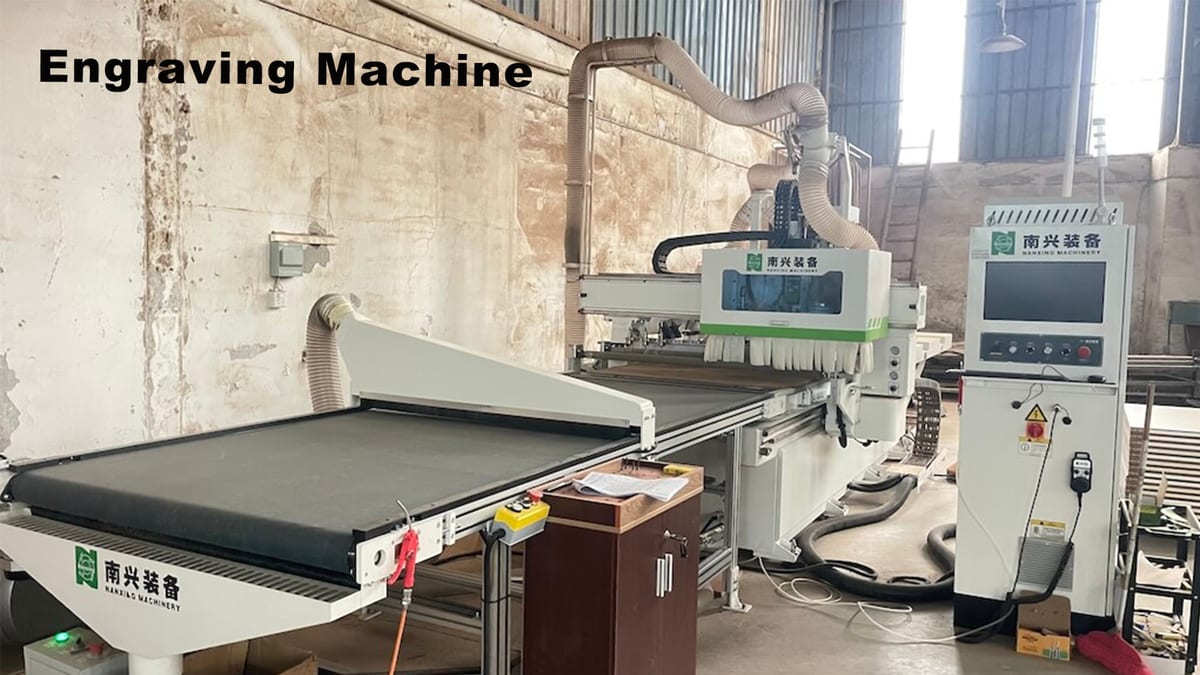
Dedicated workshops: cutting, edge banding, assembly, painting/finishing, packing. Each should be a separate, staffed area.
Why it matters. Production capacity determines whether the factory can handle your volume and timeline. A factory running at 95% capacity cannot absorb rush orders or scale for your next project.
Verification. Ask for a factory floor plan or a video walkthrough. If the "manufacturer" deflects or offers only showroom photos, that's a signal.
2. Certifications and compliance
Certifications are not decorative. They are verifiable proof that a manufacturer operates documented management systems.
Certification | What it proves | Why it matters to you |
|---|---|---|
ISO 9001:2015 | Documented quality management system | The factory has written procedures for production, inspection, and corrective action |
ISO 14001:2015 | Environmental management system | Important for markets with green procurement requirements (government, EU, LEED-certified projects) |
BIFMA compliance | Furniture meets ANSI/BIFMA performance standards | Essential for North American commercial projects; many specifiers require it |
FSC certification | Wood sourced from sustainably managed forests | Required for certain government and corporate sustainability mandates |
Material test reports | Formaldehyde emission, load testing, finish durability | Proves product safety and durability |
Verification. Request certificate copies with the company name visible. Cross-reference with the issuing body. Certificates without matching company names are borrowed or fabricated.
3. OEM/ODM capabilities and customization scope
If you're searching for an office furniture OEM partner, you need more than a factory that claims "we can customize." You need to understand the specific scope of what they can customize and the process they follow.
OEM (Original Equipment Manufacturing): You provide the design, drawings, specifications, materials. The manufacturer produces exactly what you've specified. You own the intellectual property.
ODM (Original Design Manufacturing): The manufacturer provides both design and production. You select from their existing product architecture and customize dimensions, finishes, or configurations.
What to verify:
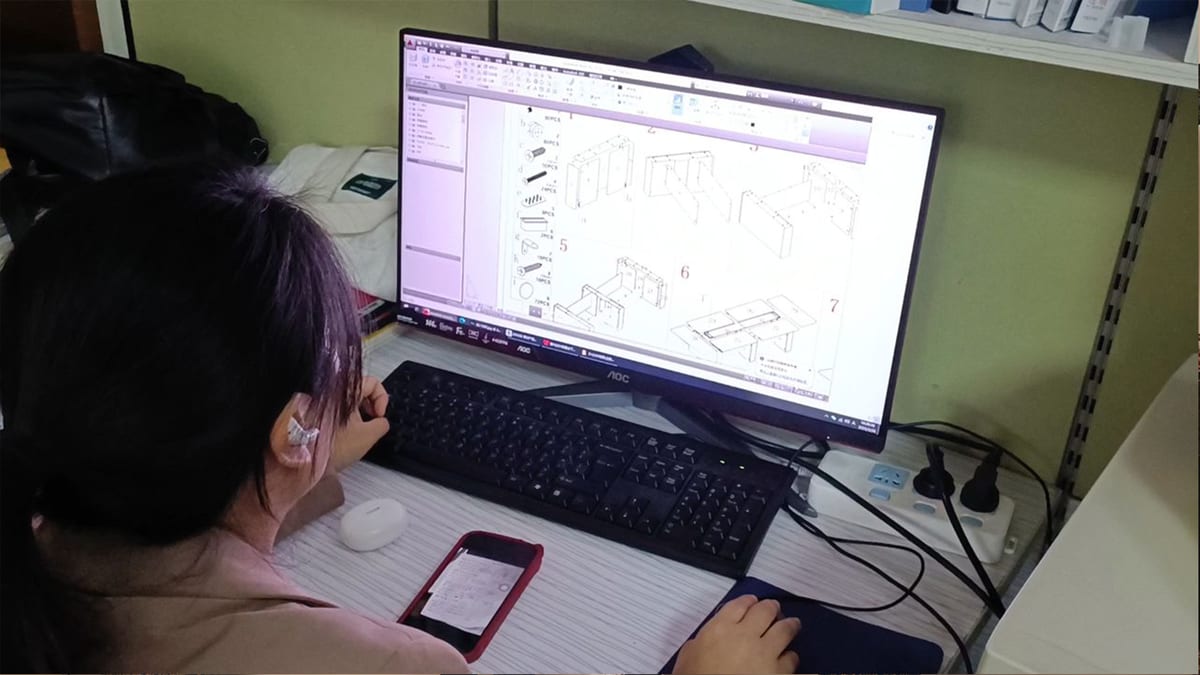
Can they produce from your drawings? What format do they accept (CAD, 3D models, hand sketches)?
Do they have an in-house design or engineering team that can interpret specifications and flag manufacturability issues before production?
What is the scope of customization? Dimensions, finishes, colors, hardware, branding/logo insertion, packaging.
What is the sample process? How long from specification to finished sample? What is the sample cost?
What are the minimum order quantities (MOQs) for custom items vs. catalog items?
Why it matters. The OEM/ODM decision shapes your entire product strategy. A manufacturer with deep OEM capability lets you build a differentiated product line. One with only ODM capability limits you to variations of existing designs, which your competitors can also access.
4. Export experience and shipping coordination
Producing furniture and shipping it internationally are two different competencies. A factory that makes great products but can't pack them for a six-week ocean voyage will cost you in damaged goods and client complaints.
What to verify:
Countries served. A manufacturer that has shipped to 50+ countries has handled diverse customs requirements, documentation, and shipping routes. That experience translates to fewer problems on your shipment.
Packing standards. Do they have a dedicated packing workshop? Do they use corner protectors, shrink wrap, foam inserts, and carton reinforcement? Ask for photos of packed containers.
Shipping terms. Do they offer FOB and CIF? Can they coordinate LCL (less than container load) shipments for smaller orders?
Documentation. Can they provide commercial invoices, packing lists, certificates of origin, and fumigation certificates as needed?
Why it matters. International shipping problems don't show up in the unit price. They show up as damaged goods, customs delays, and frustrated clients weeks after you thought the order was complete.
5. Quality control processes
"Quality control" is not an event that happens at the end of production. It's a system that runs from raw material intake to final shipment.
The QC stages that a serious manufacturer should have:
Raw material inspection. Verifying incoming MDF, steel, hardware, and laminates against specifications before they enter production.
In-process inspection. Checking dimensions, assembly, and finish at each production stage.
Final inspection. Load testing, functional testing, finish inspection, and dimensional verification on finished products.
Pre-shipment inspection. Checking the packed order against the purchase order for quantities, specifications, and packaging integrity.
Verification. Ask for their QC procedure document. A manufacturer that has one will share it. One that doesn't will offer vague assurances about "strict quality control."
Red flags: warning signs when evaluating Chinese manufacturers
Not every factory that looks good on a website is a good partner. Here are the warning signs that experienced buyers learn to recognize, sometimes after costly mistakes.
They can't show you the factory
If a "manufacturer" can only show product photos and a showroom, never a production floor, they are likely a trading company. This isn't inherently dishonest. Trading companies serve a purpose. But you need to know what you're dealing with, because it affects pricing, quality control, and accountability.
Prices that seem too good to be true
The furniture market, like most markets, has a cost floor determined by materials, labor, and overhead. A price 30 to 40% below the market average usually means something has been compromised: material grade, finish quality, hardware, or structural integrity.
A dealer we know switched to a lower-priced supplier and discovered, after two container loads, that drawer slides had been swapped for cheaper versions, edge banding was thinner than specified, and MDF density was below spec. The "savings" were wiped out by returns, replacements, and a lost client.
The cost of a wrong manufacturer choice isn't just the order value. It's the downstream damage to your reputation and client relationships. One bad shipment can lose you a client you spent years building.
No verifiable certifications
"We're getting certified" is not the same as being certified. "Our partner factory is certified" means you're dealing with a trading company using someone else's certificate. Only accept certifications with the actual manufacturer's name.
No export track record in your market
A factory that has only shipped domestically or to one region may struggle with your market's specific requirements, whether that's GCC standards for the Middle East, BIFMA for North America, or EN standards for Europe.
No sample process
A legitimate manufacturer should have a clear sample process with defined lead times and costs. Refusing samples or offering only catalog photos suggests they cannot produce to specification.
OEM vs. ODM: which model fits your business
This decision shapes your product strategy, margins, and competitive position.
Factor | OEM | ODM |
|---|---|---|
Design ownership | You own it | Manufacturer owns it |
Differentiation | Full, unique products | Limited, others can source similar designs |
Investment required | Higher (design, specs, development) | Lower (select and customize) |
Time to market | Longer (8 to 16 weeks for development) | Shorter (4 to 8 weeks for customization) |
MOQs | Typically higher | Typically lower |
Best for | Brands building proprietary lines | Dealers adding product range quickly |
The decision comes down to your business strategy, not which model is "better." If you're a dealer with strong design capability and want to build a differentiated brand, OEM is the path. If you need to fill a product gap quickly for a project, ODM gets you there faster.
Many successful furniture businesses use both: OEM for their signature lines where differentiation matters, ODM for commodity categories where speed and price matter more.
The Guangzhou advantage: what manufacturing hub location actually means for your order
"Location" in manufacturing is more than a point on a map. It's a structural factor that affects every aspect of your order.
Supply chain proximity. When your manufacturer sources MDF, hardware, and laminates within 50 km of the factory, lead times compress. Raw material quality issues get resolved in hours, not weeks. Sample iterations happen in days, not weeks.
Labor pool depth. Guangzhou has a concentrated workforce with furniture manufacturing experience. Lower turnover, faster training, and more consistent output quality compared to regions where furniture manufacturing is a smaller industry.
Logistics maturity. The export infrastructure around Guangzhou (ports, freight forwarders, customs brokers, packing specialists) means your container gets loaded, documented, and shipped with fewer handoffs and fewer problems.
Competitive pressure. In a cluster of manufacturers, competitive pressure drives quality up and complacency down. Factories that underperform lose business to the one next door. This dynamic works in your favor.
For commercial buyers evaluating a Guangzhou office furniture manufacturer, location is a measurable advantage in lead time, cost, and reliability.
How to verify a manufacturer before committing
Due diligence before your first order prevents problems that are expensive to fix after. Here's a practical verification sequence.
Step 1: Request documentation
Ask for company registration, ISO certificates, factory photos (production floor, not showroom), QC procedures, and a client reference list. A legitimate manufacturer provides these within 48 hours.
Step 2: Order samples
The sample process is a micro-test of the entire production relationship. It reveals how accurately they interpret your specifications, how they communicate about details and adjustments, whether they meet their stated lead times, and the actual quality of materials and finishing.
Sample cost is a small investment relative to a container order. Think of it as an audition.
Step 3: Check references
Ask for 2 to 3 client references, ideally in your market or region. Contact them. Ask about delivery reliability, quality consistency, communication responsiveness, and how they handle problems.
Step 4: Start with a trial order
Before committing to a large project, place a smaller trial order. One container or less. This tests the full cycle: specification, production, QC, packing, shipping, and delivery. The trial order validates everything the manufacturer claimed in their sales communication.
Step 5: Consider a factory visit
For ongoing partnerships, a factory visit provides information that no amount of documentation can. You see the production floor, meet the team, and assess the operation firsthand. If a factory visit is met with resistance, that's information in itself.
Understanding cost structure: FOB, CIF, and pricing transparency
Price quotes without context are meaningless. Here's what affects the actual cost of your order.
Unit cost factors:
Material grade (E1 vs. E0 MDF, cold-rolled vs. galvanized steel, laminated vs. veneered surfaces)
Finish quality (melamine, HPL, veneer, lacquer, each at different price points)
Hardware origin (Chinese vs. imported hinges, slides, locks)
Packaging level (standard carton vs. reinforced export packing with corner protectors)
Shipping cost structure:
FOB (Free on Board). You pay the factory for goods delivered to the port. You arrange and pay for shipping from there. Gives you control over freight costs and routing.
CIF (Cost, Insurance, Freight). The factory arranges shipping to your destination port. Convenient but less transparent. The factory's shipping markup is embedded in the total price.
LCL (Less than Container Load). For orders that don't fill a full container. Higher per-unit shipping cost but lower total investment for smaller orders.
What transparent pricing looks like: a manufacturer that breaks down unit price, packaging cost, and shipping cost separately gives you the ability to compare accurately. One that provides only a lump sum makes comparison impossible, and that's usually intentional.
What export manufacturing experience since 2008 looks like
Claims are cheap. Proof is not. Here's what a manufacturer with genuine export experience can show you, using our own operation as a reference.
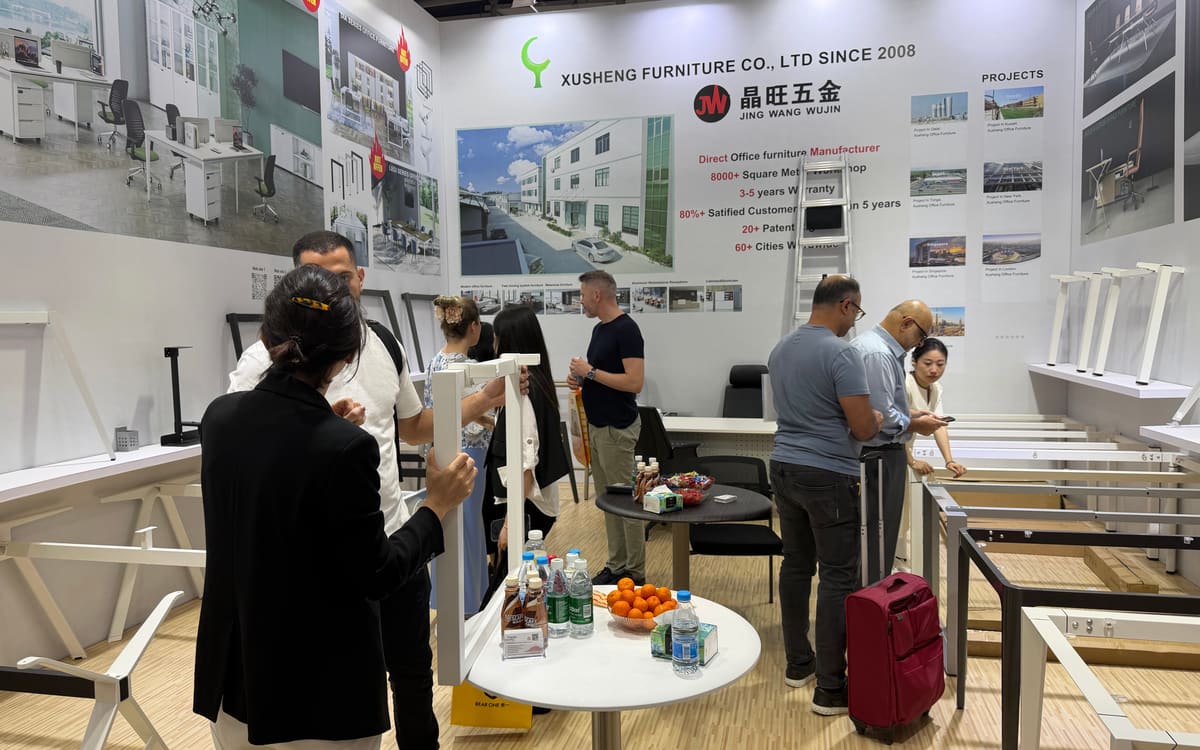
XuSheng Office Furniture has been manufacturing in Guangzhou since 2008. That's not a marketing statement. It's a verifiable fact backed by company registration, ISO certification history, and a project portfolio spanning 80+ countries.
What export manufacturing experience since 2008 means in practical terms for buyers evaluating an office furniture OEM or ODM partner:
A 50,000 sqm production base with dedicated workshops for cutting, assembly, finishing, and packing. Not a fragmented operation spread across subcontractors.
ISO 9001:2015 and ISO 14001:2015 certifications maintained through regular audits. A documented quality management system, not a one-time certificate.
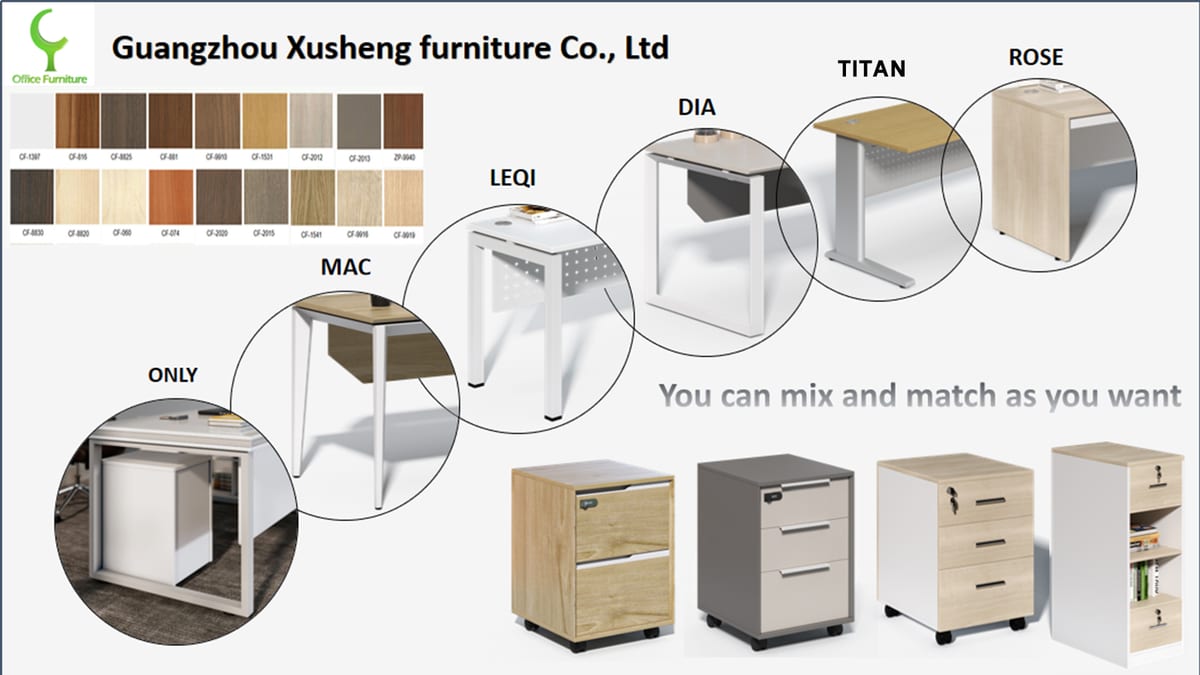
92+ product models across executive desks, workstations, conference tables, file cabinets, and office partitions. A deep catalog that lets buyers source an entire project from one manufacturer.
OEM and ODM capabilities with a defined process from specification to sample to production. Not an ad hoc "we can customize" promise.
Project references in demanding markets: Kuwait government projects, Qatar commercial buildings, New York corporate headquarters, Singapore office fit-outs, and London Olympic venues. Projects where specification compliance and delivery reliability were non-negotiable.
These are not abstract capabilities. They are the result of learning accumulated since 2008 about what commercial buyers need, what goes wrong in international orders, and how to prevent those problems.
If you're evaluating whether XuSheng is the right office furniture manufacturer in China for your project, the verification framework above applies to us as much as to any manufacturer. We encourage you to use it.
Your manufacturer evaluation checklist
Print this. Use it.
Factory verification:
Factory floor area confirmed (30,000+ sqm threshold)
Production workforce specified
Monthly capacity stated
Factory photos or video walkthrough provided (production floor, not showroom)
Company registration verified
Certifications:
ISO 9001:2015 certificate provided with matching company name
ISO 14001:2015 certificate provided (if environmental compliance matters for your market)
BIFMA compliance confirmed (for North American projects)
Material test reports available (formaldehyde, load, finish)
OEM/ODM capability:
OEM process documented (specification → sample → production)
Customization scope defined (dimensions, finishes, hardware, branding)
Sample process defined (timeline, cost, revision policy)
MOQs stated for custom and catalog items
In-house design or engineering capability confirmed
Export capability:
Countries served: 50+ indicates broad experience
Packing standards documented with photos
Shipping terms offered (FOB, CIF, LCL)
Export documentation capability confirmed (invoices, certificates, customs)
Quality control:
QC procedure document provided
Raw material inspection process described
In-process inspection checkpoints defined
Final inspection criteria documented
Pre-shipment inspection included
Communication and references:
Response time tested (under 24 hours for initial inquiry)
Technical staff accessible, not only sales intermediary
2 to 3 client references provided and contacted
English communication quality assessed
Next steps
The wrong manufacturer costs more than the order. It costs the client you spent years winning.
If you're at the evaluation stage, start with the checklist above. Then talk to our team about your specific project requirements. We can recommend suitable products from our catalog, discuss OEM/ODM options, and provide a quotation based on your quantity, specification, and delivery needs.
For the full sourcing process, from initial specification to final shipment, see our companion article: B2B Office Furniture Procurement: A Dealer's Complete Guide to Sourcing from Manufacturers.
XuSheng Office Furniture. Guangzhou manufacturer since 2008. 11,000 sqm production base. ISO 9001:2015 certified. 80+ countries served. Contact our team to discuss your project.
FAQ
Frequently asked questions
01How can a buyer verify a reliable Chinese office-furniture supplier?
A buyer should verify factory area, production workforce and monthly capacity; request a production-floor walkthrough; inspect dedicated cutting, edge-banding, assembly, finishing and packing areas; and confirm company registration. The article also recommends checking documents, samples and references before a large order.
02What certifications and quality records should a buyer request?
Request certificates with the manufacturer’s legal name and cross-check the issuing body. The article discusses ISO 9001, ISO 14001, BIFMA, FSC and material test reports, together with documented raw-material, in-process, final and pre-shipment QC procedures.
03When should a buyer choose OEM instead of ODM?
OEM suits a business that owns designs and wants a differentiated product line. ODM suits a dealer that wants a faster launch by customizing an existing manufacturer design; the article notes that OEM generally requires more design investment while ODM is faster but less exclusive.
04What due-diligence steps does the article recommend before a large order?
Request company and QC documents, order physical samples, contact two or three references, start with a smaller trial order and consider a factory visit before committing to a larger shipment.
05What do FOB, CIF and LCL mean for an office-furniture order?
FOB means the buyer arranges freight after the factory delivers the goods to the port. CIF means the factory arranges freight and insurance to the destination port. LCL is used when an order does not fill a full container and usually has a higher per-unit shipping cost.
Looking for a supplier?
Need a product, sample, or project quote?
Use the catalog to choose products, then send the list for manufacturing, dealer, OEM / ODM, or project support.