
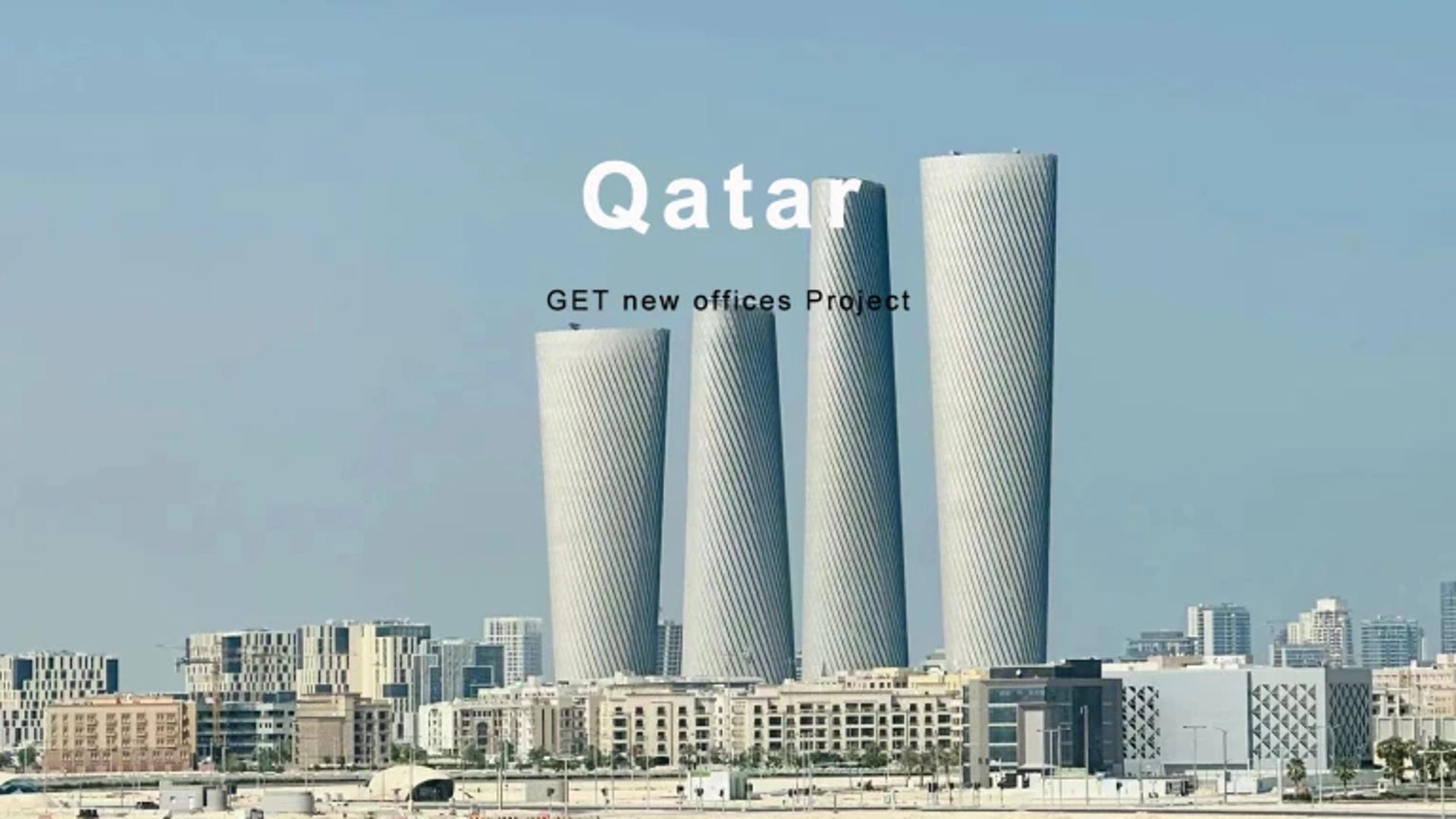
Project
Project Overview

Client Background
The client, Generic Engineering Technologies W.L.L. (GET), was founded in 2008 and is headquartered in Doha, Qatar. Project source material describes GET as employing approximately 7,000 people across its regional offices and undertaking engineering projects in Qatar, Lebanon, Greece, and Oman across MEP, fit-out and interior design, landscaping, facility management, infrastructure and public services, marine, structural, architectural, and maintenance work. At the time of this 2019 project, GET had 11 years of general-contracting and project-management experience. The brief called for a modern, relaxed office that would reinforce GET’s corporate image.
Design Inspiration
Based on the office design drawings provided by the buyer, Jones Chou developed a flexible furniture plan for the entire project. The design centered on efficient, environmentally friendly materials and a layout that supports smooth daily work.
Each furniture piece was created to combine modern function with practical use, while also meeting expectations for sustainability and long-term durability.
Project Challenges
Q1. Office dimensions did not match the original drawings
After completing the furniture and seating design according to the construction plans, the team held a video conference to finalize contract details. During this process, it became clear that several offices were smaller than shown in the original drawings.
Q2. Insufficient power access in the conference area
During office construction, fewer electrical outlets were reserved than expected. As a result, there was no power supply for seats in the middle and rear sections of the 20-person conference table.
Solutions
A1. Space optimization through revised measurements
Using updated on-site measurements from the buyer, we corrected the layout data and adjusted the original plan. The initial 16 single partition desks were redesigned into a more compact double-partition arrangement.
This preserved required functions, reduced furniture footprint, and lowered partition manufacturing costs.
A2. Smart power routing for conference seating
Because the center of the conference table was reserved for decorative elements, the designer placed eight power line box positions in front of participants. This approach kept the table visually clean while ensuring reliable power access for everyone during meetings.