
How to Evaluate Wooden Office Furniture Quality from Chinese Manufacturers: Materials, Standards & What to Check
A furniture dealer receives a container of 200 executive desks from a new supplier in Guangzhou. The photos looked sharp. The sample was acceptable. But when the container opens, the edge banding is already lifting on…
A furniture dealer receives a container of 200 executive desks from a new supplier in Guangzhou. The photos looked sharp. The sample was acceptable. But when the container opens, the edge banding is already lifting on 30% of the units. The melamine surface scratches with a fingernail. The formaldehyde smell is strong enough that the warehouse team opens every window.
This scenario plays out more often than most suppliers will admit. The cost goes beyond returned goods. You lose the client, you damage your reputation, and you spend weeks managing a problem that should have been caught before production started.
If you source wooden office furniture from Chinese manufacturers, whether you're a dealer filling OEM orders, a procurement manager outfitting a corporate project, or an importer building a product line, the framework below will help you evaluate product quality before you commit to a full order.
Why material quality matters more than unit price
Most sourcing conversations start with price. Margins in furniture distribution are tight, and every dollar saved on procurement goes to the bottom line.
But price and cost are not the same thing. A desk that costs 8% less but generates a 12% return rate is more expensive. A filing cabinet that saves $3 per unit but fails after 18 months in a client's office costs you the relationship.
The real cost of poor quality shows up in three places:
Direct losses: Returns, replacements, and the logistics of shipping defective products back or disposing of them locally.
Client attrition: A commercial client who receives substandard furniture doesn't complain. They simply don't come back. Repeat orders are where the margin lives.
Opportunity cost: Every hour your team spends managing quality issues is an hour not spent selling, designing, or building relationships.
Evaluating quality before you place a large order is not an extra step. It is the step that makes every other step worthwhile.
Understanding wooden office furniture materials
Not all "wooden" furniture is the same. The material a wooden office furniture manufacturer in China uses determines the product's durability, appearance, environmental safety, and price. Understanding these differences, from MDF vs particleboard to the implications for office furniture material selection, is the first step to evaluating quality.
MDF (Medium Density Fiberboard)
MDF is the most common core material in commercial wooden office furniture. It is made by breaking down hardwood or softwood residuals into wood fibers, combining them with wax and a resin binder, and pressing them into panels under high temperature and pressure.
MDF dominates office furniture production for good reasons. It has consistent density and flatness (no grain direction, no warping), takes melamine lamination and veneer well, routes cleanly for precise edge banding, and stays cost-effective at scale without sacrificing structural integrity.
What to check:
Density: Commercial-grade MDF should be 700-800 kg/m³. Lower density means softer panels that dent and screw-pull more easily. Ask your supplier for the density specification. A manufacturer who uses proper MDF will know this number.
Thickness consistency: Measure panel thickness at multiple points. Variation of more than 0.3mm across a 1200mm panel indicates poor press control.
Edge quality: The cut edge of MDF should be smooth and uniform. Rough or crumbly edges suggest low-quality fiber or insufficient binder.
Particleboard
Particleboard is made from wood chips, sawmill shavings, and sawdust bonded with resin under heat and pressure. It is less dense than MDF and generally less expensive.
Where particleboard works: non-structural panels where cost is the primary concern, vertical panels in filing cabinets and wardrobes that don't bear significant weight, and partition panels and backs of cabinets.
Where particleboard doesn't work well: desktop surfaces (it dents under point loads and doesn't hold screws as firmly as MDF), drawer bottoms and shelves that carry weight, and any application where edge banding needs to hold over time (particleboard edges are more porous).
What to check:
Grade: P2 grade (EN 312) is the minimum for furniture. Some manufacturers use construction-grade particleboard to cut costs. It is rougher, less consistent, and weaker.
Surface integrity: Run your fingernail across the surface. If the melamine separates easily, the particleboard surface is too uneven for proper adhesion.
Solid wood and natural veneer
Solid wood and veneer are the premium options. They are not always necessary, but for executive offices, reception areas, and high-visibility spaces, they provide the warmth and authenticity that synthetic finishes can't fully replicate.
Solid wood in office furniture is typically used for desk tops, table tops, and visible structural elements. Oak, walnut, or ash are common for premium lines. It is often combined with MDF cores in desk construction, with a solid wood edge, MDF core, and veneer surface.
Natural veneer is a thin slice of real wood (0.5-1.0mm) applied over MDF or particleboard. It provides genuine wood appearance at lower cost than solid wood and is available in dozens of species and cuts (flat cut, quarter sawn, rotary).
What to check:
Veneer thickness: At 0.5mm, veneer can be sanded and refinished once. Below 0.4mm, it is essentially a surface film. Any damage goes straight to the core. Ask for veneer thickness in writing.
Color consistency: Natural variation is expected, but significant color differences between panels in the same piece indicate poor material sorting.
Joint quality: On solid wood tops, check that joints are tight with no visible gaps. Finger joints and dowel joints should be flush.
Material selection guide by product type
Not every product needs the most expensive material. Here is a practical guide:
Product | Recommended Core | Recommended Surface | Why |
|---|---|---|---|
Executive desk | MDF 25mm+ | Melamine or veneer | MDF provides flatness and screw-hold; surface finish determines appearance |
Manager desk | MDF 25mm | Melamine | Cost-effective with good durability |
Filing cabinet | MDF 18mm | Melamine | MDF holds hardware better than particleboard |
Office workstation | MDF 25mm desktop, MDF 18mm partitions | Melamine | Structural stability requires MDF |
Conference table | MDF 25-40mm | Melamine or veneer | Thicker MDF prevents sag on long spans |
Mobile cabinet | MDF 15-18mm | Melamine | MDF needed for drawer slide mounting |
Partition screen | Particleboard or MDF 18mm | Melamine or fabric | Vertical load is minimal; cost can be reduced here |
Environmental and safety standards you need to know

When you source wooden office furniture, the materials don't only affect durability. They affect health. Formaldehyde-based resins bind MDF and particleboard, and the amount of formaldehyde those panels emit matters directly to your end users and to whether your products can be legally sold in certain markets.
E0, E1, and E2: the formaldehyde emission grades for office furniture
These E0 and E1 grade standards measure how much formaldehyde a panel emits per liter of air, tested under controlled conditions:
Grade | Formaldehyde Emission | What It Means for You |
|---|---|---|
E0 | ≤ 0.05 mg/L | The safest tier. Suitable for enclosed offices, healthcare, and government projects. Increasingly expected in Middle East and European tenders. |
E1 | ≤ 0.124 mg/L | The standard grade for most commercial furniture. Legal for sale in the EU. Adequate for well-ventilated offices. |
E2 | ≤ 0.3 mg/L | Not suitable for indoor commercial furniture in most developed markets. Avoid for any export-oriented product. |
Do not accept "E1 grade" as a verbal assurance. The E0/E1 grade claim must be backed by a test report from an accredited laboratory (SGS, TÜV, or equivalent). The report should include the test method (typically EN 717-1 or JIS A 1460), the sample date, and the specific emission value, not only a pass/fail.
A practical test you can do on-site: open a drawer or cabinet door and smell the interior. E1-grade panels have a faint, barely noticeable odor. E2-grade panels have a sharp, irritating smell. If the smell is strong enough that you notice it immediately, the panels are likely E2 or worse, regardless of what the supplier claims.
CARB Phase II (for the US market)
If your products will be sold in the United States, CARB Phase II compliance is legally required. California's Air Resources Board sets the strictest formaldehyde emission standards in the world, and they apply to all composite wood products sold in the state. That effectively means the entire US market.
CARB Phase II limits:
Hardwood plywood: ≤ 0.05 ppm
MDF: ≤ 0.11 ppm
Particleboard: ≤ 0.09 ppm
CARB compliance requires third-party certification, not just testing. Your manufacturer should have a CARB-certified mill number. If they cannot provide it, their products cannot be legally sold in California or any state that has adopted CARB standards.
ISO certifications relevant to wooden furniture
ISO certification alone doesn't guarantee quality, but it indicates that the factory has structured processes. That matters when you are evaluating whether a manufacturer can produce consistently, rather than make one good sample.
ISO 9001: Quality management system. Confirms the factory has documented procedures for production control, inspection, and corrective action.
ISO 14001: Environmental management system. Relevant if your clients require green procurement documentation.
ISO 45001: Occupational health and safety. Less relevant to product quality, but indicates factory maturity.
Certification bodies vary in rigor. A certificate from BSI, SGS, or TÜV carries more weight than one from an unknown registrar. And a certificate is a starting point, not a conclusion. Audit the factory's actual processes, not their paperwork.
Surface finishes: what separates durable from disposable
The surface finish is what your client sees and touches every day. It is also the component most likely to show premature wear if the wrong finish is used or applied poorly.
Melamine laminate
Melamine is the workhorse finish for commercial office furniture. It is a paper-based laminate impregnated with melamine resin and thermally fused to the MDF or particleboard core.
Advantages: highly scratch and wear resistant, available in hundreds of colors and wood-grain patterns, cost-effective, and easy to clean and maintain.
Quality indicators:
Fusion quality: On a properly fused melamine panel, you should not be able to peel the surface layer with a blade at the edge. If it separates, the press temperature or pressure was insufficient.
Surface hardness: Draw a line with a #2 pencil on the surface. If it leaves a visible groove, the melamine is too soft for commercial use.
Color consistency between panels: Place two panels side by side under natural light. A noticeable color shift indicates poor ink control during printing or different production batches mixed together.
Natural wood veneer
Veneer provides the look and feel of solid wood at a fraction of the cost. It is the standard for executive offices and boardrooms where appearance carries weight.
Quality indicators:
Adhesion: Run your hand across the surface. There should be no raised areas, bubbles, or soft spots. These indicate air pockets or insufficient glue spread during pressing.
Seal coat: The clear coat over veneer should be even and free of orange-peel texture. A rough or uneven topcoat will show every fingerprint and collect dust in the texture.
Matching: On multi-panel pieces (like a desk with a return), the veneer grain should be book-matched or at least visually coordinated. Random grain direction signals a factory that doesn't pay attention to finish quality.
Paint and lacquer finishes
Painted finishes (typically PU, polyurethane, or PE, polyester) are common on modern office furniture, especially white and colored desks.
PU paint (most common) offers good hardness and chemical resistance. 2K (two-component) PU is the commercial standard. 1K PU is softer and less durable. It should be applied in at least three coats: primer, color, and clear topcoat.
What to check:
Adhesion test: Make a light crosshatch pattern with a blade and apply tape. If paint comes off with the tape, the surface preparation or curing was inadequate.
Edge coverage: Paint on vertical edges should be as thick and smooth as the horizontal surface. Thin, uneven edges are the first place paint chips.
Cure quality: Press your thumbnail into an inconspicuous area. If it leaves a permanent mark, the paint hasn't fully cured, which means it never will.
Product-specific quality checkpoints
General quality principles matter, but each product type has its own failure points.
Executive desks (including wooden executive desks)
Edge banding: The PVC or ABS edge banding should be flush with the panel surface, with no visible glue line. Run your finger along the edge. It should be smooth with no ridge. Banded edges that are raised or uneven will catch on clothing and peel over time.
Drawer slides: Open and close every drawer. The action should be smooth through the full travel, with no sticking, wobbling, or grinding. Three-section ball-bearing slides are the commercial minimum. Two-section roller slides are acceptable only on budget lines.
Cable management: Check that grommet holes are clean-cut and properly sized. Sharp or poorly cut grommet edges damage cables.
Structural stability: Push down firmly on each corner of the desk. Any wobble indicates insufficient joinery or undersized hardware.
Filing cabinets (including wooden filing cabinets)
Panel thickness: Lateral filing cabinets should use minimum 18mm MDF for the body. Thinner panels flex under load and cause drawers to misalign.
Drawer rails: Suspension rails should be rated for the cabinet's intended load. A standard lateral file drawer holds 30-40kg of files. The rail must support this without sagging.
Anti-tip mechanism: For multi-drawer vertical cabinets, verify that only one drawer can open at a time. This is a safety requirement in many markets.
Lock quality: Turn the lock with the key and check for play. A lock that wobbles or feels loose will fail quickly in daily use.
Office workstations
Modular alignment: If you are buying modular workstations (2-person, 4-person, 6-person configurations), assemble a full cluster and check that all panels align at the same height. Misalignment between modules is the most common quality issue in workstation production.
Partition stability: Screens should not wobble when bumped. Check the mounting brackets. They should grip the desk firmly with no lateral play.
Desktop surface: The desk surface should be flat across its entire span. Place a straightedge across the width. Any gap greater than 2mm indicates panel warping.
Conference tables
Seam quality: For tables longer than 2400mm, the top is typically made from two or more panels joined together. The seam should be nearly invisible. Run your finger across it. If you can feel it, it will become visible over time as the panels expand and contract.
Base stability: A conference table with a pedestal base should not rock when someone leans on one end. Test this yourself. If it rocks on a flat floor in the factory, it will be worse on an uneven client site.
Cable management: Built-in cable channels should be accessible and large enough for power and data cables. Many conference tables look good but are impractical for actual meeting use.
Red flags: signs of a quality problem
During sample evaluation or factory visits, these indicators suggest that the manufacturer's quality control is insufficient.
1. Inconsistent edge banding
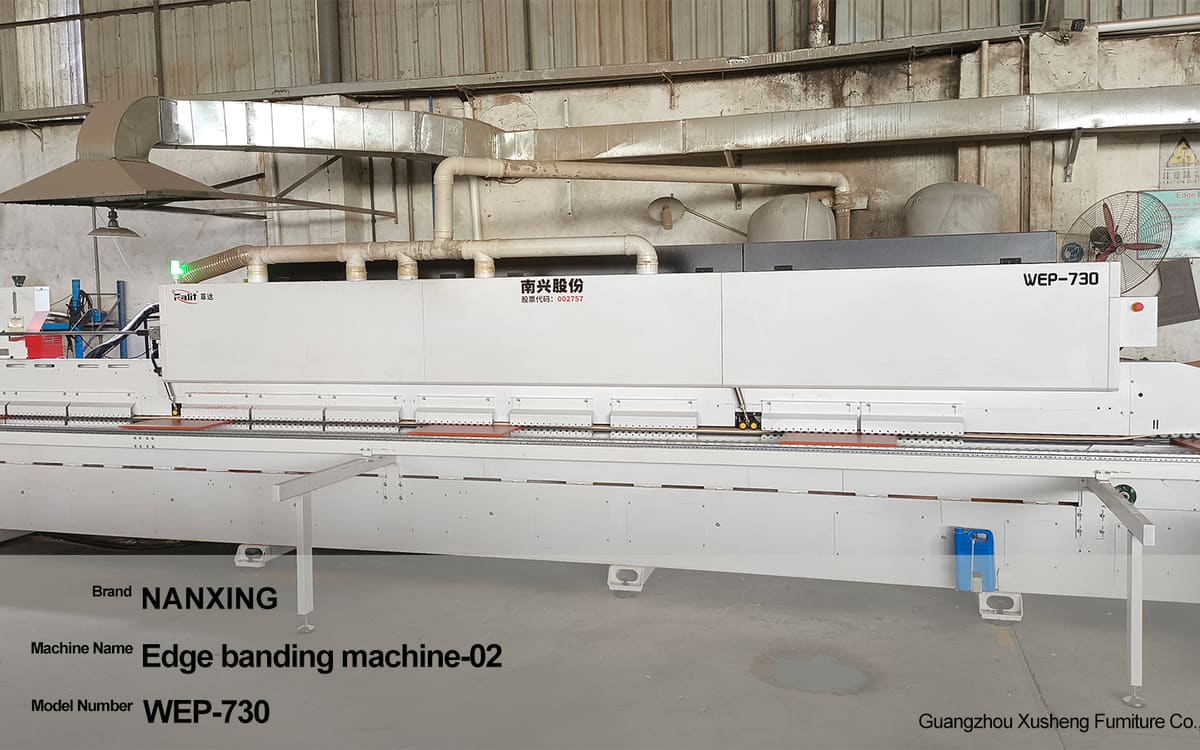
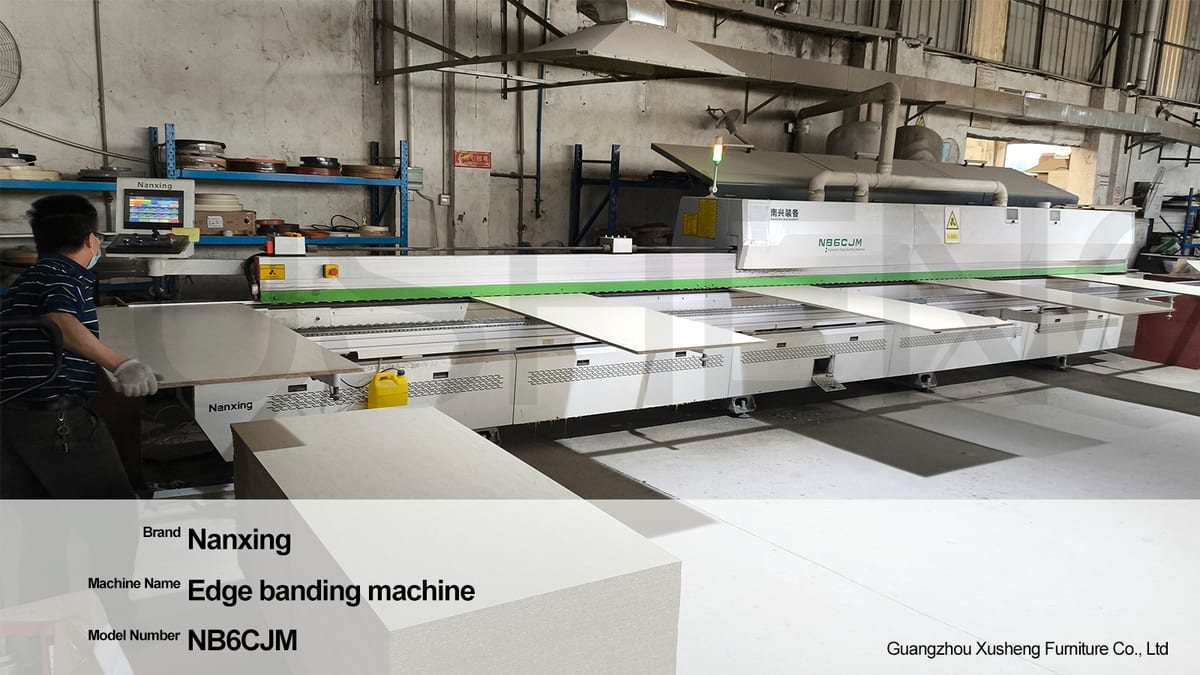
If the edge banding on one side of a desk is flush but raised on the other, the factory's edge banding machine is out of calibration. This will affect every piece they produce until it is fixed.
2. Visible substrate under the finish
If you can see particleboard or raw MDF through the melamine or paint, the surface finish is too thin or the substrate wasn't properly prepared. This will only get worse with use.
3. Strong formaldehyde odor
A sharp chemical smell inside cabinets or drawers indicates E2-grade or lower panels. This is a health and compliance issue that can block your products from entire markets.
4. Hardware that feels loose or misaligned
Drawer slides that wobble, locks that stick, and hinges that don't align indicate poor hardware quality, poor installation, or both. Hardware is the most interactive part of any furniture piece. When it fails, the whole product fails in the user's eyes.
5. Panels that warp or bow
Place a panel flat on a level surface and check if all four corners sit flush. A panel that rocks has internal stress from improper pressing, inadequate moisture content, or uneven storage. Once installed, it will only warp further.
Pre-shipment quality check protocol
Quality evaluation doesn't end with the sample. The most critical check happens before the goods leave the factory.
Sample evaluation checklist
Before confirming a production order, evaluate the sample against this checklist:
Panel material matches specification (MDF density, thickness, grade)
Surface finish meets durability standard (pencil hardness, adhesion test)
Edge banding is flush with no visible glue line
Hardware operates smoothly (drawers, locks, hinges)
Formaldehyde emission grade matches claim (smell test + test report)
Color matches approved swatch under natural and fluorescent light
Dimensions are within ±2mm tolerance
Weight matches expected range (underweight panels indicate thin cores)
Third-party inspection
For orders above $5,000, a pre-shipment inspection (PSI) by a third-party agency is a worthwhile investment. The cost is typically $200-350 per inspection, negligible compared to the cost of receiving a container of defective goods.
The inspection should cover:
AQL sampling: The inspector checks a statistically valid sample (typically AQL 2.5 Level II) from the finished batch, not hand-picked pieces.
Functional testing: All moving parts, locks, and mechanisms tested on every sampled piece.
Dimensional verification: Critical measurements checked against the specification drawing.
Packaging assessment: Carton strength, corner protection, and moisture barriers evaluated for the shipping route.
Quality agreement terms
Include these terms in your purchase contract:
AQL standard: Specify the Acceptable Quality Level (2.5 for major defects, 4.0 for minor).
Material specification: State the core material, density, thickness, and emission grade in writing.
Replacement clause: The supplier replaces defective units at their cost, including freight.
Pre-shipment inspection right: You (or your appointed inspector) have the right to inspect before shipment, and the supplier must hold the goods until inspection is passed.
Putting it together
Evaluating wooden office furniture quality from Chinese manufacturers comes down to three things:
Know the materials: Understand the difference between MDF and particleboard for office furniture, between E0 and E1 grade, between melamine and veneer. These distinctions determine whether a product lasts five years or fifteen.
Check the right things: Focus on edge banding, surface hardness, hardware operation, and formaldehyde grade. These are the failure points that show up first.
Verify before you ship: A sample is not a production batch. A supplier's word is not a test report. Inspect before the goods leave the factory, not after they arrive in your warehouse.
If you are evaluating wooden office furniture manufacturers in China and want a supplier who uses E0/E1-grade MDF, applies edge banding on calibrated machinery, and supports third-party quality inspection before shipment, that is exactly what we do at XS Furniture. Contact our team to request a sample or discuss your project requirements.
Related:
FAQ
Frequently asked questions
01How should a buyer compare MDF and particleboard for office furniture?
The article presents MDF as a denser, flatter core with good adhesion and precision cutting, while particleboard is a lower-cost option suited to cabinet bodies and lower-load applications. It cautions against using particleboard where heavy loads, frequent use, humidity or premium appearance are required.
02Which formaldehyde and market-compliance checks are discussed?
The guide compares E0, E1 and E2 emission grades, recommends an accredited laboratory report rather than a verbal claim and discusses CARB Phase II for US composite-wood sales. Exact thresholds, test methods and destination requirements should be confirmed against the current applicable standard.
03How can a buyer check melamine, veneer and painted finishes?
For melamine, check fusion, surface hardness and color consistency. For veneer, check adhesion, seal coat and grain matching. For paint, check tape adhesion, edge coverage and curing.
04What should be checked on desks, cabinets, workstations and conference tables?
Check desk edge banding, drawer travel, cable holes and stability; cabinet panel thickness, drawer rails, anti-tip mechanisms and locks; workstation module alignment, screen stability and flat desktops; and conference-table seams, base stability and cable access.
05What should a pre-shipment inspection cover?
The article recommends matching materials and dimensions to the approved specification, checking finishes and edge banding, testing hardware, verifying emissions and color and reviewing packaging. For larger orders it describes third-party sampling, functional and dimensional tests and packaging assessment, with inspection and replacement terms written into the contract.
Looking for a supplier?
Need a product, sample, or project quote?
Use the catalog to choose products, then send the list for manufacturing, dealer, OEM / ODM, or project support.