
Office Furniture Quality Control in China: What Dealers Should Check Before Shipment
How can dealers verify office furniture quality before shipment? Explore Xusheng's real factory checks, from incoming materials and trial assembly to final QC, packing, container loading and defect handling.
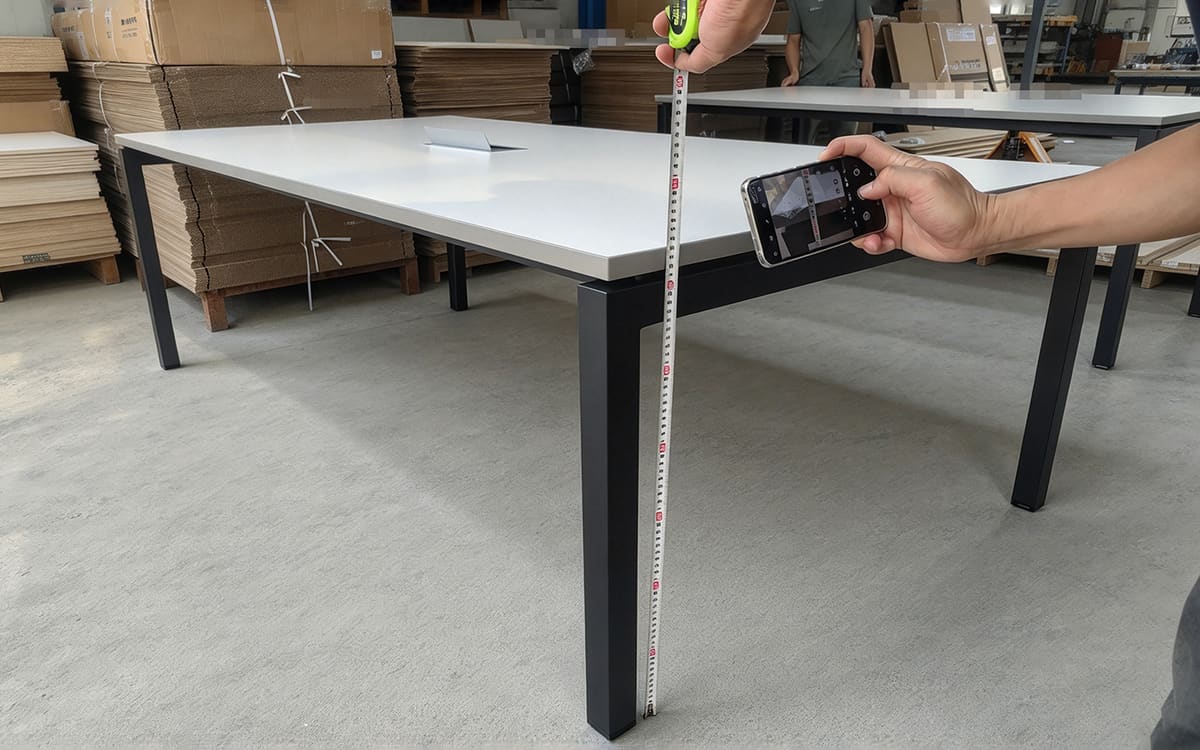
Office Furniture Quality Control in China: What Dealers Should Check Before Shipment
A dealer can inspect a finished office desk and find nothing obviously wrong with it.
The desktop looks good. The metal frame feels stable. The drawers open smoothly, and the packaging appears suitable for export.
But what happened before that desk reached the finished goods area?
Were the correct materials delivered? Did the panels match the approved specifications? Were the drilling positions checked? Did anyone test the assembled product? And if a mistake was found during production, was it corrected before the product moved to the next stage?
These questions matter because office furniture quality is not determined by a single inspection before shipment.
For overseas dealers importing from China, the greater risk is often not one visibly damaged desk. It is a problem that goes unnoticed across a larger order and only becomes apparent when the furniture is being installed for customers.
A wrong fitting, an incorrect drilling position or an overlooked customization detail can affect multiple products. By the time the container arrives, correcting the issue becomes more complicated.
At Xusheng Furniture, our quality control process covers incoming materials, production, trial assembly, finished products, packing and container loading.
Different people are responsible for checks at different stages, including production workers, supervisors, factory management and QC personnel.
The objective is not to claim that mistakes never happen. It is to identify problems early, stop non-conforming products from moving forward, correct the issue and retain useful records for future orders.
For dealers sourcing office furniture from China, understanding how a manufacturer manages quality throughout production is just as important as evaluating the finished product.
1. Why Office Furniture Quality Control Matters to Dealers
When a dealer purchases office furniture from China, the factory's responsibility is to manufacture and deliver products according to the agreed order.
The dealer, however, has another responsibility: supplying furniture that can be sold, installed and supported in the local market.
A manufacturing problem can therefore create several additional problems for the dealer.
Imagine receiving a shipment of 200 office desks. The desktops look acceptable, but some of the per-drilled holes do not match the metal frames.
The dealer may need to stop installation, identify the affected products, contact the supplier and arrange replacement parts.
Meanwhile, the end customer is waiting.
The cost is no longer limited to the value of the incorrect components. It may also involve installation labour, additional transport, storage, customer communication and delayed project completion.
This is why quality control matters commercially.
A reliable manufacturer should be able to explain not only what it checks, but also when those checks take place, who is responsible and what happens when something fails.
For dealers, three questions are particularly useful:
● Can the factory identify a problem before it affects more products?
● Can it correct the problem and verify the result?
● Can it use the experience to reduce the chance of the same issue recurring?
These questions reveal more about a supplier's working practices than a general statement such as "we have strict quality control".
2. Incoming Quality Control: Checking Materials Before Production
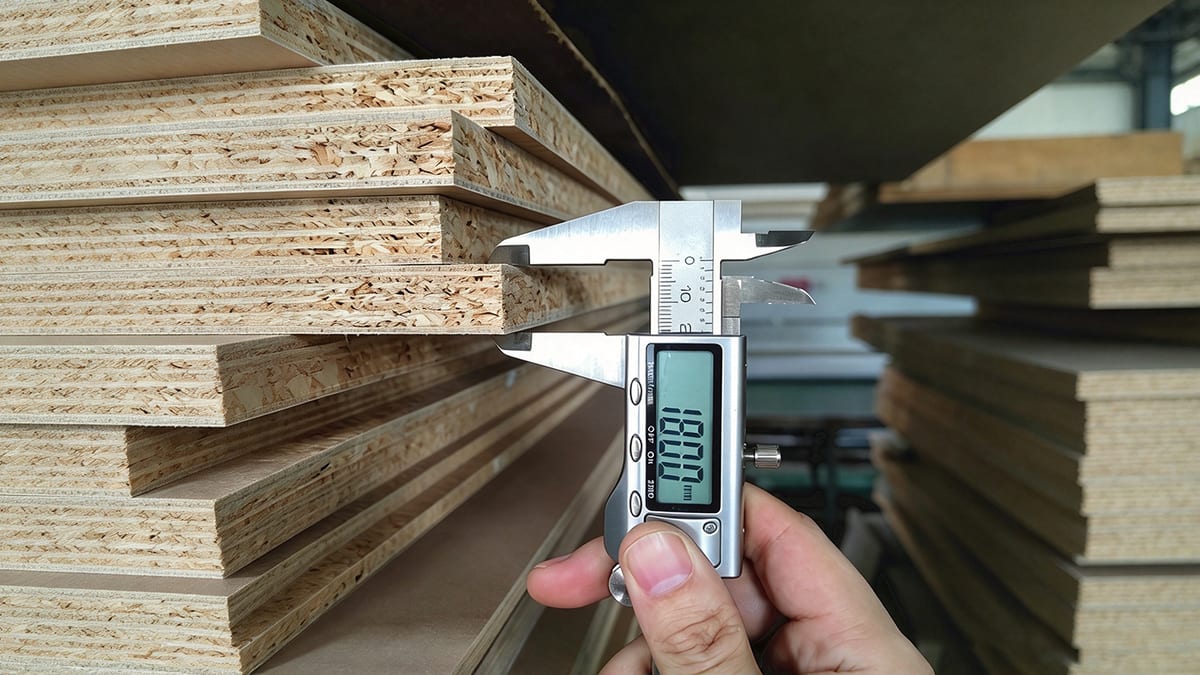
Quality problems sometimes begin before manufacturing starts.
A supplier may deliver a board in the wrong colour, a metal frame with an incorrect dimension or hardware that does not match the customer's specification.
If these components enter production without being checked, the problem can spread through cutting, drilling, assembly and packing.
At Xusheng, incoming materials are checked against the relevant purchase requirements, customer order, drawings or approved samples.
Board materials
For melamine-faced boards, the checks include:
● Colour and wood grain or surface pattern
● Board thickness and specification
● Surface scratches or visible damage
● Broken edges and other obvious defects
● Consistency with the confirmed order
A board may be perfectly usable in another product but still be wrong for the customer's order.
For example, a dealer may have selected a particular wood grain finish for an executive desk range. Receiving a different finish is a specification problem even if the substitute board is otherwise in good condition.
Metal desk frames
Metal frames are checked for relevant dimensions, steel thickness, surface finish, colour, welding and connection positions.
This is especially important for office desks and workstations that combine board components with metal structures.
A frame that does not match the confirmed dimensions or connection points can create assembly problems later.
Hardware and edge banding
Hardware is checked for model, quantity, appearance, function and compatibility with the product.
Edge banding is checked for colour, thickness, specification and its match with the selected board.
These may appear to be minor details, but they can affect the appearance, assembly and usability of the finished furniture.
Packaging materials
Cartons, protective corners and internal packaging materials are also checked.
The factory needs the correct packaging materials available before the finished products are packed.
What happens when incoming materials fail inspection?
Xusheng does not knowingly put identified non-conforming materials into production while the issue remains unresolved.
The response depends on the nature and extent of the problem.
If one or two boards are damaged or incorrect, we contact the supplier to arrange prompt replacement.
If an entire batch has a problem, we contact the supplier immediately and assess the situation more broadly, including whether subsequent deliveries can meet the required standard.
The same principle applies to metal desk frames.
A small number of defective frames may be replaced individually. If a larger quantity is affected, the entire batch may need replacing.
Where a supplier repeatedly causes serious quality problems, Xusheng may reconsider the relationship and change suppliers.
For a dealer, this is an important distinction. A manufacturer must manage the quality of purchased materials and components as well as its own production work.
3. In-Process Quality Control: Stopping Problems Between Production Stages
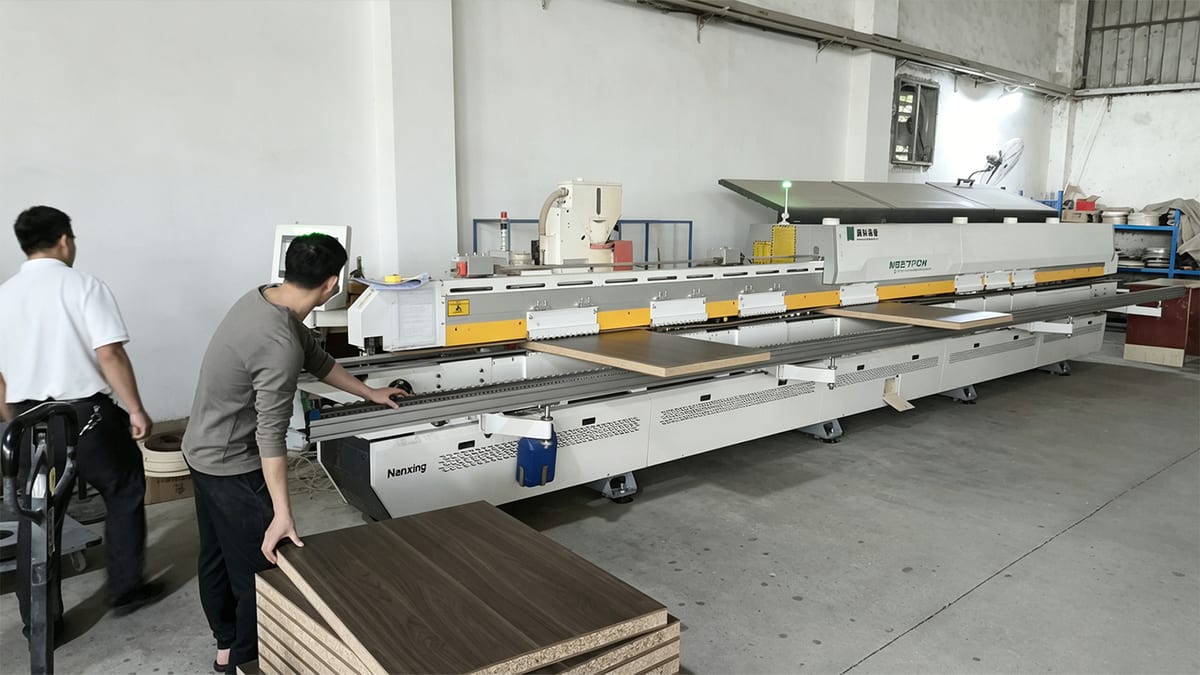
Incoming material inspection is only the beginning.
Once production starts, new problems can occur during cutting, edge banding, drilling or other manufacturing operations.
At Xusheng, quality responsibility is shared across production workers, team leaders, supervisors, factory management and QC personnel.
It is not limited to a single final inspection department.
Workers check their own work
Employees are responsible for identifying visible problems in the products they process.
If a panel has been cut incorrectly or a drilling position appears wrong, the issue should be reported and dealt with rather than passed along.
The next production stage provides another opportunity to check
Xusheng production process moves from one operation to another.
Workers receiving semi-finished components are expected to identify unsuitable parts from the preceding stage.
If a defective component is found, it is separated and reported to the previous production stage or the relevant person in charge.
This creates an additional opportunity to intercept problems.
Supervisors and QC personnel conduct checks
Production supervisors, factory management and QC personnel also carry out inspections during production.
These include periodic or unannounced checks of relevant processes.
The purpose is to identify problems that individual operators may have missed and ensure that corrective action takes place.
What happens when a problem is found?
The affected component is stopped from moving forward.
Depending on the problem, it may be reworked or replaced.
After corrective action, it must be checked again before proceeding to the next stage.
If the same problem appears repeatedly, the factory may need to investigate equipment settings, processing parameters or operating methods.
A wider problem is escalated promptly to the relevant supervisor and factory management.
This approach is particularly important in furniture manufacturing because one incorrect machine setting can affect multiple panels before the problem becomes obvious.
The aim is to find and correct defects before they move further down the production line.
4. Trial Assembly: Why Checking Individual Components Is Not Enough
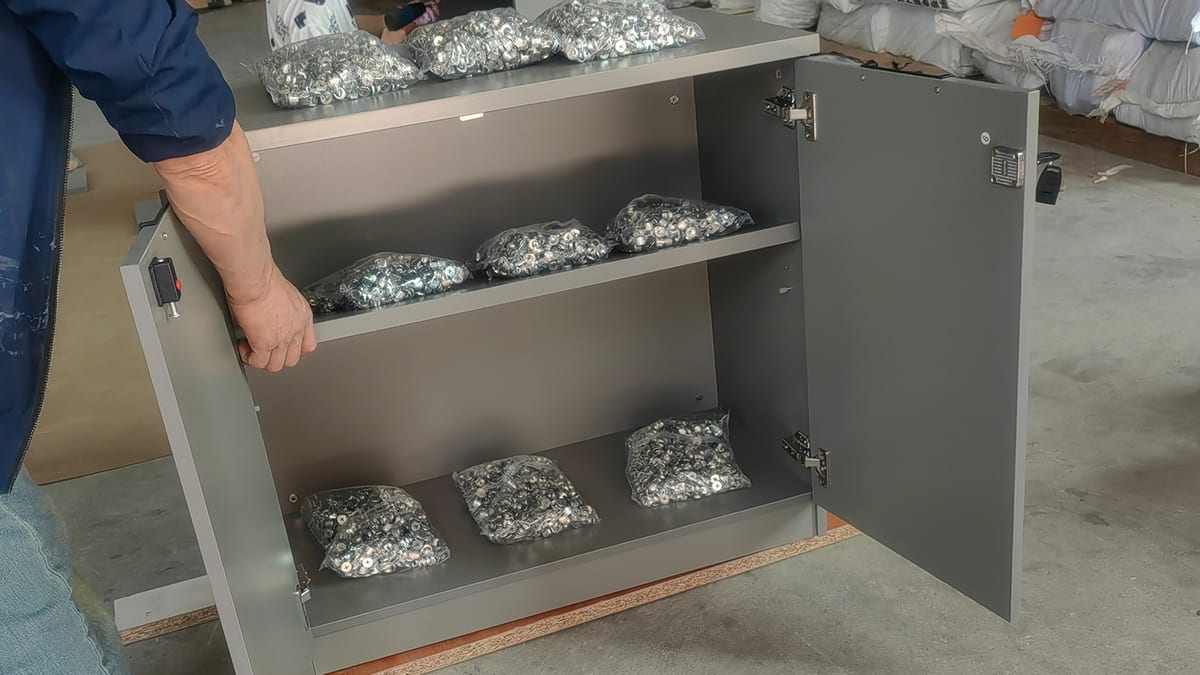
A desktop can have a clean surface and correct dimensions. A metal frame can have an acceptable finish. A set of fittings can look complete.
But these checks do not necessarily prove that the components will work together correctly.
That is why trial assembly is an important part of office furniture quality control.
At Xusheng, trial assembly is checked against the customer's confirmed order, drawings and specifications.
The process goes beyond simply assembling a product for a photograph.
Dimensions and structure
The assembled product is measured and compared with the confirmed requirements.
The overall dimensions, structure, proportions and relevant connection points are checked.
Fittings and assembly compatibility
The team checks whether drilled holes, screws, connectors and other fittings match the intended construction.
This helps identify problems that might otherwise appear during installation at the customer's premises.
Stability and load-bearing performance
The assembled furniture is checked for stability, including obvious movement or looseness.
Relevant products also undergo practical load-bearing tests.
These checks help verify the product's actual performance, although the precise test requirements depend on the product and agreed specifications.
They should not be confused with a claim that every product has passed a particular independent laboratory certification.
Cabinet and drawer functions
For storage furniture, mobile pedestals and filing cabinets, functional checks are particularly important.
These include the operation of doors, drawers, hinges, runners and locks.
The team also checks relevant gaps, alignment and fit.
Workstations and modular furniture
For workstations, partitions and multi-component furniture systems, trial assembly helps verify how the different parts connect.
A workstation may contain several panels, frames and accessories. Each component needs to work with the others.
What happens when trial assembly identifies a problem?
The relevant components are adjusted or replaced, followed by further assembly and checking.
The objective is to resolve the problem before the affected products continue through the production process.
For dealers, trial assembly offers a practical way to verify whether the furniture can be installed and used as intended.
It also complements sample approval and bulk production consistency, because the approved specification still needs to be reproduced correctly during actual manufacturing.
5. Final Quality Control: How Finished Furniture Is Inspected
After production and relevant assembly checks, finished products are subject to final quality control.
At Xusheng, final QC uses sampling rather than claiming that dedicated QC personnel fully inspect every single finished product.
The inspection quantity depends on factors such as order size, product type and quality risk.
We do not apply one publicly stated fixed inspection percentage to every order.
What does Final QC cover?
Depending on the product, checks include:
● Surface appearance, colour and visible damage
● Edge banding and workmanship
● Product dimensions and construction
● Hardware and fitting compatibility
● Assembly and relevant functional performance
● Model, specification and customer customization requirements
● Consistency with the confirmed order
The purpose is to assess whether the finished products meet the agreed requirements before they proceed.
What happens if a product fails?
The problem is recorded and the affected product or component is reworked or replaced.
It is then checked again.
If a serious or repeated issue is identified, the inspection scope is expanded according to the risk.
Where necessary, this can involve a comprehensive inspection of the affected products.
The decision depends on the circumstances rather than an automatic rule that every issue triggers the same response.
Non-conforming products should not be released to the next stage until the relevant issue has been addressed and the result checked.
For dealers, this matters more than an unsupported promise of "100% perfect quality".
A useful question to ask a supplier is:
What happens when your final inspection finds a problem?
The answer should describe a working process, not just an intention to be careful.
6. A Real QC Case: How a Packing Worker Prevented Incorrect Locks from Being Shipped
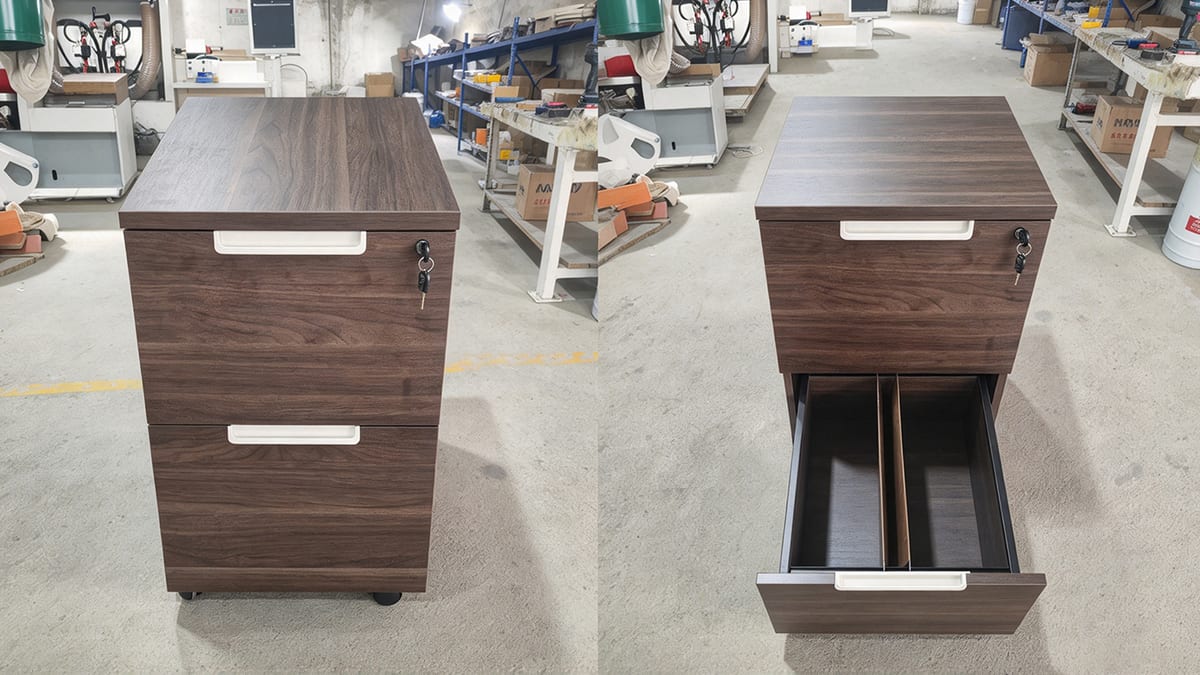
One of Xusheng actual production experiences shows why quality responsibility should extend beyond dedicated QC staff.
The order involved customized mobile pedestals.
Our standard mobile pedestal design normally places the lock at the upper-left corner.
For this particular order, however, the customer requested the lock at the upper-right corner.
That difference was part of the confirmed order specification.
The problem was discovered during packing
While preparing the products for packing, a worker noticed that the purchased locks were the left-hand version.
They did not match the customer's requested right-hand lock position.
If the products had been shipped with those locks, the customer would have faced a functional installation problem.
The packing worker reported the discrepancy immediately.
Packing was stopped
After receiving the report, the supervisor stopped packing the affected mobile pedestals.
The team opened the relevant packaging and checked the components against the order requirements.
The mistake was confirmed.
The hardware supplier was contacted immediately and asked to deliver the correct right-hand locks.
The replacement arrangement included the required order quantity plus 20 additional locks.
The correction was tested before packing resumed
Receiving the correct locks was not treated as the end of the problem.
The incorrect locks were replaced, and the team assembled and tested multiple mobile pedestals to check the new fittings.
The checks included the lock position, installation compatibility and operation.
The team also checked the other affected products for the same issue.
This was a sampling and verification process, not a claim that every pedestal was fully assembled and tested individually.
Had further problems appeared, the team would have expanded the investigation and taken additional corrective action, potentially including reworking or re-manufacturing affected products.
Fortunately, the assembly and functional tests were satisfactory.
The products were then returned to the packing line and the order proceeded.
Why did the packing worker know what to check?
There is another important part of this case.
At Xusheng, our sales team provides the relevant production positions with order information highlighting the requirements they need to pay attention to.
For customized orders, those details can include changes to hardware positions, materials, dimensions or other specifications.
The aim is to ensure that employees understand the particular requirements relevant to their own work.
In this case, the difference between a standard left-hand lock and a customized right-hand lock was noticed before shipment.
What should dealers learn from this case?
The first lesson is that quality control must include customer-specific requirements.
A lock may be perfectly functional but still be wrong for the order.
The second is that workers outside the QC department can prevent serious problems when they know what to look for.
The third is that corrective action should include verification.
Replacing the wrong component is not enough if nobody checks whether the replacement works.
And finally, a manufacturer should be prepared to stop a process when a problem is found.
The value of this case is not that Xusheng never makes mistakes. It is that a mistake was identified, escalated, corrected and tested before the goods were shipped.
7. Quality Records: How Xusheng Works to Prevent Repeat Problems
Correcting a problem solves the immediate issue.
But for a dealer placing repeat orders, there is another question:
Will the same problem happen again?
At Xusheng, quality records are used not only to document defects but also to support future production decisions.
Depending on the issue, records may include:
● Customer order, product model or production batch
● Description of the problem
● Photographs, videos or inspection records
● Relevant production stage and possible cause
● Rework, replacement or other corrective action
● Results of subsequent checks
● Points requiring attention in future production
For repeated problems, the team may review operating methods, equipment parameters or inspection priorities.
A practical example: the wrong board material
In one situation, a supplier delivered an incorrect board material for a customer's order.
The issue was recorded.
When that customer placed another order, the team paid particular attention to the board specification to reduce the chance of the same mistake recurring.
In some cases, important requirements are highlighted in red on the production order to draw the workshop's attention to a previously identified risk.
This is a simple measure, but it has a practical purpose.
A customer should not have to experience the same avoidable problem every time they reorder.
For dealers developing a long-term product range, this kind of order-specific attention is especially valuable.
A manufacturer's quality records should help the factory remember what matters to the customer, even when the next order arrives months later.
8. Packaging Quality Control: Protecting Furniture After Production
A finished product may pass inspection and still arrive damaged if it is packed incorrectly.
That is why quality checks continue into the packaging stage.
At Xusheng, packing inspections cover the agreed carton specification, internal protection, fittings and product identification.
Carton condition
The team checks for obvious carton damage, moisture, deformation and sealing problems.
Internal protection
Protective materials such as EPE, corner protectors and other agreed packing components are checked.
Panels, metal frames and fittings are packed according to the relevant requirements.
Labels and shipping marks
Product models, quantities, customer logos, carton markings and other agreed identification details are checked against the order.
This is important when a container includes several product models or customized configurations.
Accessories and instructions
Relevant fitting packs, screws, connectors and assembly instructions are checked for completeness.
Missing fittings may be inexpensive individually, but they can delay installation of the entire product.
Packed-product inspection
Selected packed cartons may be checked, including opening cartons where necessary to inspect their contents.
If a problem is identified, the affected packaging or components are corrected, replenished or replaced and checked again.
For overseas dealers, packaging quality is part of the product's commercial value.
The objective is not simply to make a carton look tidy. It is to protect the product, preserve the correct contents and help the dealer receive goods that can be identified and installed properly.
9. Container Loading Inspection: What Happens Before the Goods Leave China?
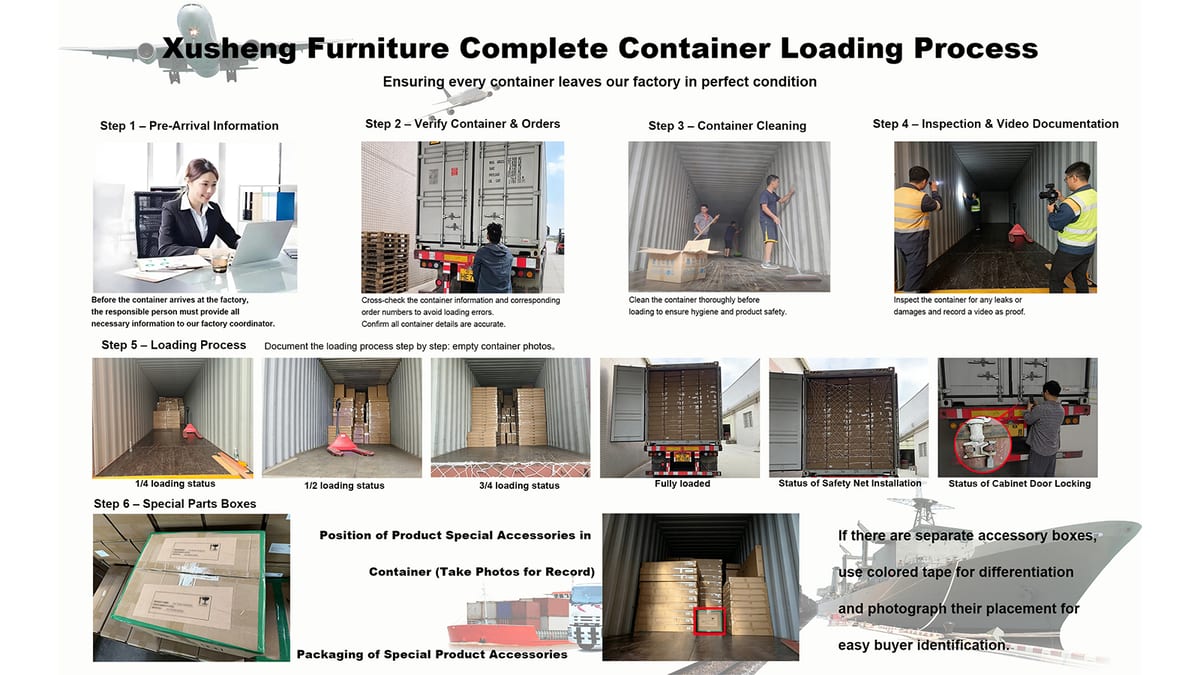
The quality-control process does not end when cartons are moved into the warehouse.
Container loading is another stage where mistakes or damage can occur.
Xusheng follows a documented loading process that covers container verification, cleaning, inspection, loading records and final closure.
Before the container arrives
The designated contact provides the necessary information to the factory coordinator.
This allows the factory to prepare for the loading operation.
Verify the container and order
When the container arrives, the team checks the relevant container information and order details.
The order, packing list, product models and carton quantities are checked as part of the loading preparation.
Clean and inspect the container
The container is checked for cleanliness, moisture, visible damage, possible leaks and other conditions that may affect the goods.
It is cleaned before loading where required.
Photographs or videos are used to record the container's condition.
Monitor the loading process
Products are loaded according to the planned arrangement, taking account of carton dimensions, weight and packaging requirements.
During loading, the team checks for obvious carton damage, excessive compression and unsuitable stacking.
Protective or anti-movement measures are used where appropriate.
Record loading progress
Xusheng documented loading process includes photographs of the empty container and loading progress at approximately 25%, 50%, 75% and fully loaded stages.
The records also include safety net installation and container door closure.
These photographs provide a clearer record than a single image taken after the doors are shut.
Identify special accessory cartons
Special accessory boxes can be marked with coloured tape for easier identification.
Their position inside the container is photographed and recorded.
This helps the buyer locate them after arrival.
Final loading confirmation
The team checks the relevant loading quantities and records shipment information, including the container and seal details.
If damaged packaging, incorrect quantities or loading abnormalities are found, the issue is addressed before the operation continues.
The aim is to maintain a clear record of what was loaded and how the container was prepared for shipment.
Dealers can see the documented loading process on the Xusheng factory and container loading page.
10. What QC Evidence Should Dealers Request Before Shipment?
A dealer does not necessarily need to be physically present at the factory to obtain useful information about an order.
However, the evidence requested should be relevant to the product and purchasing risk.
At Xusheng, customers can arrange different forms of quality verification depending on the order and their requirements.
Production photographs
These may show materials, manufacturing stages and finished products.
They can help the dealer understand the actual order's progress.
Trial assembly and testing videos
Videos can show relevant dimensions being measured, products being assembled, stability and load-bearing checks, or the operation of doors, drawers and locks.
For customized furniture, this can be particularly useful.
Packing and loading records
Photographs and videos can document packaging, loading progress and container closure.
QC records and inspection reports
Relevant records or reports may be provided according to customer requirements and the applicable inspection arrangements.
Live video inspections
Customers can arrange a live video call to view production, trial assembly or relevant checks.
Factory visits and third-party inspections
Customers may also visit the factory or arrange an inspection through their own representative or an independent third party.
The timing and scope should be discussed in advance.
These materials are not automatically all supplied with every order. They are arranged according to the customer's requirements and the order circumstances.
What evidence is most useful?
For a standard repeat order, a dealer may focus on the confirmed specification, finished-product checks and packaging.
For a customized product, photographs of the final appearance may not be enough. Assembly, measurements and functional testing may be more important.
For a large project, an agreed physical inspection before shipment may provide additional assurance.
The key is to request evidence that addresses the actual risks of the order.
A video of a clean factory is not the same as evidence that the correct customized furniture has been produced.
11. Factory Inspection vs Third-Party Inspection
Factory quality control and third-party inspection are not interchangeable.
The factory's own QC process is responsible for identifying and addressing problems throughout manufacturing.
An independent inspection provides another opportunity to assess the order against agreed requirements.
Factory QC
Factory QC can operate throughout production.
It may identify problems at incoming material inspection, during processing, at trial assembly, during final QC or while packing.
This allows corrective action before the problem progresses further.
Third-party inspection
A third-party inspector can assess the goods independently within an agreed inspection scope.
This may be useful for a new supplier relationship, a complex order or a shipment where the buyer wants additional assurance.
However, a per-shipment inspection is normally a check at a particular point in time. It cannot replace all the manufacturing controls that should have happened beforehand.
What should dealers do?
The best approach depends on the order's value, complexity and risk.
For a first order, dealers may want more direct evidence or an independent inspection.
For established repeat orders, the inspection arrangements may be adjusted according to the supplier's performance and the product's risk.
Regardless of who carries out the inspection, the acceptance requirements should be clear.
12. Office Furniture Pte-Shipment Quality Inspection Checklist
Before approving shipment, dealers can review the following points with their supplier.
Product specifications
● Are the product models and quantities correct?
● Do the materials, colors and finishes match the approved requirements?
● Are the dimensions and relevant structural details correct?
● Have customer-specific modifications been checked?
Assembly and functionality
● Have relevant products undergone trial assembly?
● Are the connection points and fittings compatible?
● Have stability and applicable load-bearing checks been carried out?
● Do drawers, doors, hinges, runners and locks function correctly?
Quality inspection
● Has the factory completed its relevant final QC checks?
● Have identified problems been recorded and corrected?
● Were corrected products checked again?
● Was the inspection scope expanded where necessary?
Packaging
● Do cartons meet the agreed requirements?
● Are internal protective materials correctly used?
● Are accessory packs and instructions complete?
● Are carton labels, model references and shipping marks correct?
Loading and shipment
● Has the container been checked before loading?
● Have loading quantities been reconciled with the packing list?
● Has the loading process been documented?
● Are special accessory cartons clearly identified?
● Have the container and seal details been recorded?
Not every question requires the same evidence for every order.
The purpose of the checklist is to help the dealer and supplier agree on what should be verified before the goods leave the factory.
13. How to Evaluate an Office Furniture Manufacturer's QC System
When comparing office furniture manufacturers in China, it is easy to focus on product photographs, prices and delivery promises.
These are important, but they do not explain how the factory responds when something goes wrong.
A more useful evaluation includes the following questions.
Who is responsible for quality at each production stage?
Look for an answer that explains the responsibilities of production workers, supervisors and QC personnel.
How are incorrect materials prevented from entering production?
Ask about incoming material checks and what happens when a supplier delivers unsuitable components.
Does the factory carry out trial assembly?
Find out how dimensions, fittings, stability and relevant functions are verified.
What happens when final QC identifies a defect?
Ask how the factory records, corrects and rechecks the problem.
How are repeat problems prevented?
Look for evidence that previous quality issues influence future production instructions or inspection priorities.
Can the buyer inspect the actual order?
Discuss photographs, videos, live inspections, factory visits and third-party inspection arrangements.
How is loading documented?
Ask whether the supplier checks container condition, quantities, protective measures and final closure.
The answers should be specific enough to explain what actually happens on the factory floor.
A supplier does not need to claim perfection to demonstrate responsibility.
It needs to show that quality requirements are understood, checked and acted upon.
For a dealer selecting a manufacturing partner, these are important parts of verifying an office furniture factory before placing an order.
14. Quality Control Is Also About Long-Term Product Consistency
For an office furniture dealer, quality control does not stop with the first container.
Many dealers build their business around repeat orders.
A customer may purchase workstations this year and request additional desks or storage cabinets next year.
If the colour, fittings or structural details have changed unexpectedly, the new furniture may not match the existing installation.
This is why quality records and approved specifications matter beyond a single production run.
At Xusheng, confirmed samples, drawings, order requirements and relevant production records help provide reference points for subsequent orders.
When a known problem occurred on an earlier order, the relevant requirement can receive additional attention when the customer purchases again.
The aim is to reduce avoidable inconsistencies and support repeatable production.
For dealers, this links everyday QC work to a broader commercial requirement: maintaining a product range that customers can continue buying and expanding.
Quality control should therefore be considered alongside product continuity, supplier reliability and after-sales support.
Conclusion: A Good QC System Must Work When Something Goes Wrong
No office furniture manufacturer should expect overseas dealers to believe that production problems never occur.
Materials can be delivered incorrectly. A drilling operation can go wrong. A customized fitting can be overlooked.
The important question is what happens next.
At Xusheng, quality responsibility is shared across incoming material inspection, production, trial assembly, final QC, packing and container loading.
Workers are expected to identify and report problems. Supervisors and QC personnel carry out further checks. Non-conforming components are corrected or replaced, and the results are checked before the affected products proceed.
The mobile pedestal lock case is a practical example.
A packing worker identified a mismatch between the supplied locks and the customer's customized requirements. Packing was stopped, the correct locks were obtained, multiple products were assembled and tested, and the order returned to the packing line only after satisfactory checks.
For dealers importing office furniture from China, that is the kind of process worth understanding.
Do not judge a manufacturer's quality control only by the finished product or the claims on its website.
Ask how it identifies problems, how it responds and what evidence it can provide before shipment.
Good quality control is not about claiming that nothing ever goes wrong. It is about making sure a problem is dealt with before it becomes the dealer's problem.
FAQ
Frequently asked questions
01What is office furniture quality control?
Office furniture quality control involves checking materials, components, manufacturing processes, assembled products, packaging and other relevant requirements against the confirmed order. It also includes identifying defects, correcting problems and verifying the results.
02How do Chinese office furniture manufacturers check product quality?
Processes vary between manufacturers. At Xusheng, checks cover incoming materials, production stages, trial assembly, final QC, packing and container loading. Production workers, supervisors, factory management and QC personnel share responsibility at different stages.
03Does Xusheng inspect every finished office furniture product?
Xusheng uses sampling for final QC, with inspection scope determined by the order, product type and quality risk. Serious or repeated problems may require expanded inspection or, where necessary, comprehensive checking of affected products.
04What is checked during office furniture trial assembly?
Checks can include dimensions, structural connections, fittings, stability, applicable load-bearing performance, alignment and the operation of doors, drawers and locks. The actual requirements depend on the product and confirmed order.
05What happens if office furniture fails quality inspection?
The issue is recorded and investigated. Non-conforming components may be reworked or replaced. The affected products are checked again, and the inspection scope may be expanded if the problem suggests a wider risk.
06Can dealers arrange an inspection before shipment?
Yes. Xusheng can support factory visits, live video viewing, relevant photographs or videos, and inspections by a customer's representative or a third party. The timing and scope should be agreed in advance.
07What documents or QC evidence can dealers request?
Depending on the order, dealers may request production photographs, trial assembly videos, functional test evidence, packing and loading records, or relevant QC inspection documents. Availability and arrangements should be confirmed with the supplier.
08How can a dealer check customised office furniture before shipment?
The dealer should ensure that the customisation requirements are documented and approved, then request evidence showing the actual customised features. Measurements, assembly checks and functional tests may be more useful than general finished-product photographs.
09Does a third-party inspection replace factory QC?
No. Third-party inspection provides an additional check within an agreed scope. The factory still needs to manage material quality, production processes, corrective action and other checks throughout manufacturing.
10Why should dealers ask about previous quality problems?
A supplier's response to previous problems can show whether it has a practical corrective-action process. Records may also help prevent the same issue from recurring on repeat orders.
11Does a quality certificate guarantee that every shipment is defect-free?
No. Certifications and test reports can provide useful information about particular standards, systems or tested products, but they do not automatically prove that every item in a specific shipment meets the agreed requirements. Order-specific verification remains important.
12What should a dealer check during container loading?
Relevant checks include container condition, packing quantities, carton protection, loading arrangements, special accessory boxes and shipment records. Photographs and videos can provide useful evidence of the loading process.
Looking for a supplier?
Need a product, sample, or project quote?
Use the catalog to choose products, then send the list for manufacturing, dealer, OEM / ODM, or project support.