
Sample vs Bulk Office Furniture Orders: How Dealers Can Check Quality Consistency Before Buying in Bulk
Learn how office furniture dealers can check samples, confirm specifications and verify bulk production quality before ordering from China, with practical QC procedures and a real customer case.
Sample vs Bulk Office Furniture Orders: How Dealers Can Check Quality Consistency Before Buying in Bulk
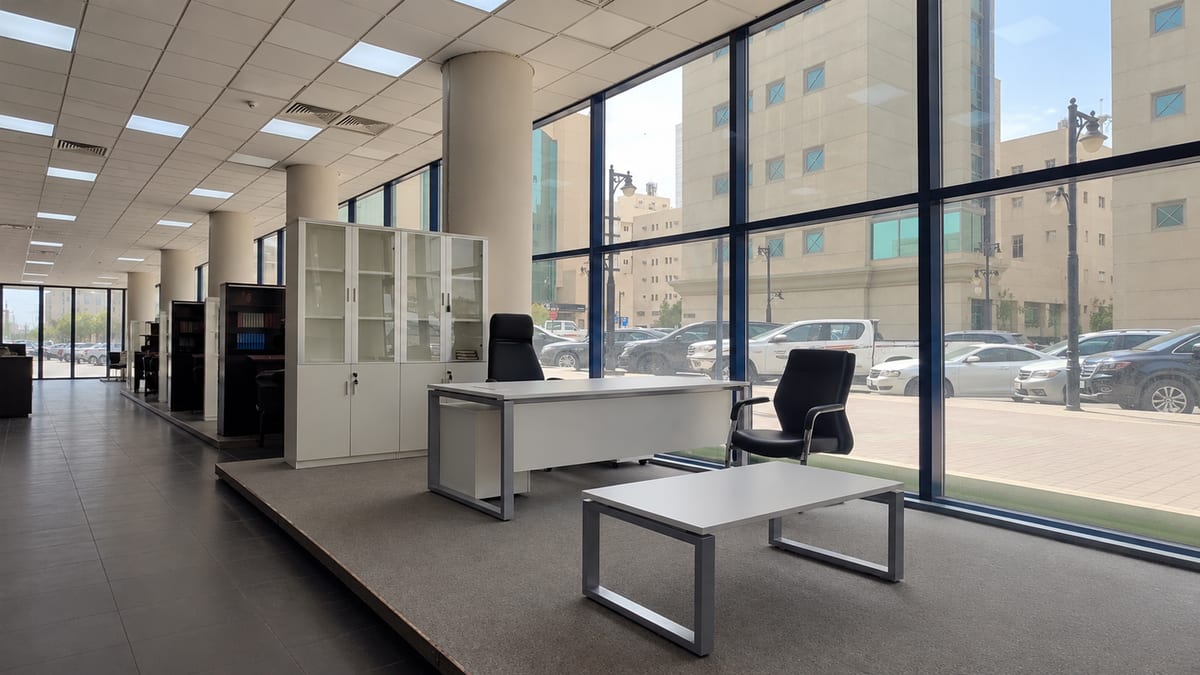
A sample arrives at your warehouse. The colour looks right, the desk feels stable, the edges are neatly finished and the fittings work as expected. You assemble it, check the dimensions and decide that it is suitable for your market.
You are ready to place a bulk order.
But there is still one important question:
Will the products in the bulk shipment meet the same standard as the sample you approved?
For an office furniture dealer, this is not a small detail. A sample may represent one carefully prepared product, while a bulk order involves multiple products, production stages, materials, fittings and packaging operations.
If the first few products look good but the remaining items arrive with inconsistent colors, missing fittings, poorly finished edges or assembly problems, the dealer is left dealing with customer complaints, replacement costs and lost time.
This is why sample approval should never be treated as the end of quality verification.
At Xusheng, we believe that the approved sample should establish the standard for subsequent production. That standard needs to be carried through the specifications, production process, quality checks and packaging.
A good sample proves what a supplier can make once. Consistent bulk production shows whether the supplier can repeat it.
For dealers sourcing office furniture from China, understanding this difference is essential before committing to a large order.
1. Why an Approved Sample Does Not Automatically Guarantee Bulk Quality
A sample and a bulk order serve different purposes.
The sample allows the buyer to assess the product before committing to a larger purchase. Bulk production tests whether the manufacturer can reproduce the agreed product consistently at the required quantity.
These are related, but they are not the same thing.
What a sample can tell you
A properly evaluated sample helps you check:
● Overall appearance, colour and surface finish
● Dimensions, proportions and construction
● Board thickness, edge banding and material details
● Hardware, fittings and connection points
● Assembly, stability and practical use
● Packaging materials and protection
● Whether the final configuration and price suit your requirements
These checks help a dealer decide whether the product is commercially suitable.
What a sample cannot prove on its own
One sample cannot independently establish that every product in a future shipment will be identical.
It does not, by itself, demonstrate whether the manufacturer can maintain the same specifications throughout production, identify defects across a batch, manage material changes or pack every item to the agreed standard.
Those things depend on the processes used after sample approval.
For example, a desk may pass inspection as a sample, but the bulk order could still develop problems if a different board specification is used, a fitting is substituted without approval, or packaging instructions are not followed.
The lesson is straightforward:
Do not evaluate only the sample. Evaluate how the supplier will carry the approved standard into bulk production.
2. What Should Office Furniture Dealers Check When Evaluating a Sample?
Before discussing bulk production, a dealer needs to know exactly what has been approved.
A sample should be assessed against the intended order requirements rather than simply judged by whether it looks attractive.
Appearance, colour and finish
Check the overall colour, surface finish, visible edges and consistency of the product's appearance.
For dealers selling several products within the same range, this is particularly important. A desk, storage cabinet and meeting table may need to work together visually.
Dimensions and construction
Measure the relevant dimensions and check the overall proportions.
Inspect the structure, connection points and assembly. A product should be assessed against the confirmed drawing or specification rather than relying on photographs alone.
Materials and edge details
Check the specified board material, thickness and edge banding.
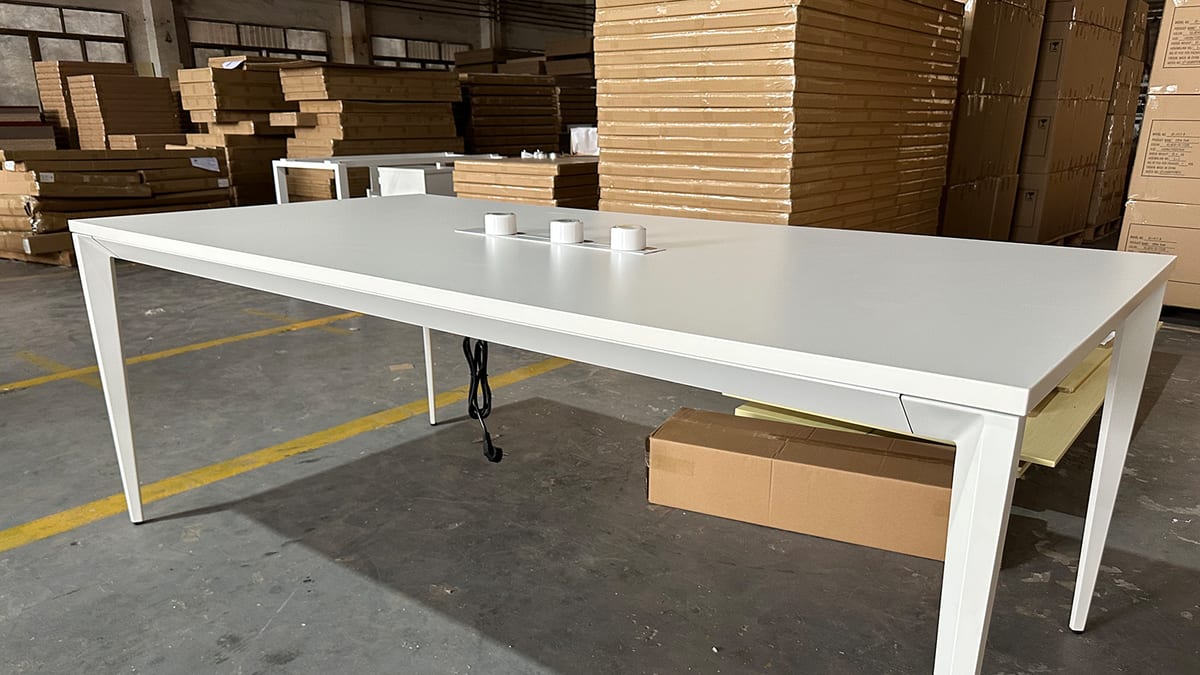
For example, Xusheng standard furniture specifications may include a 25 mm desktop with 2 mm PVC edge banding and 16 mm panels with 1.5 mm edge banding, depending on the product.
These figures are examples of product specifications, not universal requirements for every office desk. The actual order specification should determine what is expected.
Hardware and assembly
Check that the correct fittings are supplied and that the product can be assembled as intended.
For a dealer, a problem with a connection point or missing fitting can become an installation issue at the customer's premises, even when the main panels look fine.
Stability and practical use
Where relevant, check whether the desk sits level, whether the structure feels stable and whether the assembled product performs as expected.
The purpose is to identify practical problems before the product becomes part of a much larger order.
Packaging and transport protection
Packaging deserves attention at the sample stage because a product may be well made but still arrive damaged if the protection is inadequate.
Check the carton structure, internal protection, corner protection and the way panels, metal frames and fittings are packed.
The sample approval process should cover the product the customer will receive, not just the furniture visible in a product photograph.
3. Formal Sample Approval: What Needs to Be Confirmed Before Production?
Once the dealer has evaluated the sample, the next step is formal approval.
At Xusheng, bulk production must not begin until the required sample approval has been completed through a signed or written confirmation. The exact approval process depends on the product and order requirements.
This matters because a conversation such as “the sample looks good” may not capture every detail needed for production.
A written approval process creates a clearer reference for both parties.
Confirm the product specification
The confirmed information should cover the relevant details of the order, including:
● Product model and dimensions
● Board material and thickness
● Colour and surface finish
● Edge banding
● Hardware and fittings
● Structural details and drawings
● Packaging requirements
● Customer logo, labels and carton markings, where applicable
The precise requirements will depend on the product.
Keep the relevant records
Xusheng retains the customer-approved physical sample for future production reference and keeps records of confirmed specifications, drawings, CAD or other technical information, order configurations and packaging requirements.
When a repeat order is placed, historical order records can be retrieved and checked against the new requirements.
This is particularly important when a dealer reorders a product several months after the original sample was approved.
Without reliable records, the factory and buyer may have different understandings of the original product.
Understand the difference between approval and production
Formal sample approval establishes the agreed product requirements. It does not mean the bulk order has already been inspected or that every production risk has disappeared.
The next step is to reproduce the approved standard and verify the results.
A useful way to think about the process is:
Sample Evaluation → Written Approval → Specification Records → Bulk Production → QC Verification
Each stage has a different purpose, and none should be treated as a substitute for the others.
4. How Xusheng Carries the Approved Sample into Bulk Production
A sample should not become irrelevant once the bulk order starts.
It should remain a reference for the agreed product standard.
At Xusheng, the process includes retaining the approved sample and its records, arranging production according to the confirmed specifications and checking the resulting products through trial assembly and quality control.
A particularly important part of the process is that Xusheng makes a new complete sample for each bulk production run.
This sample provides an additional reference for checking the batch. It is not a claim that the entire shipment is inspected piece by piece.Consistent specifications also matter when dealers reorder products over time.
Step 1: Review the original requirements
Before production, the relevant order records are checked, including the confirmed product specifications, drawings and customer requirements.
This helps the production team work from the agreed version rather than an incomplete recollection of an earlier discussion.
Step 2: Make a complete sample for the batch
A new complete sample is made for each bulk production run.
Depending on the order, it can be used for internal verification or shared with the customer through photographs, videos or further approval.
The purpose is to identify potential differences before they affect the wider order.
Step 3: Compare the sample and bulk products
The new sample and finished products are included in the relevant inspection checks.
The focus is on whether the products meet the confirmed requirements for dimensions, materials, colour, fittings, construction, assembly and other applicable specifications.
Packaging is also part of the agreed standard.
Step 4: Investigate any problems
If a discrepancy is found, Xusheng records the issue and investigates its source.
The affected parts may need to be reworked or replaced. The relevant products are checked again before moving to the next production stage.
If the problem suggests a wider risk, the inspection scope is increased according to the nature and seriousness of the issue.
This process helps prevent a small problem from being overlooked and repeated across the rest of the order.
Our principle is simple:
The sample sets the standard. Every finished product must meet it.
5. What Happens When Bulk Production Does Not Match the Approved Sample?
No responsible manufacturer should claim that problems can never occur.
What matters is whether the supplier can identify a discrepancy, establish its cause and take appropriate action before it moves further through production.
At Xusheng, non-conforming products or components are reworked or replaced, and the problem is recorded. They must be checked again and confirmed as acceptable before proceeding to the next production stage.
The inspection scope depends on the issue and the order.
If a component does not meet the specification
The team identifies the problem, records it and investigates the relevant component or process.
Depending on the findings, the affected component may be reworked or replaced.
If the same problem may affect other products
The inspection scope is expanded according to the risk.
This may involve checking more products, examining the same components across the batch or, where necessary, conducting a more comprehensive inspection.
The decision depends on the nature and seriousness of the problem rather than a single fixed rule for every situation.
If the problem could affect delivery
Xusheng assesses the potential impact on the delivery schedule and communicates with the customer when necessary.
The aim is to address the issue promptly without allowing an unresolved quality problem to pass unnoticed simply to maintain the original schedule.
Recording the issue also provides a history for future attention if a similar problem occurs again.
A quality-control process is not just about finding defects. It is about correcting them, verifying the correction and reducing the chance of the same problem recurring.
6. What If Materials or Hardware Change After Sample Approval?
This is an important issue for dealers placing repeat orders.
A product may have been approved months earlier, but a material or hardware item may subsequently become unavailable or require an alternative.
The factory should not assume that any replacement is acceptable simply because it appears similar.
At Xusheng, the process starts by checking the original order, approved sample and historical specification records.
A suitable alternative may then be considered, including a matching option or an upgraded option where appropriate.
However, a change that affects the confirmed specification must be discussed with the customer and approved before it is implemented.
Depending on the significance of the change, Xusheng may make a new sample or provide photographs or videos for verification.
If an upgraded alternative creates additional costs, Xusheng can take responsibility for those costs in the relevant circumstances.
If the required standard cannot be ensured, the product should not be switched to an unapproved alternative and put into production without the customer's agreement.
This distinction matters because a substitute may look similar while differing in material, performance, finish or compatibility.
A practical example
Suppose a dealer has approved a desk with a specific colour, board thickness and handle design.
Before the next order, the original handle becomes unavailable.
A reliable process would be to:
1.Check the original specification and approved sample.
2.Identify a suitable alternative.
3.Assess the effect on appearance, function and cost.
4.Explain the proposed change to the customer.
5.Obtain approval before implementing the change.
6.Produce a new sample or supporting visual evidence when necessary.
This protects both sides from an avoidable disagreement after delivery.
7. Packaging Consistency: An Approved Product Still Needs the Right Protection
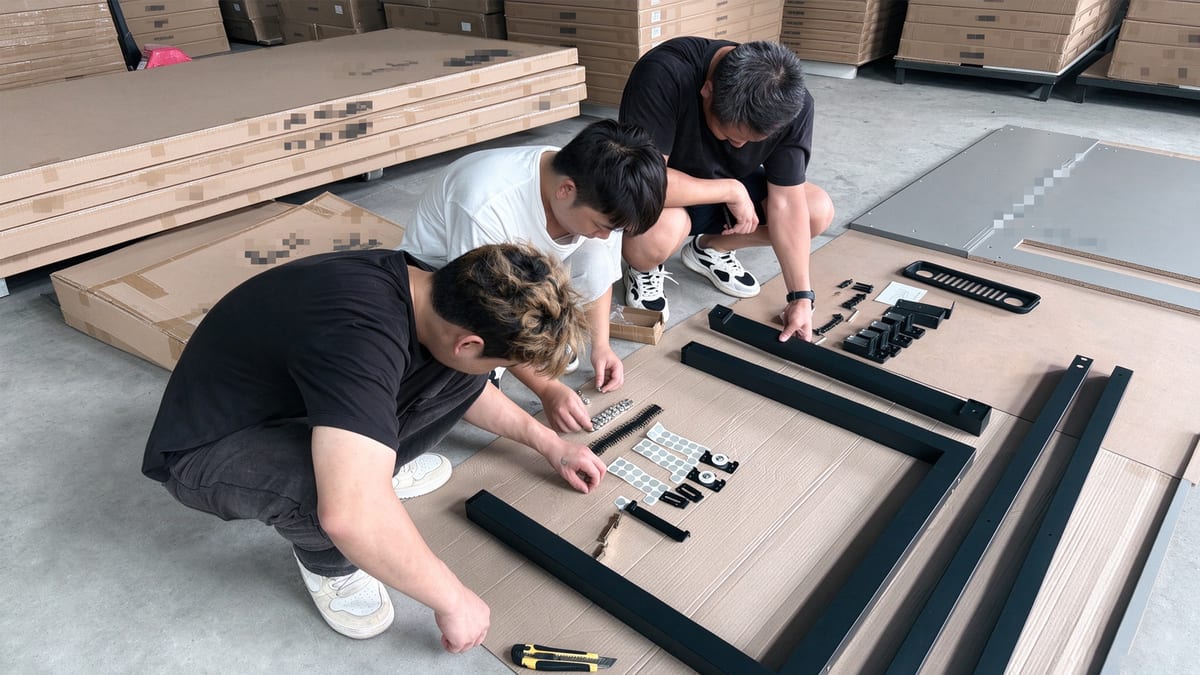
For imported office furniture, quality is not only about the assembled product.
The customer also needs the goods to arrive in the agreed condition.
A sample may look excellent, but the bulk order can still create problems if carton materials, internal protection or packing arrangements change.
At Xusheng, packaging requirements are included in the confirmed order records and are checked alongside the product requirements.
Depending on the order, the relevant checks include:
● Carton dimensions, materials and construction
● Internal protective materials and corner protection
● Separate packing of panels, metal frames and hardware
● Hardware organization and accessory completeness
● Product labels, model references, carton markings and customer branding
● Consistency with the customer's approved packing requirements
Sample and finished-goods packaging are also included in the inspection process.
If a packaging problem is identified, it should be corrected, and the team should check whether similar issues may affect other products.
Why this matters to dealers
A damaged panel, missing fitting or poorly protected edge can create additional work after arrival.
The dealer may need to contact the supplier, provide photographs, arrange replacement parts and manage the end customer's expectations.
That is why packaging should be considered during sample evaluation rather than left until the container is ready to ship.
A sample should represent the product and the packaging standard the dealer expects to receive in the bulk order.
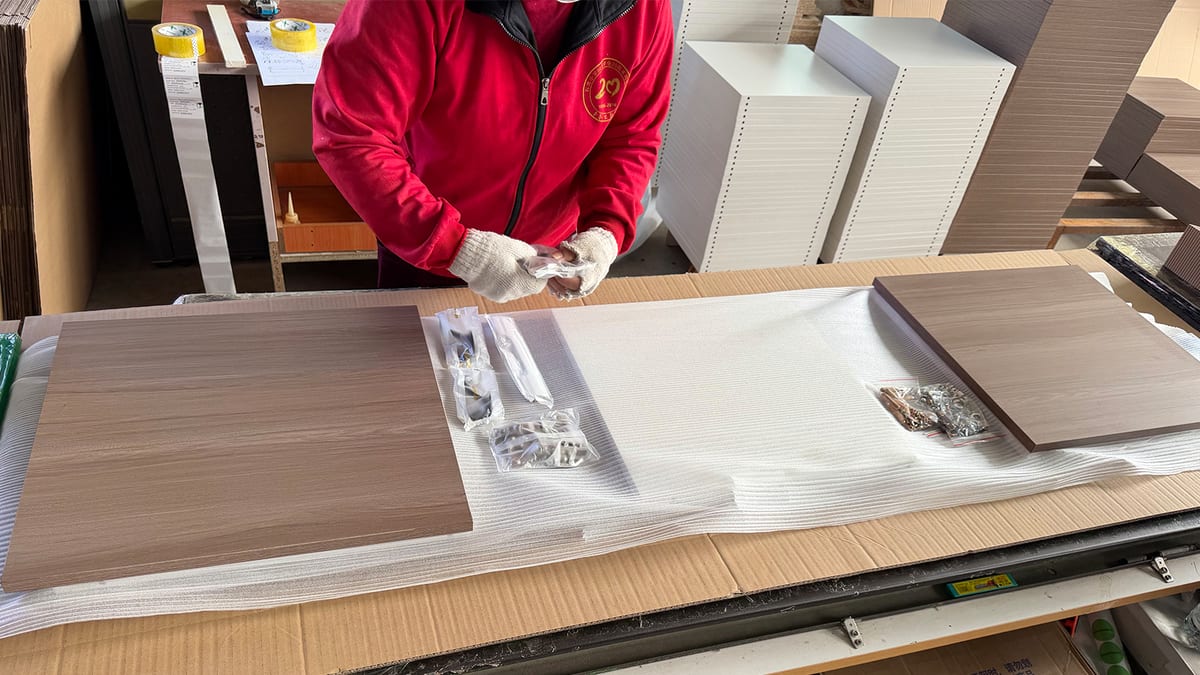
8. Can Dealers Inspect the Actual Bulk Order Before Shipment?
Yes. Sample approval and per-shipment verification serve different purposes, and dealers may want to use both.
The approved sample establishes what the product should be. A per-shipment inspection provides an opportunity to assess the actual order before it leaves the factory.
Xusheng can support different inspection arrangements, subject to advance discussion and the order's circumstances.
These include:
● Visiting the factory to inspect products or work in progress
● Viewing production, trial assembly, QC or packaging through a live video call
● Reviewing genuine photographs and videos of production, inspection, packing or container loading
● Arranging an inspection through the customer's own representative or a third-party inspection company
● Receiving product samples, photographs or videos for confirmation where appropriate
The inspection time and scope need to be agreed in advance.
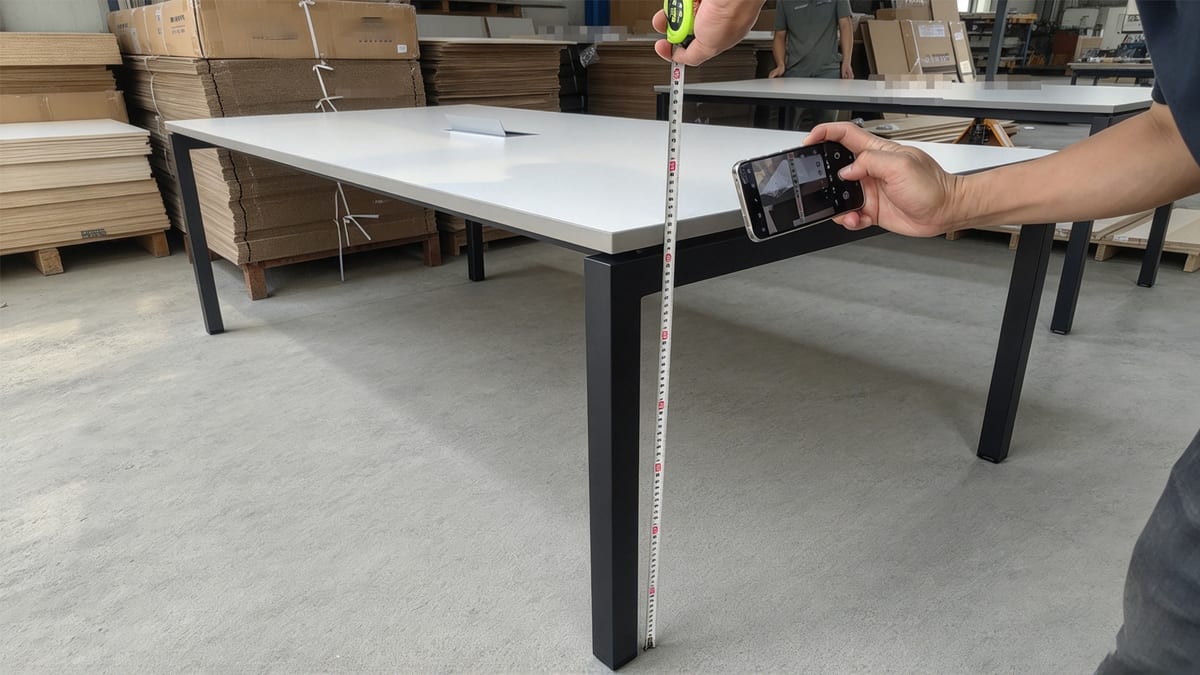
What should a dealer ask to see?
Depending on the order, useful checks may include:
Product identity: Are the models and configurations the ones ordered?
Specifications: Do dimensions, materials, colors and fittings match the confirmed requirements?
Assembly: Are the products assembled correctly, and are any visible structural or fitting problems present?
Packaging: Are the agreed protective materials and packing arrangements being used?
Corrective action: If a problem has already been identified, has it been addressed and checked again?
Dealers should remember that photographs and videos can provide useful evidence, but they may not establish every detail of the order. For higher-risk or more complex orders, a suitably scoped physical inspection may provide additional assurance.
9. Sample Orders and Bulk Orders Have Different Lead Times and Costs
Another common misunderstanding is assuming that if a sample can be produced quickly, the bulk order should take the same amount of time.
In reality, the two orders have different requirements.
Samples are usually prioritized so that customers can evaluate the product and make a purchasing decision.
Bulk orders require planning for the model, quantity, confirmed specifications, materials, production schedule, QC and packaging.
At Xusheng, the normal lead time for a standard order is approximately 45 days after the relevant specifications are confirmed. Some orders may be completed in around 30 days when the circumstances allow.
These are planning references, not guaranteed lead times for every order.
Xusheng assesses the actual requirements and production schedule before confirming a delivery commitment. If the requested timeline cannot reasonably be guaranteed, this should be explained rather than promised simply to secure the order.
Sample costs also need to be understood separately from bulk pricing.
Xusheng normally charges for samples according to the product, configuration and customization requirements. International sample shipping is generally paid by the customer and calculated separately. For customers with clear purchasing plans, sample support may be available depending on the circumstances.
Whether the sample fee can be offset against a subsequent bulk order can be discussed individually; it is not an automatic arrangement for every order.
For dealers, this means the sample stage is a commercial evaluation investment. It helps assess product suitability before committing to a larger order, while bulk production has its own cost and scheduling requirements.
10. A Real Customer Case: From a USD 300 Sample to Around USD 3 Million in Annual Purchases
One of Xusheng customer relationships illustrates why sample evaluation can matter beyond the first purchase.
The relationship began with a sample order worth approximately USD 300. The customer wanted to understand the product quality before committing to a larger order.
Rather than relying only on photographs or a supplier's description, the customer personally unpacked and assembled the sample.
The checks included:
● Product balance and stability
● Structural strength and load-bearing performance
● Colour and overall appearance
● Product style and finish
● Assembly and practical use
These checks allowed the customer to evaluate the furniture directly before deciding whether it was suitable for their business.
After confirming the sample's quality, appearance and assembly performance, the customer proceeded with bulk purchasing.
The subsequent orders were arranged according to the confirmed product specifications. Through repeated bulk purchases, the customer gradually developed confidence in the consistency of the products and the working relationship with Xusheng.
The relationship also involved after-sales support. When transport damage affected a desktop panel, Xusheng arranged a replacement panel for the customer.
This is an important distinction: transport damage is not proof of a production defect. However, the way a supplier responds when a problem occurs can influence whether a dealer remains confident in the partnership.
During the 2023–2024 period, the customer's annual purchases from Xusheng were approximately USD 3 million.
The figures describe the development of this particular customer relationship. They should not be interpreted as a guaranteed outcome for every dealer who starts with a sample.
What can other dealers learn from this case?
First, a sample gives a buyer an opportunity to assess the actual product rather than making a decision based only on images.
Second, the transition from a sample to bulk purchasing requires more than an attractive sample. The approved specifications, production checks and order requirements must carry through to subsequent orders.
Third, repeat business depends on the overall experience, including how the supplier handles problems after delivery.
For a new dealer, the first sample is not a guarantee of future success. It is a way to reduce uncertainty before making a larger commitment.
For an established dealer, a well-managed sample and specification process also helps maintain consistency when introducing new products or extending an existing range.
11. A Practical Checklist Before Moving from Sample to Bulk
Before placing a bulk order, dealers can use the following checklist to confirm that the important details have been covered.
Sample-to-Bulk Verification Checklist
Use this list during supplier discussions and before approving production.
Progress
0 / 11
□ The sample has been checked for appearance, colour and finish.
□ Dimensions, materials, board thickness and edge details have been checked.
□ Hardware, fittings, structure and assembly have been evaluated.
□ The sample's stability and practical performance have been assessed where relevant.
□ Packaging materials and transport protection have been reviewed.
□ The final configuration, price, quantity and delivery requirements have been confirmed.
□ The approved specifications, drawings and relevant order records have been saved.
□ Formal signed or written sample approval has been completed before bulk production.
□ The process for handling specification changes has been agreed.
□ Bulk production will include a batch sample, QC checks and corrective action if required.
□ Pte-shipment inspection arrangements have been discussed where necessary.
Copy checklist
This checklist is a practical starting point rather than a substitute for product-specific technical requirements or a formal inspection plan.
12. How to Choose a Supplier That Can Repeat an Approved Sample
A supplier's ability to make a good sample is useful, but dealers should also ask how that supplier manages the transition to bulk production.
A few questions can reveal whether the supplier has a clear process.
How are approved samples and specifications recorded?
The supplier should be able to explain how the confirmed product details are retained and used in production.
What happens if a component does not meet the agreed specification?
Look for a clear process for recording the problem, correcting it, checking the result and deciding whether further inspection is necessary.
What happens if a material or fitting becomes unavailable?
The supplier should explain how alternatives are evaluated and how customer approval is obtained before a change affects the agreed product.
Can I inspect my actual order before shipment?
Ask which options are available, how much notice is needed and what the inspection can cover.
What happens if something is damaged or missing after delivery?
A supplier should explain how the issue is reported, investigated and resolved.
These questions are useful when comparing potential partners because they focus on the processes behind the product, not just the appearance of one sample.
For dealers planning to reorder products over several years, these processes also connect with choosing an office furniture supplier for the next 5–10 years.
The objective is not to find a supplier that claims to have no problems. It is to find one that can work to confirmed requirements, identify deviations and respond responsibly when something goes wrong.
Conclusion: The Sample Is the Beginning of Verification, Not the End
For an office furniture dealer, approving a sample is an important purchasing decision. It allows you to assess the product before committing to bulk quantities.
But a sample is only useful if the agreed standard continues into production.
That requires clear specifications, formal approval, retained records, appropriate QC, controlled changes and packaging that matches the confirmed requirements.
It also requires honest communication about production schedules, inspection arrangements and the costs involved.
At Xusheng, our approach is to retain the approved sample and specifications, make a new complete sample for each bulk production run, inspect the sample and finished goods, and investigate and correct problems when they arise.
We also support customers who want to inspect their actual orders before shipment, with the scope and timing agreed in advance.
For dealers, the most useful question is not simply whether a supplier can produce one good sample.
It is whether the supplier has a process for reproducing the approved product, checking the bulk order and dealing with problems when they occur.
The sample sets the standard. The production process must carry it through.
That is what turns sample approval into a more reliable purchasing decision.
Primary CTA:
Discuss Your Sourcing Plan
Secondary CTA:
Explore Xusheng Furniture Systems
FAQ
Frequently asked questions
01How do I know if an office furniture sample represents the bulk order?
Check whether the supplier retains the approved sample, records the specifications and uses them as references for production. Ask how the bulk order is checked and what happens when a discrepancy is found. A sample alone cannot prove that every item in a shipment will be consistent.
02Should I approve a sample in writing before placing a bulk order?
Written approval is a useful way to establish the agreed product requirements. At Xusheng, formal signed or written sample approval must be completed before bulk production begins. The approval should be supported by clear specifications and relevant order records.
03What should I check before approving an office desk sample?
Check the dimensions, materials, board thickness, edge banding, colour, surface finish, hardware, structure, assembly, stability and packaging. The exact checks depend on the product and its intended use.
04Does Xusheng make a new sample for every bulk production run?
Yes. Xusheng makes a new complete sample for each bulk production run. The sample is used alongside the relevant QC checks to help verify that the finished products meet the confirmed requirements. Further customer confirmation may be arranged depending on the order.
05What happens if the bulk order does not match the approved sample?
Xusheng records the problem, investigates the cause and arranges rework or replacement of non-conforming components where necessary. The affected products are checked again before proceeding to the next production stage. The inspection scope may be expanded according to the problem and the risk to the wider order.
06Can a supplier change materials or hardware after sample approval?
A change that affects the confirmed specification should be discussed with the customer and approved before implementation. The supplier should check the original records, assess suitable alternatives and explain any relevant changes to cost or delivery.
07Can I inspect my office furniture order before shipment?
Xusheng can arrange factory visits, live video viewing, production and packaging photos or videos, and inspections by a customer's representative or a third party. The inspection timing and scope should be agreed in advance.
08How much does an office furniture sample cost?
Sample costs depend on the product, configuration and customisation requirements. International shipping is generally calculated separately and paid by the customer. Any arrangement to offset the sample fee against a subsequent bulk order is discussed individually.
09How long does bulk office furniture production take after sample approval?
Xusheng normal lead time for a standard order is approximately 45 days after the relevant specifications are confirmed. Some orders may be completed in around 30 days, depending on the product and production schedule. The actual lead time should be confirmed for each order.
10Is sample approval enough to guarantee bulk quality?
No. Sample approval establishes the agreed product standard, but consistent bulk production also requires specification control, production checks, QC and corrective action when problems are identified. Dealers should consider the complete process rather than relying on the sample alone.
Looking for a supplier?
Need a product, sample, or project quote?
Use the catalog to choose products, then send the list for manufacturing, dealer, OEM / ODM, or project support.