
Office Furniture Specifications Checklist for Dealers: What to Confirm Before Placing an Order in China
A guide for dealers covering office furniture dimensions, board and steel specifications, hardware, screens, finishes, packaging, private labelling, technical documents and production changes before ordering.
Office Furniture Specifications Checklist for Dealers: What to Confirm Before Placing an Order in China
Introduction: A Product Photo Is Not a Product Specification
Two office desks can look almost identical in a catalogue. They may have the same colour, similar dimensions and a similar metal frame.
But are they actually the same product?
The answer depends on what is inside the specification.
One desk may use a 25 mm desktop, 2 mm ABS edge banding and a 1.5 mm steel frame. Another may look similar but use different board thicknesses, thinner steel, alternative hardware or a different surface finish.
These differences may not be obvious in product photographs. However, they can affect manufacturing costs, assembly, product performance and the consistency of future orders.
For overseas office furniture dealers, this is why checking specifications before ordering is so important.
A product catalogue helps you choose the furniture you want. A confirmed technical specification tells the manufacturer exactly what to produce.
At Xusheng Furniture, we work with overseas dealers, importers and project buyers who need more than a product image and a price. They need clear dimensions, materials, construction details, hardware configurations, colors and packaging requirements.
For standard products, we use our existing product catalogue and specification sheets. For customized products, our designers work from customer drawings, CAD files or detailed product descriptions to prepare drawings for approval.
The final confirmed specifications then become the reference for purchasing materials, production, quality inspection and future repeat orders.
In this guide, we explain what office furniture dealers should check before placing an order with a Chinese manufacturer, using Xusheng actual product specifications and manufacturing processes.
1. Start with the Complete Product Dimensions
Dimensions are the first specifications that should be confirmed.
A product may be described as a 1,600 mm office desk, but that measurement alone does not explain the complete product.
Dealers should check the overall dimensions and the measurements of the individual components.
Depending on the furniture type, the required information may include:
● Overall length, width and height (L × W × H).
● Desktop length, width and thickness.
● Cabinet and side cabinet dimensions.
● Mobile pedestal dimensions.
● Steel frame and leg dimensions.
● Desk leg height.
● Screen height, width and thickness.
● Drawer dimensions.
● Cabinet door dimensions.
● Internal storage dimensions.
For workstation systems, it is also important to confirm the dimensions of the complete configuration rather than relying only on the measurements of one individual desk.
A four-person workstation, for example, needs to be checked as a complete arrangement, including its shared structure, screens and connecting components.
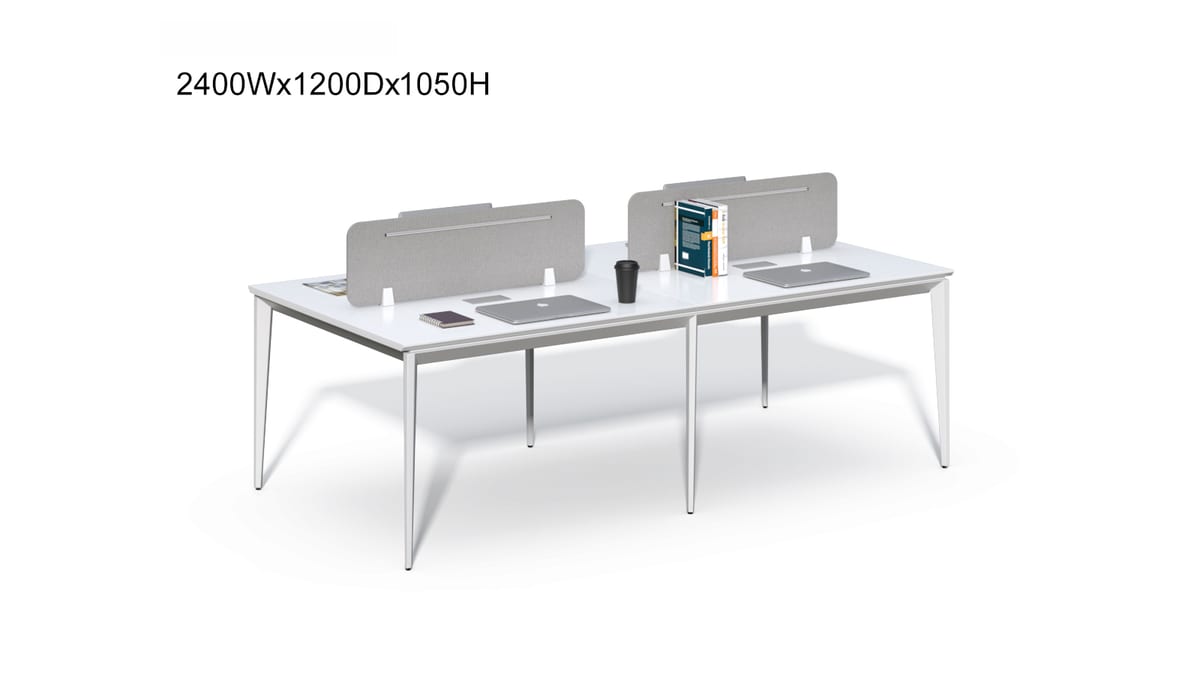
Standard dimensions and customized dimensions
At Xusheng, standard products are mainly confirmed against our existing product catalogue and standard specification sheets.
For customized products, customers can provide:
1.Their own product drawings.
2.CAD files.
3.Written dimensions and product descriptions.
4.Project requirements or reference designs.
If the customer provides dimensions rather than a complete technical drawing, our designers can prepare product drawings according to the requirements.
We then mark the revised dimensions clearly on the drawings and send them to the customer for confirmation.
For special customized products, we can also provide rendered product images or technical drawings to help the customer understand the proposed design.
The final dimensions must be confirmed in writing before production is arranged.
The approved drawings and dimension records are retained for future reference, making it easier to reproduce the same specifications when the customer places a repeat order.
2. Confirm the Board Material and Thickness
Board specifications have a direct influence on the construction, appearance and cost of panel-based office furniture.
A quotation that simply says “melamine board” does not provide enough information for a proper comparison.
Dealers should confirm the board type, thickness, environmental grade, colour, surface texture and the specifications used in different parts of the product.
Board materials available at Xusheng
Our main manufacturing material is Melamine Faced Chipboard (MFC), also commonly referred to as melamine-faced particleboard.
We can also work with:
● MDF (Medium-Density Fibreboard).
● Fire-resistant board.
However, MDF and fire-resistant board generally involve higher material costs. We explain this difference to customers before confirming the quotation.
The appropriate material depends on the product design, application, budget and customer requirements.
Common board thicknesses
The following are board thicknesses available within Xusheng product range and manufacturing arrangements.
Board thickness | Application or availability |
|---|---|
12 mm | Used for suitable product components |
16 mm | Commonly used for cabinets and other panels |
18 mm | Available for product-specific applications |
25 mm | Main specification for standard office desk tops |
30 mm | Special customization subject to MOQ |
50 mm | Available for thicker, heavier-style desktops |
The standard desktop specification is mainly 25 mm.
A 50 mm desktop can be selected when the product design requires a thicker, heavier appearance.
A 30 mm desktop requires special production arrangements and must meet the relevant minimum order quantity.
These options should not be confused with the standard specification of every Xusheng model.
The final thickness depends on the selected product and approved design.
Environmental grades
Xusheng offers E1 and E0 board options.
The required grade should be confirmed before the order is finalized, together with the relevant material documentation where required by the customer.
Board colour and surface texture
Dealers should also confirm:
● Decorative board colour.
● Wood grain or plain colour.
● Surface texture.
● Matte or other surface effects.
● Special decorative finishes.
● Whether different furniture components need matching or contrasting finishes.
For a complete office furniture range, it is important to consider the desk, side cabinet, mobile pedestal and filing cabinet together.
A colour that looks suitable on one product may not create the intended appearance when used across the entire furniture system.
Final board approval
Xusheng designers prepare the final customized drawings according to the customer's requirements.
If the customer is unsure about the board colour or grain, we can arrange to send physical samples for confirmation.
Once the customer approves the final selection, the confirmed board specification is recorded and used for material purchasing and production.
We also retain the relevant sample records for future repeat orders.
3. Check the Edge Banding Specification
Edge banding is another detail that dealers should never overlook.
It affects the finished appearance of panel edges and helps protect the exposed board edges during normal use.
Two desks can have the same desktop thickness but different edge-banding materials and thicknesses.
These differences should be made clear before production.
ABS and PVC edge banding
Xusheng mainly uses ABS edge banding, while PVC edge banding is also available.
Our ABS edge banding has relevant certificates and test reports.
The customer should confirm the required material rather than assuming that every quotation uses the same type.
Xusheng common edge-banding thicknesses
Board thickness | Edge-banding thickness |
|---|---|
12mm | 1 mm or 1.5 mm |
16mm | 1.5 mm |
18mm | 1.5 mm |
25mm | 2 mm |
Different board components may require different edge-banding specifications.
The final arrangement depends on the approved product design.
Colour and surface matching
The edge banding should match the board colour.
Its surface appearance should also coordinate with the board finish and texture.
Available effects include matte, gloss and other finishes according to the selected material.
For example, a wood-grain desktop should have an edge finish that is visually compatible with the board rather than an obviously mismatched decorative strip.
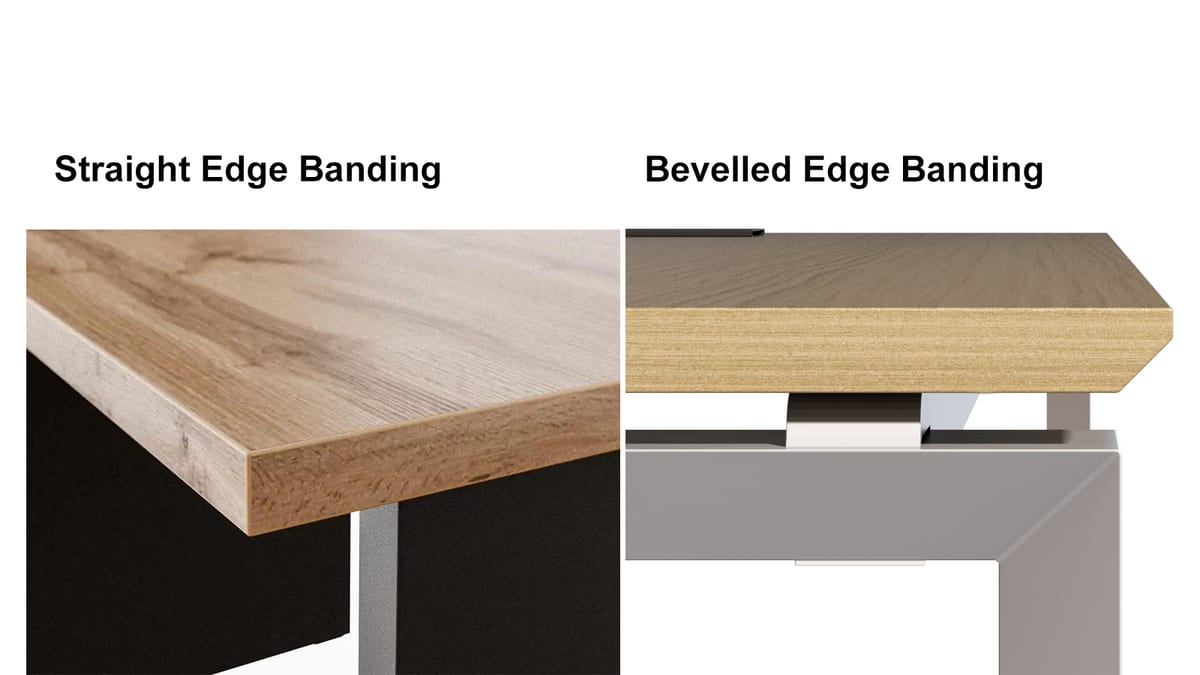
Edge shapes
Xusheng mainly uses two edge profiles:
● Straight edge.
● Bevelled edge.
The selected edge shape should be confirmed in the product drawing or production specification sheet.
Production consistency
Before mass production, the edge-banding result is checked against the approved sample.
At Xusheng, our working principle is:
The sample is the finished product standard, and every finished product must meet the approved sample standard.
If the production result does not meet the confirmed requirements, it should not continue through the production process as an acceptable product or be released for shipment.
4. Confirm the Steel Frame Material, Thickness and Dimensions
For office desks, workstations and meeting tables, the steel frame is one of the most important structural components.
Dealers should not simply ask whether a desk has a metal frame.
They should understand what steel is used, how thick it is, what profile dimensions are involved and how the frame is constructed.
Steel material and thickness
Xusheng mainly uses cold-rolled steel for its office furniture frames.
Our common steel thicknesses are:
● 1.2 mm.
● 1.5 mm.
The appropriate thickness depends on the product structure and design requirements.
It is not necessary to use the thickest possible steel for every product. The objective is to select a suitable specification for the intended structure and application.
Common steel tube profiles
Xusheng uses several square and rectangular tube profiles.
Profile type | Common dimensions |
|---|---|
Square tube | 40 × 40 mm |
Square tube | 50 × 50 mm |
Rectangular tube | 40 × 20 mm |
Rectangular tube | 50 × 25 mm |
Rectangular tube | 50 × 40 mm |
Rectangular tube | 60 × 30 mm |
These are available profile specifications, not a fixed specification for every desk.
The selected profile depends on the product model, design and structural requirements.
Desk leg height
Our common desk leg height is 725 mm.
For round coffee tables, the common height is 425 mm.
Other desk leg dimensions depend on the specific model and design.
Likewise, the dimensions of crossbars, support beams and reinforcement structures vary according to the furniture design.
Dealers ordering customized furniture should therefore confirm these details through the approved technical drawings rather than assume that every frame uses the same structure.
5. Understand the Steel Frame Welding and Connection Structure
Steel frame dimensions are only part of the specification.
The welding positions, connection plates, fixing points and assembly structure also need to be considered.
Common welding positions
During office desk frame production, welding may be required at:
1.Desk leg and crossbar connections: Joining the legs and crossbars to create a stable frame.
2.Desk leg and base connections: Common on T-shaped desk legs.
3.Steel tube corners: Joining steel tubes to form rectangular or U-shaped frames.
4.Crossbar and connecting plate joints: Preparing plates that allow other components to be attached with screws.
5.Desktop mounting plates: Welding small steel plates used to secure the desktop.
6.Reinforcement plates: Strengthening load-bearing positions and helping reduce frame movement.
7.Nut and adjustable foot connections: Providing fixing points for screws and adjustable feet.
The exact welding positions depend on the product structure.
Common welding methods
Xusheng steel frame production may use different welding methods according to the material and application.
Welding method | Main application |
|---|---|
MIG/MAG welding (commonly referred to as CO₂ gas-shielded welding) | Main method for ordinary carbon steel desk frames and batch production |
TIG welding | Special precision welding and certain stainless steel components |
Laser welding | Special applications requiring fine weld seams and accurate component fitting |
Common weld forms
The frame design may use:
● Continuous welding along specified joints.
● Intermittent welding, according to the designed length and spacing.
● Tack welding to hold components in position before final welding.
Not every joint requires the same welding method or weld length.
The requirements should follow the structural design.
What should be checked?
Welding quality checks should consider:
● No cracks.
● No missing welds.
● No burn-through.
● No obvious frame deformation.
● Accurate fixing-hole positions.
● Smooth assembly.
● No burrs after grinding.
● No excessive grinding that weakens the weld.
The completed desk should also undergo the relevant load-bearing and stability checks for its design.
One important detail is that knock-down desk frames usually combine welded sections with screw-connected sections.
More welding does not automatically mean a better desk frame.
A practical structure needs the correct balance between welded connections, removable components, fixing points and assembly requirements.
Powder coating and anti-rust treatment
Steel surface treatment should also be included in the specification.
Xusheng steel frame protection process includes:
Pickling → Photostatting → Oiling → Powder Coating
The full steel frame is coated, including its support legs, rather than leaving exposed metal areas.
Colour and powder-coating appearance are selected according to Xusheng standard colour options or the customer's approved customized requirements.
For humid markets, dealers should pay particular attention to the steel material, surface preparation and coating process.
Our previous article, Why Office Desk Steel Frames Rust in Humid Markets and What We
Learned from Real-World Projects, explains this issue in more detail.
6. Confirm the Steel Frame Connections and Knock-Down Structure
The connection structure affects assembly, transportation and future maintenance.
For dealers importing office furniture, it is important to know whether a desk frame can be dismantled, how its components connect and what fixing hardware is required.
At Xusheng, the following details are confirmed according to the product design:
● Which positions are welded and which use screw connections.
● The installation positions of desk legs, crossbars and connecting plates.
● Desktop mounting plate positions.
● Screw specifications and quantities.
● Other connecting components.
● Whether the frame is designed for knock-down assembly.
● The required assembly sequence.
● Whether the structure is suitable for the intended packaging arrangement.
These details are recorded in product drawings or installation information where applicable.
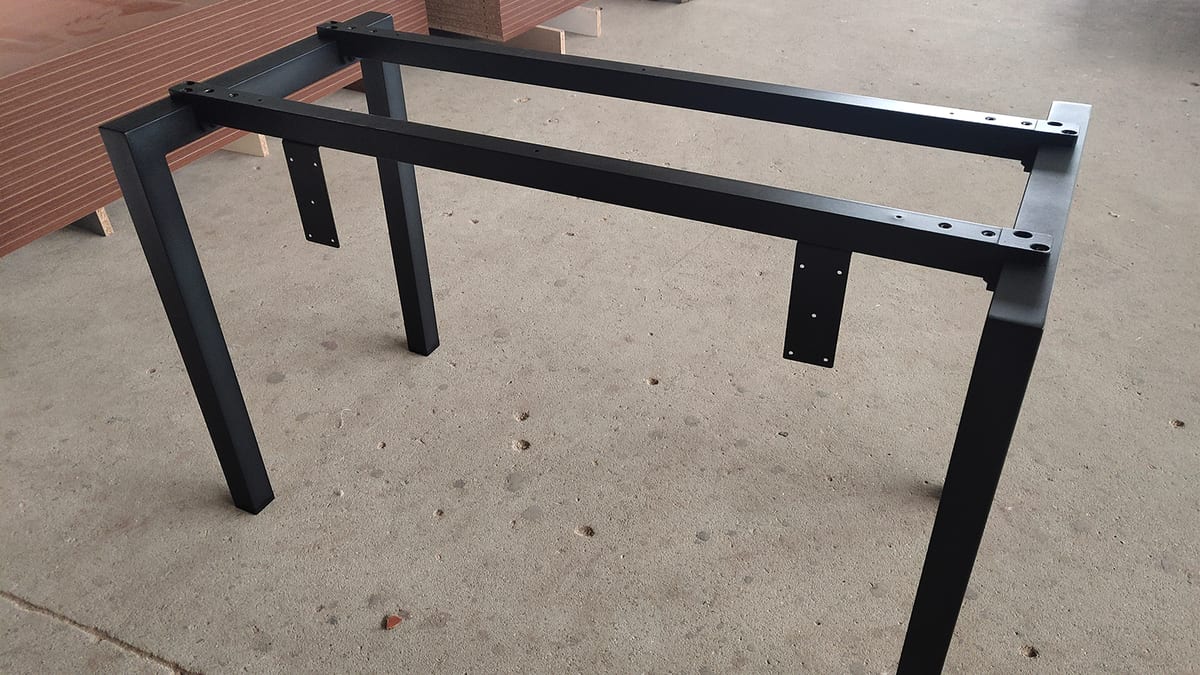
Two-stage steel frame assembly checks
Xusheng carries out assembly checks at two different stages.
First check: Steel frame workshop
The steel frame is assembled in the steel frame workshop to check:
● Overall structural stability.
● Connection strength.
● Whether the welding points contain holes.
● Whether the frame has obvious deformation.
● Whether the powder coating is even.
● Whether the connections fit correctly.
Second check: Finished product production line
The frame is assembled again during finished product production.
This second check confirms that the frame works correctly with the desktop and other furniture components.
Photographs and videos are taken to retain test records.
We also send relevant updates to customers so that they can see the progress of their customized products and the actual assembly results.
These records can also help customers understand the intended assembly method and provide a reference when checking the products after delivery.
7. Confirm Every Hardware Component
Hardware specifications should be checked separately for each product model.
A desk or cabinet may look complete in a photograph, but the actual hardware configuration can vary considerably.
For example, two mobile pedestals may both have three drawers and a lock, but use different drawer runners, locking systems, handles and castors.
Dealers should confirm the following components.
Hardware | What to confirm |
|---|---|
Hinges | Model, specification and opening direction |
Drawer slides | Type, length and load requirements |
Locks | Model, installation position and left/right orientation |
Screws and connectors | Specification and quantity |
Handles | Style and colour |
Castors | Specification, quantity and function |
Gas lifts | Model and functional requirements |
Height-adjustable fittings | Configuration and compatibility |
Other functional hardware | According to the selected product |
Pay attention to installation direction
Some customized details are easy to overlook.
For example, a customer may require a mobile pedestal lock to be installed on the right-hand side rather than the standard left-hand position.
The product may still look almost identical, but the wrong lock position can make it unsuitable for the customer's intended use.
This is why Xusheng checks hardware against the approved drawings, samples and customer requirements.
Hardware lists and functional testing
Different product models require different hardware configurations.
The relevant hardware list should record the selected components and quantities.
Before mass production, actual installation and functional testing are carried out to check that the fittings match the product structure and operate as intended.
A hardware list is only useful when the correct components are actually installed.
8. Check Screens, Cable Boxes and Functional Accessories
Modern office furniture often includes more than a desk and a metal frame.
Workstations may require screens, cable management, electrical components and other accessories.
These items should be included in the specification before the order is confirmed.
Xusheng partition screen systems
Xusheng has three main screen systems: C03, T03 and T08.
Their specifications differ, so dealers should confirm the correct series rather than treating all screens as interchangeable.
C03 Series
Specification | Details |
|---|---|
Screen thickness | 20–60 mm |
Aluminium thickness | 1.0–1.2 mm |
Standard aluminium colour | White, charcoal Grey, anodized finish |
Standard heights | 1050, 1200, 1350, 1500, 1650, 1800, 2000, 2400, 2700 mm |
Standard widths | 600–1800 mm |
T03 Series
Specification | Details |
|---|---|
Screen thickness | 32 mm |
Aluminium thickness | 1.2–1.3 mm |
Standard aluminium colour | White, charcoal Grey, anodized finish |
Standard heights | 1050, 1200, 1350, 1500, 1650 mm |
Standard widths | 600–1800 mm |
T08 Series
Specification | Details |
|---|---|
Screen thickness | 60 mm |
Aluminium thickness | 1.3–1.5 mm |
Standard aluminium colour | White, charcoal Grey, anodized finish |
Standard heights | 1050, 1200, 1350, 1500, 1650, 1800, 2000, 2400, 2700 mm |
Standard widths | 600–1800 mm |
For C03 and T08 screens, higher screen configurations have fewer available functional options.
The actual arrangement should therefore be checked against the selected height and design.
Screen material options
Depending on the selected system, screen materials include:
● Fabric.
● Wood panels.
● Glass.
● Magnetic whiteboards.
● Pinboard.
● Cable-hanging boards.
The screen material, colour, height, width and thickness should be confirmed together.
Cable management
Xusheng offers two common cable-trough options:
● Standard cable trough: 100 mm.
● Flip-top cable trough: 150 mm.
The type and installation position should be confirmed in advance.
Desktop cable boxes
Cable boxes can change in style, size and colour as market requirements develop.
The important point is to confirm the actual cable box model before the desktop is manufactured.
The installation position is on the desktop. Xusheng reserves the appropriate cut-out according to the dimensions of the cable box selected and approved by the customer.
Changing the cable box after the desktop has been manufactured may require additional work.
Other functional accessories
Depending on the product and customer requirements, the configuration may also include:
● Power sockets.
● USB interfaces.
● Wireless charging components.
● Keyboard trays.
● Monitor arms.
● Other functional accessories.
These components should be checked for compatibility with the desktop, steel frame and overall product structure.
Special accessories must have their positions and dimensions marked on the product drawings.
Before mass production, the relevant accessories are installed and tested.
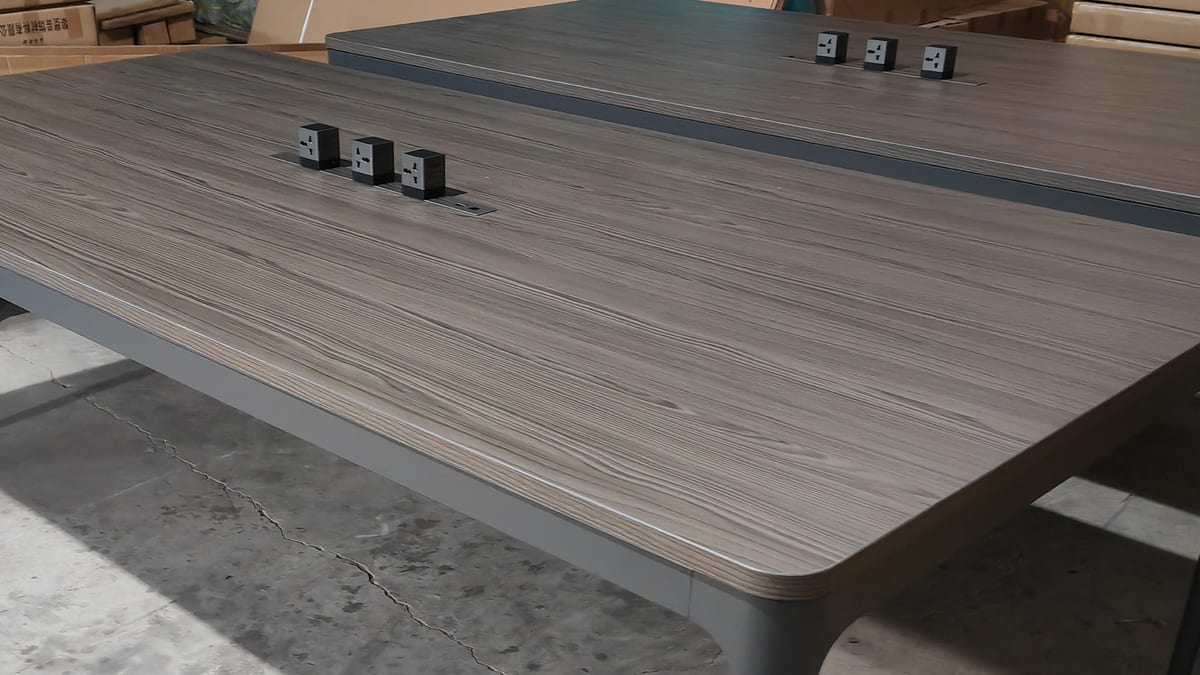
For electrical accessories, the applicable product requirements and destination-market compliance should also be confirmed for the specific project. Do not assume that every electrical configuration is automatically approved for every market.
9. Confirm Product Colour and Surface Finishes
Colour is more than a decorative decision for office furniture dealers.
It affects showroom presentation, product matching, customer preferences and future replenishment.
A product may look slightly different on a computer screen from how it appears in a physical material sample.
This is particularly important for wood-grain boards, fabric screens and different powder-coated metal finishes.
What should be confirmed?
Product component | Confirmation requirements |
|---|---|
Board | Wood grain, plain colour, Grey, white and other options |
Board texture | Wood grain, fabric texture and other patterns |
Board finish | Matte, gloss, soft-touch and special finishes |
Steel frame | Colour and powder-coating appearance |
Screens | Fabric, glass and other finish colour |
Complete furniture set | Coordination between desks, side cabinets, pedestals and filing cabinets |
How Xusheng helps customers choose colour
Our business team provides customers with:
1.Xusheng standard board colour chart.
2.Standard steel frame colour chart.
3.Screen fabric colour chart.
We can also recommend board colour and textures that may be more suitable for the customer's target market.
For example, a dealer serving a market that favour light contemporary interiors may prefer a different selection from a dealer focusing on darker executive furniture.
The recommendation should reflect the customer's market rather than simply follow one universal colour preference.
Physical samples and final approval
If the customer is unsure about the selected colour or finish, Xusheng can arrange to send physical samples for confirmation.
The final colour and surface finish must be approved and recorded before production.
These records are retained for future repeat orders, helping the customer maintain consistency across an established furniture range.
10. Confirm Packaging Specifications Before Production
Packaging is not something that should be left until the end of manufacturing.
It affects transportation protection, container loading, warehouse storage and the customer's installation experience.
Dealers should confirm the packaging method at the same time as the product specifications.
Carton construction
Xusheng uses five-layer corrugated cartons for its standard export packaging arrangements.
The carton dimensions are determined according to the product size and packing method.
Internal protection materials include:
● EPE.
● Foam.
● Protective corners.
● Other suitable protective materials.
The specific arrangement depends on the product structure and transportation requirements.
Separate packaging of components
Panels, steel frames and hardware are packed separately.
This helps organize the different product components and makes them easier to identify during delivery and assembly.
Each package should contain the required:
● Hardware packs.
● Screws.
● Connectors.
● Assembly instructions.
The quantities and contents need to match the relevant order.
Private-label carton printing
For overseas dealers, packaging can also be part of the brand presentation.
Xusheng can arrange customer-specific:
● Carton logos.
● Product model numbers.
● Carton shipping marks.
● Product labels.
● Special packaging requirements.
Packaging dimensions and CBM
Packaging information should be provided before shipment planning.
This includes:
● Carton dimensions.
● Packed product weight.
● Total CBM.
These details help the dealer and shipping planner prepare the 20HQ or 40HQ loading arrangement.
The packaging method should also be considered when comparing different product configurations.
Final packaging approval
The packaging design is prepared according to the product structure and transportation requirements.
The customer confirms the final packaging arrangement before it is used for mass production and shipment.
11. Confirm Private Label and Branding Requirements
For many overseas dealers, private-label manufacturing is an important part of building their own business.
However, private labeling should be confirmed as a complete requirement rather than treated as a simple request to print a logo on a carton.
Xusheng can support branding across the product, packaging and supporting documents.
Product branding
Depending on the product, the customer can request:
● Product logos.
● Brand nameplates.
● Branding in specified positions.
● Customized board colour.
● Customized steel frame colour.
● Different hardware and accessory configurations.
Packaging branding
Customers can request:
● Their own carton logo.
● Custom carton printing.
● Product labels.
● Model identification.
● Shipping marks.
● Special packaging designs.
Branded installation documents
Assembly instructions can also use the customer's brand or a specified document version.
This helps dealers maintain a consistent presentation when supplying furniture under their own brand.
What does Xusheng need from the customer?
Customers should provide the relevant logo files and brand information.
Xusheng then prepares the requested branding, label or packaging designs.
The customized drawings, labels and packaging designs must be approved by the customer before production.
We retain the approved branding and packaging records for future repeat orders.
The objective is to make sure the next shipment follows the same approved brand requirements rather than starting the design process again.
12. Prepare the Technical Documents and Specification Records
A product specification should not exist only in an email conversation or a salesperson's notes.
The confirmed information needs to be recorded in a form that the relevant teams can retrieve and use.
At Xusheng, the technical and order-related information may include the following.
Document | Purpose |
|---|---|
Technical drawings | Show product dimensions and construction |
CAD files | Provide editable technical design information where applicable |
Product specification sheet | Record the agreed product specifications |
Material list | Identify the selected board and other materials |
Hardware list | Record fitting models and quantities |
Assembly instructions | Explain the required installation method |
Packing details | Record carton dimensions and packing arrangements |
Colour approval records | Identify confirmed board, steel and screen finishes |
Final approved drawings | Establish the customer's confirmed design |
Test reports and certificates | Provide supporting material or quality information when required |
Depending on the customer's requirements, Xusheng can provide relevant material test reports, certificates and other quality documentation.
We also retain historical technical records.
This is particularly important for dealers who place repeat orders over several years.
If a customer orders the same desk again, the original specifications can be retrieved instead of relying on memory or an old product photograph.
A good specification system should help both the factory and the dealer answer one simple question:
Are we producing the same product that the customer approved last time?
13. How Xusheng Keeps the Approved Sample and Bulk Production Consistent
Confirming the specifications is only the first step.
The next challenge is making sure that the production team follows them.
A dealer may approve a sample with a particular board thickness, colour, steel frame, hardware and packaging arrangement.
The mass production order should follow those approved requirements.
At Xusheng, the approved sample and confirmed specifications remain the reference throughout production.
Step 1: Retain the approved sample and drawings
The final approved sample, drawings and specification records are retained for reference.
Step 2: Send the requirements to the relevant production positions
The business team provides the customer order information and the relevant points that each production position needs to pay attention to.
Different positions receive the information relevant to their work.
Step 3: Check incoming materials
Incoming boards, steel components, hardware, edge banding and packaging materials are checked against the confirmed order requirements.
Step 4: Check during production
Employees carry out checks on their own work, while the next production stage also checks the semi-finished products it receives.
Production supervisors and QC personnel carry out patrol or sampling inspections.
If an issue is found, the affected product is stopped, corrected and checked again before moving forward.
Step 5: Trial assembly
Products are assembled to check dimensions, structure, fittings, stability, alignment and functional performance.
For steel frames, Xusheng carries out assembly checks in the steel frame workshop and a second assembly check during finished product production.
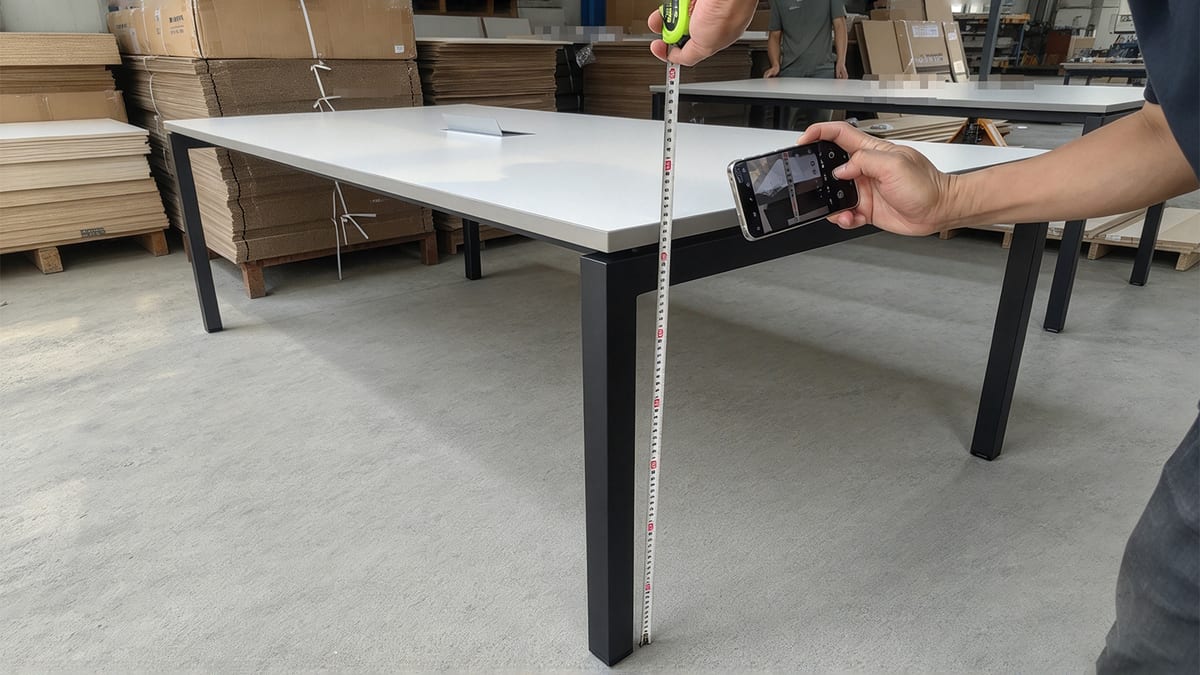
Step 6: Final QC
Finished products are checked against the approved requirements, including:
● Product model.
● Dimensions.
● Board colour and finish.
● Steel frame.
● Hardware.
● Product configuration.
● Assembly performance.
Final QC uses sampling. If serious or repeated problems are found, the inspection scope is expanded and may require a full inspection.
Step 7: Packaging checks
Before shipment, packaging is checked against the customer's approved requirements.
This includes carton identification, protective materials, hardware packs, labels and assembly instructions.
Keeping customers informed
Photographs and videos are taken during relevant production and testing stages.
Where arranged for the order, these updates are shared with customers so they can see the progress of their customized furniture.
The purpose is not simply to show that production is taking place.
It is to give the customer a practical reference for understanding the finished product and checking it after delivery.
For a more detailed explanation of the approved sample and bulk production process, see Sample vs Bulk Office Furniture Orders: How Dealers Can Check Quality Consistency Before Buying in Bulk.
14. What Happens When a Customer Wants to Change the Specifications?
Specification changes need careful handling, particularly after the customer has approved the final drawings and the order has been confirmed.
At Xusheng, the usual sequence is:
1.The customer confirms the final product specifications and drawings.
2.Both parties sign the contract.
3.The customer pays the deposit.
4.Xusheng starts purchasing materials and arranging production.
At this stage, the confirmed specifications form part of the agreed order.
If the customer later wants to change the desktop size, board colour, steel structure, hardware or packaging, we first need to understand the reason and the full extent of the requested change.
We do not simply treat every new request as an automatic production instruction.
There are two practical ways to handle the situation.
Option 1: Continue with the Existing Contract
This is generally our preferred approach.
The current order continues according to the confirmed contract.
Any new requirements can be planned for the next order.
This usually avoids unnecessary material waste, supplier disruption and additional costs.
Where appropriate, Xusheng can also assess whether production needs to be accelerated or slowed down to suit the customer's wider purchasing plans.
Option 2: Change the Specifications in the Current Order
If the customer genuinely needs to change the existing order, Xusheng will:
● Confirm the full list of requested changes.
● Explain the additional costs involved.
● Contact relevant suppliers to stop the original material supply where possible.
● Obtain the customer's prompt confirmation of the replacement specifications.
● Check which materials or components have already been purchased or supplied.
● Evaluate any costs that cannot be reversed.
● Update the drawings and production information.
● Reassess the production schedule.
If unavoidable costs have already been incurred, the customer is responsible for those costs according to the agreed circumstances and contract.
However, Xusheng will also consider how supplier coordination and production adjustments can reduce unnecessary losses and additional expenses.
We generally recommend completing the current order according to the original agreement and introducing the new specifications in the next order whenever possible.
This is usually the less costly option for the customer.
Why written approval matters
Without a clear record of the final specifications, both the dealer and manufacturer may end up working from different versions.
That creates unnecessary risk.
A written approval process helps establish:
● What was originally agreed.
● What has been changed.
● Which version is now valid.
● Whether additional costs apply.
● Whether the delivery schedule needs to change.
The purpose is to protect both parties and avoid misunderstandings during production.
15. A Practical Office Furniture Specifications Checklist for Dealers
Before placing your next office furniture order, use the following checklist to review the important information.
Specification area | What to confirm | Confirmed |
|---|---|---|
Product dimensions | Overall L × W × H and component dimensions | ☐ |
Drawings | Final technical drawings and CAD information | ☐ |
Board material | MFC, MDF or fire-resistant board | ☐ |
Board thickness | Desktop and other panel thicknesses | ☐ |
Environmental grade | E1 or E0, as required | ☐ |
Board finish | Colour, texture and surface effect | ☐ |
Edge banding | ABS/PVC, thickness, colour and profile | ☐ |
Steel material | Cold-rolled steel and thickness | ☐ |
Steel profiles | Square and rectangular tube dimensions | ☐ |
Steel structure | Legs, crossbars and reinforcement | ☐ |
Welding | Positions, methods and weld requirements | ☐ |
Surface treatment | Preparation and powder-coating finish | ☐ |
Connections | Screws, connecting plates and assembly method | ☐ |
Hardware | Hinges, slides, locks, handles and castors | ☐ |
Screens | Series, thickness, dimensions and material | ☐ |
Cable management | Cable box and cable-trough configuration | ☐ |
Electrical accessories | Sockets, USB and other selected components | ☐ |
Colour | Board, steel, screen and complete furniture matching | ☐ |
Packaging | Carton dimensions, protection and packing method | ☐ |
Private label | Product logo, carton printing and labels | ☐ |
Documents | Specification sheet, drawings and assembly instructions | ☐ |
Sample approval | Final physical sample and written approval | ☐ |
Production approval | Confirmed specifications sent to relevant production positions | ☐ |
Change control | Process for handling changes after contract confirmation | ☐ |
Not every item applies to every office furniture product.
The purpose of the checklist is to make sure that the relevant requirements for the selected product have been discussed and confirmed.
A desk does not need screen specifications if no screen is included. A cabinet does not need a desk frame profile. A customized workstation, however, may require several of these items to be confirmed together.
The checklist should therefore be adapted to the actual product and order.
Conclusion: Confirm the Specifications Before You Confirm the Order
Choosing office furniture from a catalogue is relatively straightforward.
Making sure the factory produces exactly what you approved is a different matter.
For overseas dealers, the most important specifications go beyond product appearance.
They include dimensions, board materials, thicknesses, edge banding, steel frames, welding, hardware, functional accessories, colour, packaging and branding.
They also include the drawings, samples and written records used to control production.
At Xusheng, we use our standard product specifications as the starting point for normal orders.
For customized products, our designers work with customer drawings, CAD files or product descriptions to prepare the required technical information.
The final drawings, materials, colour, hardware and packaging must be confirmed before the order proceeds.
After the contract is signed and the deposit is received, those approved specifications become the production reference.
We retain the relevant records, carry out checks during manufacturing and use trial assembly and final QC to verify the finished products.
If the customer wants to change the agreed requirements after production arrangements have started, we assess the reason, additional costs and practical impact before deciding how to proceed.
Our objective is straightforward.
We want our customers to know exactly what they are purchasing, and we want the factory to know exactly what it needs to produce.
A clear specification protects the dealer's purchasing decision, reduces avoidable misunderstandings and provides a reliable reference for future repeat orders.
A good office furniture order does not start with a price. It starts with a clearly confirmed specification.
Discuss Your Office Furniture Requirements with Xusheng
Are you planning to import office furniture from China, develop your own product range or customize an existing furniture design?
Share your product drawings, dimensions, material preferences or reference images with our team.
We can help review the product structure, prepare technical drawings, confirm suitable materials and hardware, and discuss the specifications needed for your order.
Guangzhou Xusheng Furniture Co., Ltd.
WhatsApp / WeChat: +86 159 9966 3767
Email: [email protected]
CTA: Discuss Your Office Furniture Specifications
Your success is our success. When your products sell well and your business grows, Xusheng has the opportunity to grow with you.
Primary CTA:
Discuss Your Sourcing Plan
Secondary CTA:
Explore Xusheng Furniture Systems
FAQ
Frequently asked questions
011. What specifications should I confirm before ordering office furniture from China?
Confirm the product dimensions, board material and thickness, edge banding, steel frame structure, hardware, functional accessories, colours, packaging and branding requirements. The final drawings and specifications should be approved before production.
022. What board thicknesses does Xusheng offer for office furniture?
Xusheng works with 12 mm, 16 mm, 18 mm, 25 mm and other product-specific board thicknesses. A 25 mm desktop is the main standard, while 30 mm requires special customisation and the relevant MOQ. A 50 mm desktop is available for thicker designs.
033. Does Xusheng use ABS or PVC edge banding?
Xusheng mainly uses ABS edge banding and also offers PVC. Common edge-banding thicknesses include 1 mm, 1.5 mm and 2 mm, depending on the board and product design. Our ABS edge banding has relevant certificates and test reports.
044. What steel thickness does Xusheng use for office desk frames?
The common cold-rolled steel thicknesses are 1.2 mm and 1.5 mm. The final specification depends on the product structure and design requirements.
055. Can Xusheng customise office furniture dimensions, colours and materials?
Yes. Customers can provide drawings, CAD files or written product requirements. Xusheng designers can prepare customised drawings and arrange material or colour samples where necessary. Production starts after the final requirements have been confirmed.
066. What screen specifications should dealers confirm for office workstations?
Dealers should confirm the screen series, thickness, aluminium profile, height, width, material, colour and cable-management arrangement. Xusheng offers C03, T03 and T08 screen systems with different specifications.
077. Can Xusheng provide private-label office furniture?
Yes. Xusheng supports product logos, branded packaging, carton printing, labels, product identification, customised colours and branded assembly instructions, subject to the agreed product requirements.
088. What technical documents can Xusheng provide?
Depending on the order and customer requirements, Xusheng can provide technical drawings, CAD files, product specification sheets, material and hardware lists, assembly instructions, packing details, approval records and relevant material test reports or certificates.
099. How does Xusheng ensure bulk production follows the approved sample?
Xusheng retains the approved sample and specifications, provides relevant order information to production positions, checks incoming materials and production processes, carries out trial assembly and performs final QC. Packaging is also checked against the confirmed requirements.
1010. Can a customer change product specifications after signing the contract?
Changes can be assessed, but they are not automatic. Xusheng reviews the reason, material purchasing status, additional costs and production impact. Where possible, we recommend completing the current order according to the original contract and applying the new specifications to the next order.
Looking for a supplier?
Need a product, sample, or project quote?
Use the catalog to choose products, then send the list for manufacturing, dealer, OEM / ODM, or project support.