
Why Similar-Looking Office Desks Have Different Prices
Learn why similar-looking office desks can have different prices and how dealers can compare specifications, packaging, loading efficiency and supplier support like-for-like before choosing a supplier.
Why Similar-Looking Office Desks Have Different Prices
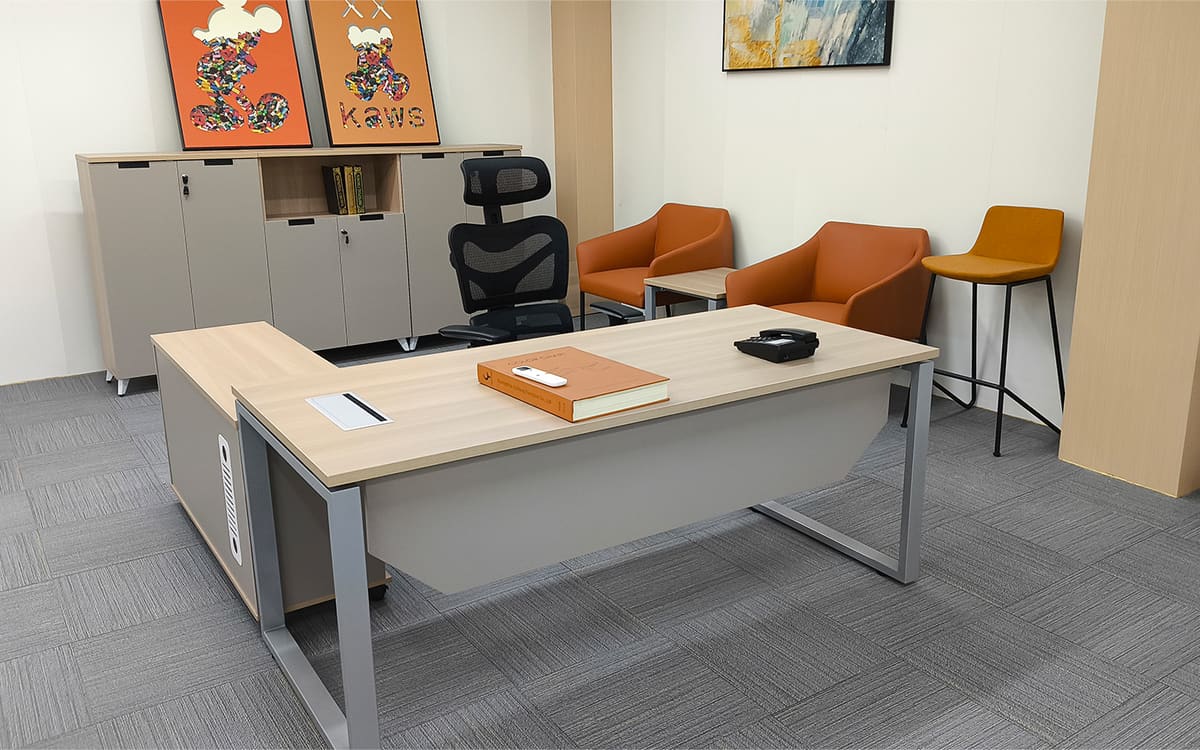
Two office desks can look almost identical in a supplier's catalogue and still be very different products.
The same overall design. Similar wood finish. Similar metal frame. The same nominal size.
Yet when an office furniture dealer compares quotations from three, four or five Chinese manufacturers, the prices can be noticeably different.
The natural question is:
Why am I paying more for what appears to be the same desk?
Sometimes one supplier simply has a higher margin.
But very often, the desks are not actually being quoted to the same specification.
Board thickness, edge banding, steel wall thickness, hardware, surface treatment, structural design, packaging and quality-control requirements can all change the factory price without dramatically changing how the desk looks in a photograph.
This leads to one of the most useful rules when comparing office furniture quotations:
Similar Appearance ≠ Same Specification ≠ Same Dealer Cost.
Before deciding which supplier is cheaper, establish whether you are actually comparing the same product.
For dealers sourcing office furniture internationally, this is one of the simplest ways to avoid choosing a quotation that looks attractive at the purchasing stage but creates additional cost later.
1. Start With the Specification, Not the Product Photo
A product image is useful for evaluating design.
It is a poor tool for evaluating manufacturing specifications.
Consider two 1,600 mm office desks shown side by side online.
Both may have a wood-finish desktop, black powder-coated metal frame, modesty panel, cable management and mobile pedestal.
From a distance, they may appear almost identical.
But underneath that appearance, the quotations could be based on very different specifications.
Specification | Example A | Example B |
|---|---|---|
Desktop | 18 mm MFC | 25 mm MFC |
Edge banding | 0.8 mm PVC | 2 mm PVC |
Steel wall thickness | 0.5-0.8 mm | 1.2-1.5 mm |
Drawer runners | Basic runners | 3-section runners |
Cable management | Basic cable hole | Aluminium cable box |
Packaging | Standard carton | Reinforced export packing |
The specifications above are illustrative examples only. They are intended to show how apparently similar desks can be quoted differently, rather than to define a universal standard.
Both products could legitimately be described as a:
1,600 mm modern office desk with metal frame.
They are simply not the same product specification.
So before asking:
Which desk is cheaper?
ask:
What exactly is included in each price?
2. Board Thickness Can Change Both Cost and Performance
Panel material is one of the first areas to check.
A quotation may simply specify MFC or melamine-faced chipboard without making the actual construction sufficiently clear.
Dealers should look deeper at:
● board grade;
● board thickness;
● surface finish;
● decorative colour and grain;
● environmental requirements where applicable;
● edge treatment.
A difference of only a few millimetres may not look dramatic in a catalogue photograph, but it changes material consumption and can affect how the product performs.
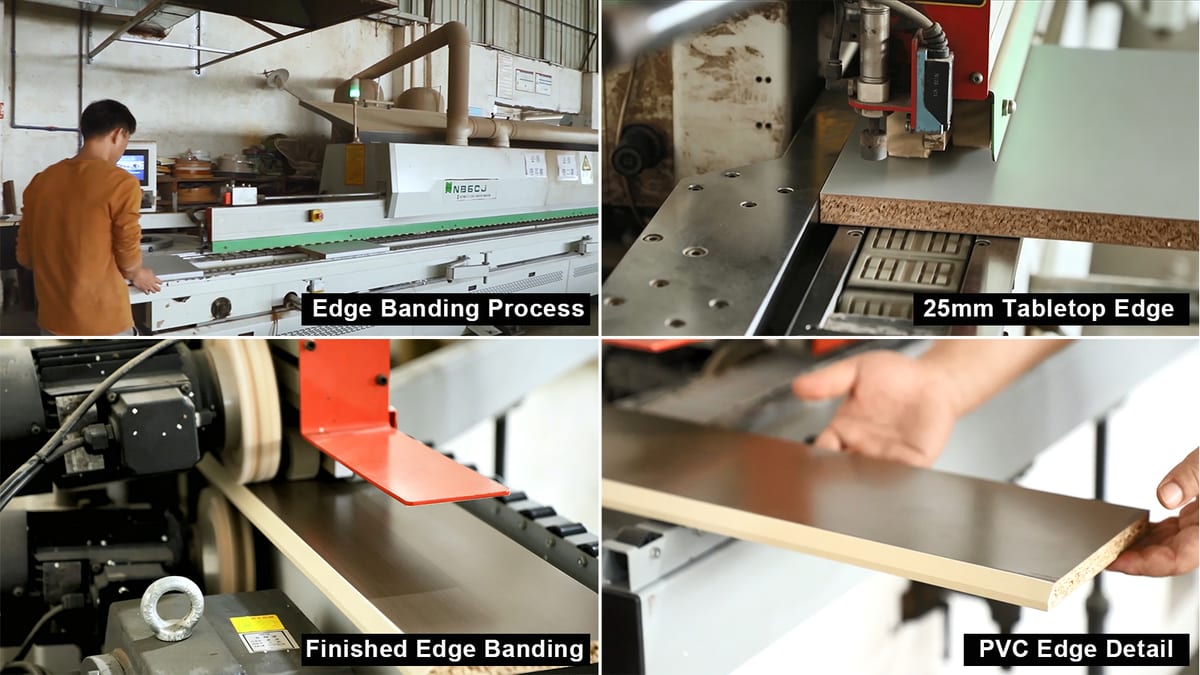
In Xusheng's commercial office furniture production, different structures use different board specifications. Standard panels may use 18 mm board, while certain desktops use thicker specifications such as 25 mm.
When comparing quotations in the market, apparently similar products may also be offered using 16 mm or 15 mm panels.
That does not automatically make the thinner product unsuitable.
The appropriate specification depends on the desk structure, span, support and intended commercial application.
The important point is that a lower price achieved by changing board thickness is a specification decision, not simply a supplier price advantage.
If Dealer A is comparing 25 mm against 18 mm, or 18 mm against 15 mm, the price should not be compared before that difference is understood.
3. Edge Banding Is Easy to Ignore Until the Furniture Is Used
Edge banding receives far less attention than desktop colour, yet it is one of the parts of an office desk that experiences regular contact and wear.
Dealers should check:
● edge-band material;
● thickness;
● adhesion;
● corner finishing;
● colour matching;
● machining quality.
For example, thicker PVC edging combined with more demanding machining or bevelled finishing normally requires a different production specification from a thin decorative edge.
Again, thicker does not automatically mean better for every application.
The question is whether the quotation matches what the dealer believes they are buying.
Poorly controlled edge finishing may create problems that are almost impossible to identify from a supplier's catalogue photograph: visible glue lines, rough corners, weak adhesion or premature edge damage.
The saving happens at the factory.
The complaint happens in the dealer's market.
4. Steel Thickness Is One of the Biggest Hidden Differences
Metal frames are another area where photographs can be misleading.
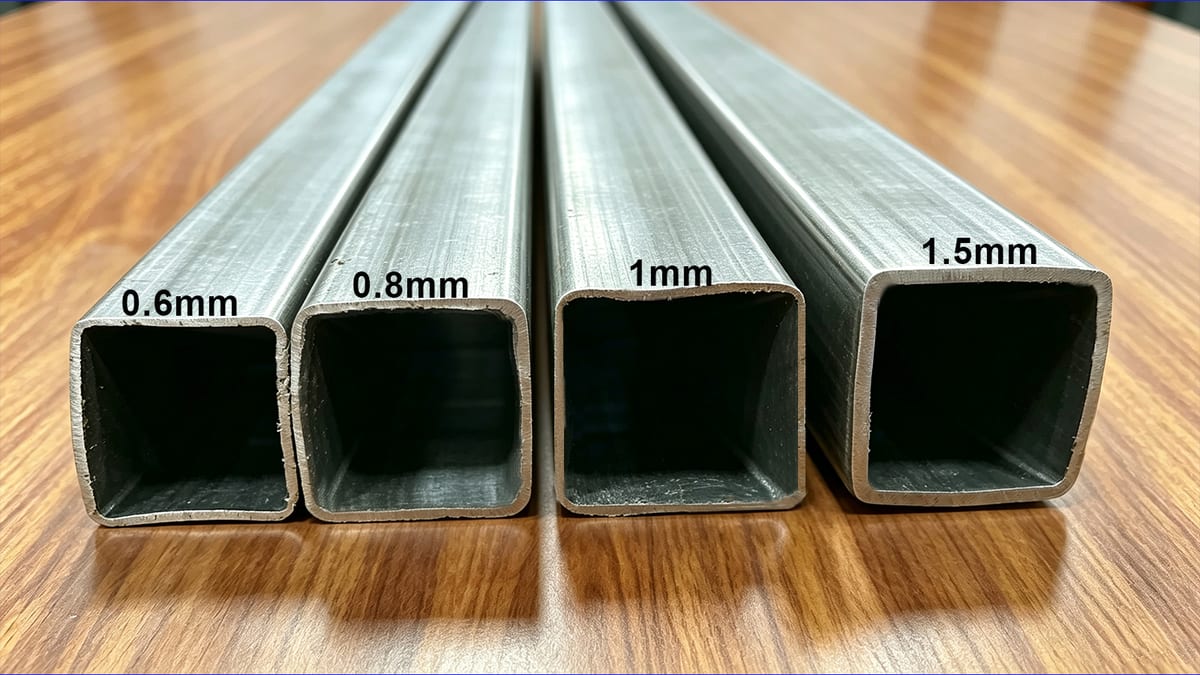
A quotation might specify a 60 × 60 mm desk leg.
That tells you the external profile.
It does not necessarily tell you the wall thickness of the steel.
Two frames can therefore look almost identical while using very different quantities of material.
In Xusheng's commercial desk production, steel specifications commonly fall around 1.2–1.5 mm, depending on the structure and product.
During market comparisons, however, apparently similar frames may also be offered with considerably thinner steel.
The effect on factory price is understandable.
Less steel means lower material cost and potentially lower product weight.
But the dealer needs to know what is being changed.
Depending on the structure and application, insufficient steel thickness can contribute to frame movement, reduced load-bearing performance, twisting or deformation, less secure connections and greater sensitivity to repeated assembly and relocation.
This does not mean the thickest possible steel should always be selected.
That simply adds unnecessary material, weight and cost.
The objective is to use a specification appropriate for the intended commercial application.
Value engineering removes unnecessary cost. Cost cutting removes necessary performance.
Those are not the same thing.
5. Surface Finishing Can Look Similar on Day One
Steel cost is not determined by wall thickness alone.
Surface preparation and powder coating also matter.
Two newly assembled black desk frames may look almost identical when photographed.
Differences can become more visible later through scratching, inconsistent coating, poor adhesion, corrosion or colour variation between batches.
For a dealer supplying one desk, a small finish variation may be manageable.
For a project containing 100 workstations, repeated variation across an open-plan office is much more noticeable.
This is why commercial buyers should look beyond colour names such as “black”, “white” or “grey”.
The real question is whether the finish can be reproduced consistently across the order.
6. Hardware Can Quietly Change a Quotation
Hardware is another common source of price differences.
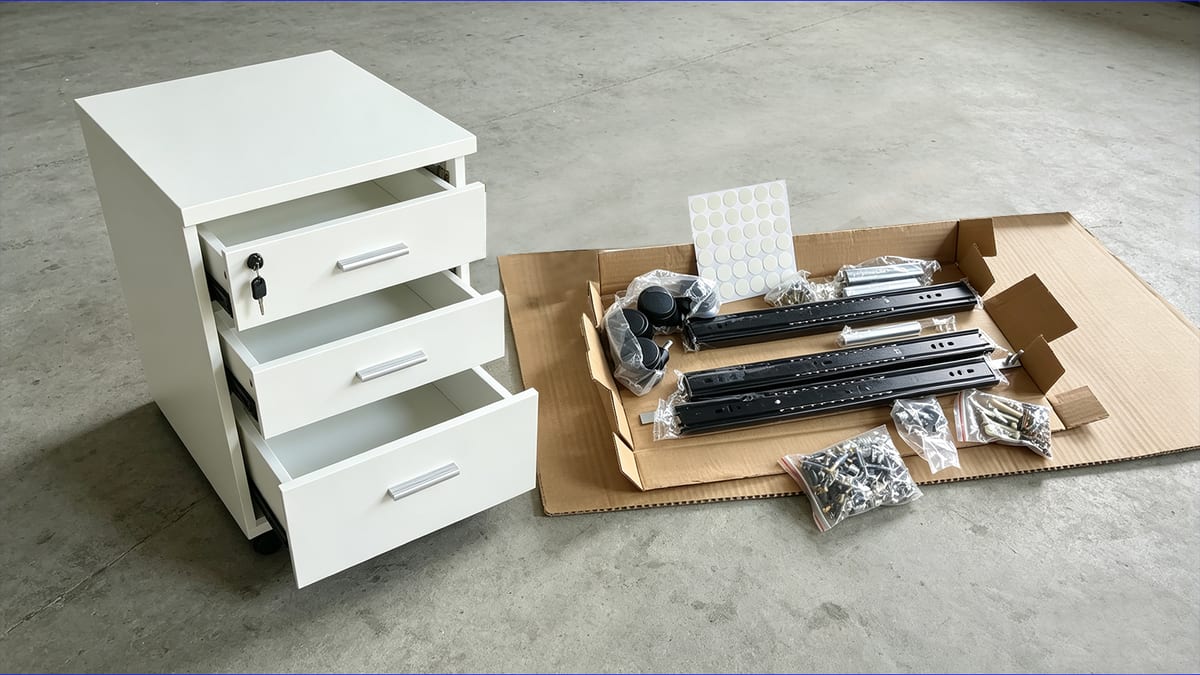
Consider a mobile pedestal.
A quotation may simply describe it as:
3-drawer mobile pedestal with lock.
That tells you very little about what is inside.
The dealer still needs to understand:
● drawer-runner specification;
● lock system;
● handles;
● castors;
● internal construction;
● connection hardware;
● future replacement availability.
The same principle applies to hinges, cable boxes, locks, connectors and other functional components.
Each difference may represent only a small amount on one desk.
Across hundreds of units, those differences accumulate.
More importantly, hardware includes many of the parts that move, connect and receive repeated use.
This is why comparing a product name and overall dimensions is not enough.
7. Structure Matters More Than Material Thickness Alone
A good quotation comparison should not become a competition over who can offer the biggest numbers.
A 25 mm panel is not automatically better than every 18 mm panel.
A 1.5 mm frame is not automatically better than every 1.2 mm frame.
And a heavier office desk is not automatically a better commercial product.
Engineering matters.
A well-designed structure can use material efficiently because loads are correctly supported and connections are positioned appropriately.
A poorly designed structure can use more material and still perform badly.
This is why, when a customer asks Xusheng to improve a product, our answer is not automatically to increase every material specification.
The reverse is also true.
When a dealer needs to reach a lower target price, the answer should not automatically be to make every component thinner.
The more useful question is:
Where does the specification actually affect commercial performance?
In one product, it may make sense to maintain the frame specification while simplifying a non-critical decorative feature.
In another, the desktop specification may be important while a different hardware option can achieve the required cost level.
That is what practical value engineering should do:
Control cost without quietly removing the performance the dealer expects.
8. Packaging Is Part of the Product Specification
Packaging is often ignored during quotation comparisons because buyers naturally focus on the furniture itself.
For an importer, that can be a costly mistake.
The product still has to travel from the factory to the dealer's warehouse or project site.
Export packaging may differ in:
● carton construction;
● internal protection;
● corner protection;
● panel separation;
● hardware packaging;
● product identification;
● shipping marks;
● installation labels.
Reducing packaging can reduce the quotation.
It can also increase the possibility that a perfectly manufactured panel arrives damaged.
For a domestic supplier delivering furniture a short distance, this may be manageable.
For a dealer importing a container thousands of kilometres, the economics are different.
Saving a small amount on packaging is not useful if the dealer later spends far more on replacement panels, local handling and customer service.
Packaging therefore belongs in a like-for-like quotation comparison.
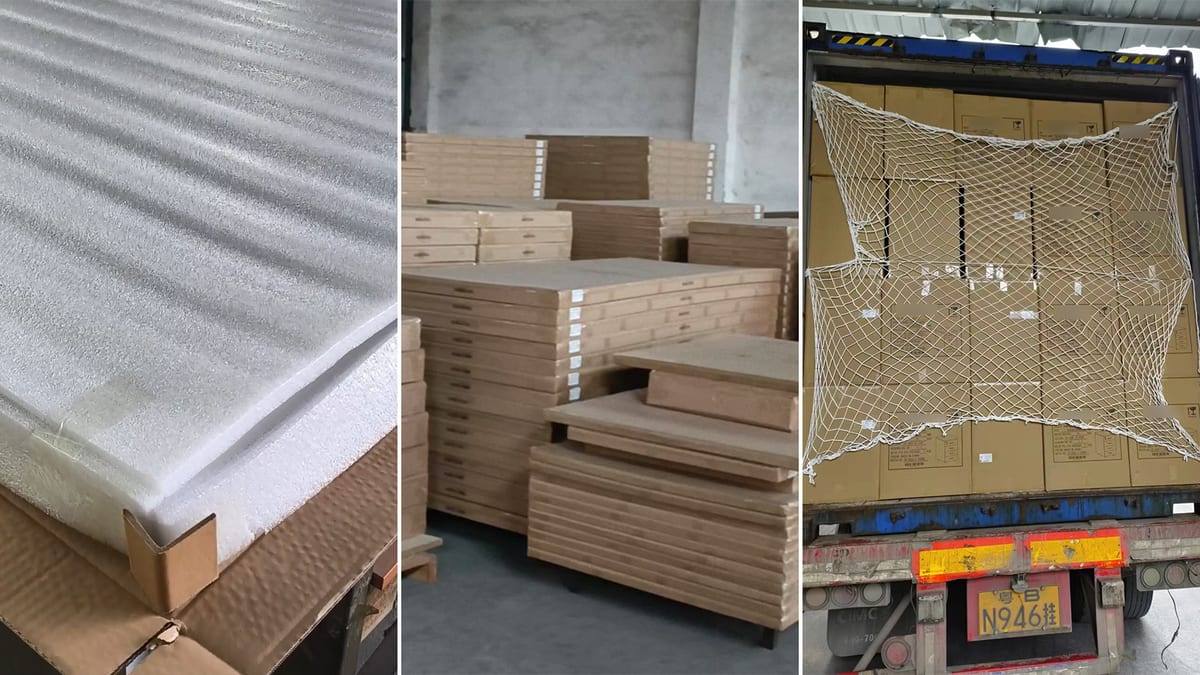
9. KD Structure and Container Loading Can Change the Real Cost
FOB price is only one part of what the dealer eventually pays.
Knock-down structure, carton dimensions and container utilisation can materially affect freight cost per sellable unit.
At Xusheng, most panel office furniture is prepared for KD shipment. Mobile pedestals are often supplied assembled because of their more complex assembly structure, although packing can be adjusted according to the customer's requirement.
Desk panels and metal frames can be packed separately, while product quantities and combinations can be planned around the purchase list to improve 40HQ utilisation.
Imagine:
Supplier A is USD 2 cheaper per desk but loads fewer desks into a container.
Supplier B has a slightly higher FOB price but uses a more efficient KD structure and carton configuration.
Depending on freight and loading quantities, Supplier B may ultimately deliver a lower cost per sellable unit.
This is why:
Lowest FOB Price ≠ Lowest Dealer Cost.
A dealer should understand both the product price and what happens to that product after it is packed.
10. Quality Control Has a Cost — But So Does the Absence of It
A quotation also reflects what happens before the carton is closed.
1. Does the supplier check incoming materials?
2. Are dimensions verified during production?
3. Is edge banding inspected?
4. Are drilling positions checked?
5. Are finished products trial assembled?
6. Are hardware, labels and packaging contents checked?
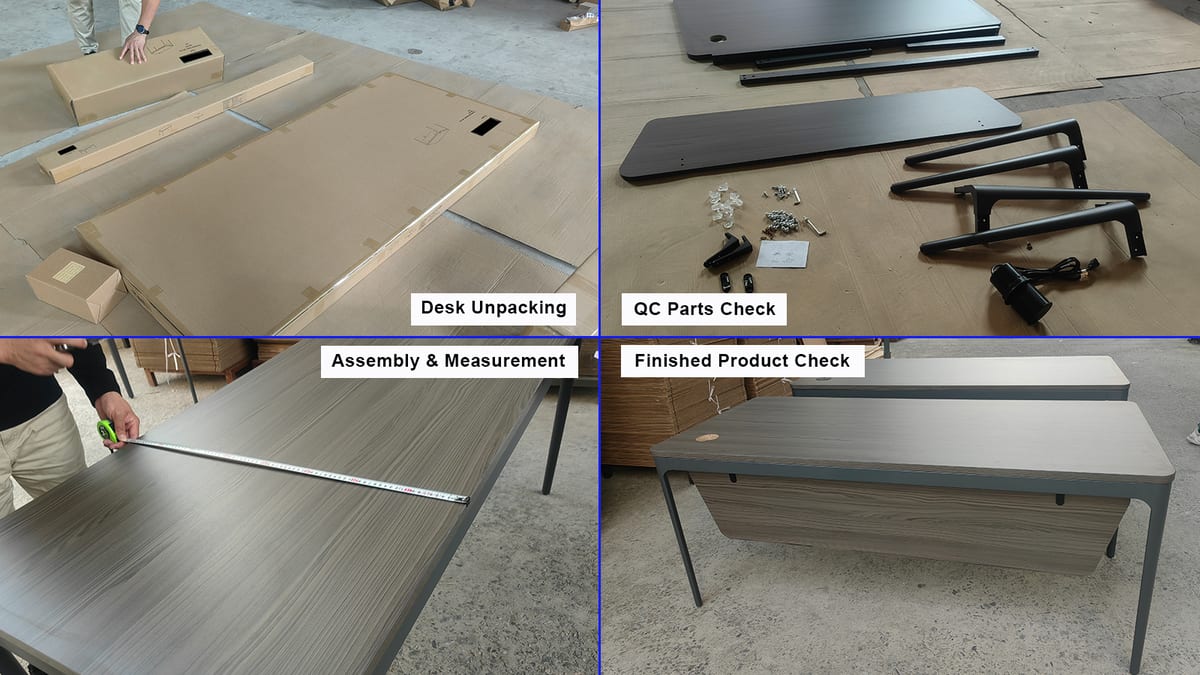
At Xusheng, checks begin with incoming boards, metal components and hardware and continue through cutting, edge banding, drilling, trial assembly, finished inspection, packaging and loading.
One particularly useful step is trial assembly.
We randomly select finished products that have already been packed, unpack them and assemble them in the same condition in which the dealer will receive them.
This makes it possible to check not only the furniture, but also the packaging, identification, customer branding, protective materials, accessories, hardware and assembly components.
If one package shows a problem, additional products of the same model can be inspected to determine whether it is an isolated issue or a repeated one.
This work does not make the desk look better in a quotation sheet.
Its purpose is to reduce the chance that the dealer discovers the problem after the container has arrived.
A quality-control cost paid at the factory can be much cheaper than a quality problem discovered in the dealer's market.
For a broader supplier assessment beyond price, continue with How to Choose an Office Furniture Manufacturer in China: What Commercial Buyers Should Verify Before Placing an Order.
[How to choose an office furniture manufacturer in China: what commercial buyers should verify before placing an order — EXISTING XUSHENG ARTICLE]
11. Sample Quality Is Only Useful If Bulk Production Follows It
A dealer may receive an excellent sample.
The commercial question is whether the next 300 units use the same agreed board, frame, hardware, finish, dimensions and structure.
We describe this as Sample-to-Bulk Consistency:
Sample-to-Bulk Consistency is the degree to which mass-produced furniture follows the approved sample in materials, dimensions, finish, structure, hardware and assembly.
A perfect sample has little commercial value if bulk production quietly moves to another specification.
When evaluating a supplier, therefore, do not ask only:
“Can you make this sample?”
Ask:
“How will you make sure the bulk order follows it?”
That question tells you far more about the manufacturing system behind the quotation.
12. A Lower Price Is Not Automatically a Bad Decision
There is nothing wrong with buying the cheaper office desk.
For some markets, the lower-priced specification may be exactly right.
A dealer supplying entry-level commercial offices may not need the same specification as a dealer working on corporate headquarters, government projects or higher-value executive spaces.
The mistake is not choosing the cheaper product.
The mistake is choosing it without knowing why it is cheaper.
If a supplier reduces cost through efficient structural design, an appropriate thinner panel, simpler non-critical details, different but suitable hardware, optimised dimensions, better material utilisation or more efficient packaging, that can be good value engineering.
If the saving comes from reducing a critical structural specification, changing agreed hardware without disclosure or removing necessary packaging protection, the commercial result is very different.
So instead of asking:
Which supplier has the lowest price?
ask:
What specification produces this price, and is that specification right for my market?
13. Use a Like-for-Like Quotation Comparison Before Choosing a Supplier

When a dealer receives quotations from three to five suppliers, the first comparison is often:
Supplier A — USD 68
Supplier B — USD 76
Supplier C — USD 89
Those numbers are useful, but they do not yet tell you which supplier offers the best commercial value.
Before comparing the final price, ask each supplier to provide the same specification information.
Office Desk Like-for-Like Quotation Comparison Template
Comparison Item | Supplier A | Supplier B | Supplier C | Why Dealers Should Check It |
|---|---|---|---|---|
Quoted Price | USD 68/set | USD 76/set | USD 89/set | Record price first, but do not make the decision from this number alone. |
Board Grade / Type | E1 MFC | E1 MFC | E1 MFC | Confirms whether suppliers are quoting the same basic panel specification. |
Desktop Thickness | 18 mm | 25 mm | 25 mm | Different thicknesses change material cost and may affect structural performance. |
Other Panel Thickness | 15 mm | 16 mm | 18 mm | Reveals material differences that photographs may not show. |
Edge Banding | 0.8 mm PVC | 1.5 mm PVC | 2 mm PVC | Helps compare edge protection, finishing requirements and manufacturing cost. |
Steel Profile | 50 × 50 mm | 60 × 60 mm | 60 × 60 mm | External dimensions affect structure, appearance and material usage. |
Steel Wall Thickness | 0.8 mm | 1.2 mm | 1.5 mm | Reveals one of the least visible differences in metal-frame desks. |
Surface Treatment | Powder coated | Powder coated | Powder coated | Similar descriptions still require confirmation of finish and consistency. |
Drawer Runners | Basic runners | 3-section runners | 3-section runners | Hardware affects function, durability and replacement cost. |
Cable Management | Cable grommet | Basic cable box | Aluminium cable box | Different accessories can materially affect larger quotations. |
Mobile Pedestal | Optional | Included | Included | Confirms whether the same furniture components are included. |
Packaging | Standard carton | Export carton + protection | Reinforced export packing | Packaging affects shipping-damage risk as well as factory cost. |
Shipping Structure | KD | KD | KD | Helps evaluate assembly and container efficiency. |
CBM / Set | —— | —— | —— | Shows how much container space each sellable unit requires. |
40HQ Loading Qty. | ___ sets | ___ sets | ___ sets | Helps compare freight cost per sellable unit. |
Sample Specification Recorded | Yes / No | Yes / No | Yes / No | Shows whether the approved sample can become a reference for bulk production. |
Trial Assembly / QC | Yes / No | Yes / No | Yes / No | Helps assess whether problems may be identified before shipment. |
Replacement Parts Support | Yes / No | Yes / No | Yes / No | Important if panels, fittings or hardware need replacement later. |
Replenishment Support | Yes / No | Yes / No | Yes / No | Helps determine whether the range can support repeat orders and expansion. |
Dealer Notes | —— | —— | —— | Record unclear specifications, exceptions and supplier commitments. |
The prices and specifications shown above are illustrative examples only. They do not represent actual quotations from Xusheng or other named manufacturers.
How to Use This Table
Ask each supplier to complete the same specification fields before comparing the final quotation.
Do not award extra points simply because a product uses thicker or more expensive materials.
The purpose is to identify:
what is different → why it is different → whether that difference matters in your market → what it does to the final dealer cost.
For example, if Supplier A quotes 0.8 mm steel and Supplier C quotes 1.5 mm steel, the conclusion should not automatically be:
Supplier C is better.
Instead ask:
Why does this structure require 1.5 mm steel?
and:
Can 1.2 mm achieve the required commercial performance for my application?
That changes the conversation from price comparison to specification evaluation.
A quotation comparison becomes meaningful only after the product specification becomes comparable.
14. Compare Dealer Cost, Not Only FOB Price
Once the specifications are comparable, move to the second level of the decision.
Consider a simplified example.
Supplier A may offer the lower FOB price but have a larger carton volume.
Supplier B may cost slightly more at the factory but fit more sellable units into the same container.
If a shipment costs USD 5,000 and:
● Supplier A loads 520 sets;
● Supplier B loads 620 sets;
the simplified freight allocation becomes approximately:
Supplier A: USD 5,000 ÷ 520 = USD 9.62 per set
Supplier B: USD 5,000 ÷ 620 = USD 8.06 per set
This example does not calculate the complete landed cost, but it demonstrates why FOB price alone can be misleading.
For a dealer, the broader model is:
Dealer Total Cost = Purchase Price + Freight + Import Costs + Inventory + Installation + After-Sales + Replacement + Replenishment Risk + Product Discontinuation Risk
Not every element can be predicted precisely.
The framework exists to prevent one visible number from hiding several less visible costs.
The lowest factory quotation does not necessarily produce the lowest dealer cost.
15. Add the Dealer's Own Market Decision
There is one more column that no Chinese manufacturer can fill in for you:
Best Fit for My Market.
After comparing the specification, price, logistics and supplier support, the dealer should make the final commercial judgement.
A simple decision sheet can look like this:|
Final Evaluation | Supplier A | Supplier B | Supplier C |
|---|---|---|---|
Specification Match | ★★★☆☆ | ★★★★☆ | ★★★★★ |
Price Competitiveness | ★★★★★ | ★★★★☆ | ★★★☆☆ |
Loading Efficiency | ★★★☆☆ | ★★★★★ | ★★★★☆ |
QC / Supply Support | ★★☆☆☆ | ★★★★☆ | ★★★★★ |
Best Fit for My Market | ☐ | ☐ | ☐ |
The dealer should complete these ratings, not the supplier.
Why?
Because there is no universal “best” office desk specification.
An entry-level dealer may correctly choose Supplier A.
A project-focused dealer may choose Supplier C.
Another market may find Supplier B offers the best balance between specification, price and logistics.
All three decisions could be commercially correct.
The wrong approach is assuming that three similar photographs mean the dealer is comparing three prices for the same product.

16. Then Look Beyond Today's Quotation
There is one question even a detailed quotation comparison cannot fully answer:
What happens after the first order?
A desk may have the right price and specification today, but a dealer also needs to consider installation, replacement parts, future stock and whether compatible furniture can be replenished when an existing customer expands.
This is particularly important for dealers building product ranges around repeat corporate business.
We examine this issue in Why Product Continuity Matters for Office Furniture Dealers.
[Why Product Continuity Matters for Office Furniture Dealers — EXISTING XUSHENG ARTICLE]
It explains what we call Replenishment Risk: the possibility that a dealer cannot obtain compatible products, finishes or components when an existing customer later needs replacements, additions or expansion.
A product that saves a few dollars today but cannot support tomorrow's customer requirement can become expensive in a completely different way.
A product can complete today's order. Product continuity helps protect tomorrow's business.
17. How Xusheng Approaches a Dealer's Target Price
Dealers sometimes come to us with a straightforward requirement:
“This desk works for my market, but I need the landed cost lower.”
A useful response is not simply:
“Our price cannot change.”
Nor should it be:
“We can make it cheaper.”
followed by hidden specification reductions.
Instead, we look at the complete product and purchasing structure.
Depending on the model and application, cost can sometimes be adjusted through:
● board configuration;
● dimensions;
● structure;
● hardware;
● non-critical features;
● product combinations;
● packaging;
● container planning.
The objective is to find a version that fits the dealer's local price band without unnecessarily reducing the basic standard required for commercial use.
There are also specifications we will not recommend.
If reaching a target price requires a material or structure that we believe is unsuitable for the intended application, the better solution is to explain the limitation and look for another way to reduce cost.
We can engineer a product towards a target price, but we will not quietly downgrade materials simply to win an order.
Cost optimisation and quality downgrade are not the same strategy.
18. The Five-Minute Quotation Test
If you have several office furniture quotations open in front of you, ask five questions before choosing one.
1. Are the material specifications actually the same?
Check the board, thickness, steel, hardware, finish and edge treatment.
2. Are the structures actually comparable?
Do not judge from external appearance alone.
3. Does each quotation include the same accessories and packaging?
A different cable box, pedestal, fitting or packing method can materially change the price.
4. How does the product affect freight and container utilisation?
Compare cost per sellable unit, not only FOB price.
5. Can the supplier reproduce and support the agreed specification?
Consider bulk consistency, QC, replacement parts and future replenishment.
If you cannot answer these five questions, you are probably not yet comparing prices.
You are comparing numbers.
19. The Better Question Is Not “Why Are You More Expensive?”
When a supplier's quotation is higher, ask:
Which specifications are different?
When another supplier's quotation is lower, ask exactly the same question.
Sometimes the lower quotation will reveal a smarter structure or more efficient production method.
Sometimes it will reveal a reduced specification.
Sometimes the higher quotation will contain necessary commercial performance.
Sometimes it will contain unnecessary cost that can safely be removed.
A professional like-for-like comparison should make those differences visible.
For dealers, this is the real purpose of quotation comparison:
Do not pay more simply because a supplier says its furniture is better. Do not pay less until you understand what has changed.
Price comparison is only one part of the sourcing decision.
Supplier capability, QC, MOQ, packaging, logistics, after-sales and long-term replenishment all affect whether the final decision works commercially.
For the complete sourcing framework, continue with Sourcing Office Furniture from China: The Complete Guide for Dealers.
[Sourcing Office Furniture from China: The Complete Guide for Dealers — EXISTING PILLAR PAGE]
Comparing Several Office Furniture Quotations?
If you already have quotations from several suppliers and the products look similar but the prices do not, send us the product images, dimensions and specifications you are comparing.
Rather than comparing the headline price alone, Xusheng can help break the requirement down by board, steel frame, hardware, structure, packaging and loading so that you can see whether the quotations are genuinely like-for-like.
Primary CTA:
Discuss Your Sourcing Plan
Secondary CTA:
Explore Xusheng Furniture Systems
Frequently Asked Questions
Why can two office desks that look the same have different prices?
Because appearance does not reveal the complete manufacturing specification. Board thickness, steel wall thickness, edge banding, hardware, surface treatment, structure, packaging and quality-control requirements can all affect factory cost.
Does a higher office desk price always mean better quality?
No. Higher price alone does not prove better quality. Dealers should compare specifications like-for-like and determine whether the additional cost provides performance their market actually needs.
Is a thicker desktop always better?
No. Appropriate thickness depends on the desk structure, dimensions, support and intended application. Increasing material without an engineering reason can add unnecessary cost.
What should dealers compare in an office furniture quotation?
At minimum, compare board grade and thickness, edge banding, steel profile and wall thickness, hardware, surface treatment, structure, accessories, packaging, CBM, loading efficiency and the supplier's quality-control process.
What is a like-for-like office furniture quotation comparison?
It means comparing suppliers using equivalent dimensions, materials, thicknesses, hardware, structural requirements, finishes, packaging and other commercial specifications before deciding which price is genuinely more competitive.
Should dealers always avoid the cheapest office furniture supplier?
No. A lower quotation can represent good value if the specification is suitable and the saving comes from efficient design, production, material utilisation or packing. The risk arises when important specifications are reduced without the buyer understanding the change.
Why should CBM and 40HQ loading quantity be compared?
Because two desks with similar FOB prices may use different amounts of container space. Better packing and KD efficiency can reduce freight cost per sellable unit.
How many office furniture quotations should a dealer compare?
There is no fixed number, but comparing three to five serious suppliers is often enough to reveal meaningful differences in specification, price, packaging and supplier support without making the evaluation unnecessarily complicated.
Looking for a supplier?
Need a product, sample, or project quote?
Use the catalog to choose products, then send the list for manufacturing, dealer, OEM / ODM, or project support.