
How New Office Furniture Dealers Should Test Their First Order
Learn how new office furniture dealers can test products, suppliers and market demand through samples, trial orders and QC before committing to larger orders.

How New Office Furniture Dealers Should Test Their First Order
Choosing products for a first office furniture order is relatively easy.
Choosing how much trust to place in a new supplier is much harder.
A new dealer may find a desk collection that looks right, receive an attractive quotation and have a positive conversation with the manufacturer. But none of those things proves what will happen when the order moves into production.
Will the actual finish match the catalogue?
Will the sample specification be repeated in bulk?
Will the cartons contain the correct fittings?
Will the furniture assemble properly after shipment?
Will the supplier respond properly when something goes wrong?
And if the products sell, can they be reordered?
For a new office furniture dealer, the first order should therefore do more than purchase stock.
The first order should validate the supplier, the product and the market at the same time.
That does not necessarily mean starting with the smallest possible order.
It means increasing commitment as evidence increases.
At Xusheng, a practical starting path for new dealer relationships often looks like this:
Catalogue → Real Product Evidence → Material Samples → Product Sample → Small Trial Order → Bulk Order → Replenishment
We call this the Dealer First-Order Validation Framework.
Its purpose is simple:
Do not make a full-container decision using catalogue-level evidence.
1. Your First Order Is Really Testing Three Things
New dealers often think the first order is mainly a product test.
It is actually three tests happening at the same time.
Product Validation
Is the product suitable for the dealer’s target market?
This includes:
● design;
● dimensions;
● finish;
● material specification;
● structure;
● assembly;
● packaging;
● target price.
Supplier Validation
Can the manufacturer consistently deliver what was agreed?
This includes:
● communication;
● specification control;
● sample accuracy;
● production consistency;
● QC;
● packaging;
● lead-time management;
● problem solving.
Market Validation
Will the product actually sell in the dealer’s market?
A technically good product can still be a poor first-order choice if the design, price point, size or configuration does not suit local customers.
This distinction matters.
A dealer should not use a large inventory commitment to answer questions that could have been answered earlier and more cheaply.
The purpose of a first order is not to prove that you trust the supplier. It is to collect enough evidence to decide how much you should trust them next.
2. Stage One: Start With the Catalogue — But Do Not Stop There
The catalogue is useful for one thing:
shortlisting.
It allows a dealer to understand the manufacturer’s product direction and identify potentially relevant categories.
For example:
● executive desks;
● manager desks;
● modular workstations;
● meeting tables;
● storage;
● reception furniture;
● office chairs.
But a catalogue should not be treated as proof of manufacturing capability.
A polished render does not tell you:
● how the edge banding actually looks;
● how stable the frame feels;
● what the board surface looks like in daylight;
● how the drawers operate;
● how the cable box is fitted;
● how the product is packed;
● whether the supplier has produced that model recently.
For that reason, the first stage should answer:
Does this supplier appear to have products relevant to my market?
Not:
Can I trust this supplier with a container?
Those are very different decisions.
3. Stage Two: Ask for Real Product Evidence

Once you have shortlisted several models, move beyond catalogue images.
Ask the supplier for real evidence of the products you are considering.
Useful evidence may include:
● current product photographs;
● product videos;
● close-ups of edge finishing;
● frame and connection details;
● drawer and hardware operation;
● cable-management details;
● assembly videos;
● packaging photographs;
● recent production photographs where available.
The purpose is not to ask the factory to produce hundreds of random photos.
It is to answer a specific question:
Does the real product correspond with the product I am considering buying?
If you are interested in a particular workstation, ask to see that workstation or a closely related structure.
If you are evaluating an executive desk, focus on the desktop, frame, cabinet, hardware, cable management and assembly.
This step can eliminate unsuitable products before the dealer spends money on international samples.
It also begins testing the supplier itself.
Can they identify the correct model?
Can they explain its specification?
Can they show details rather than only promotional images?
Can they answer technical questions clearly?
A supplier that cannot explain the product before the order may not become easier to work with after the deposit is paid.
4. Stage Three: Test the Materials Before Shipping Furniture
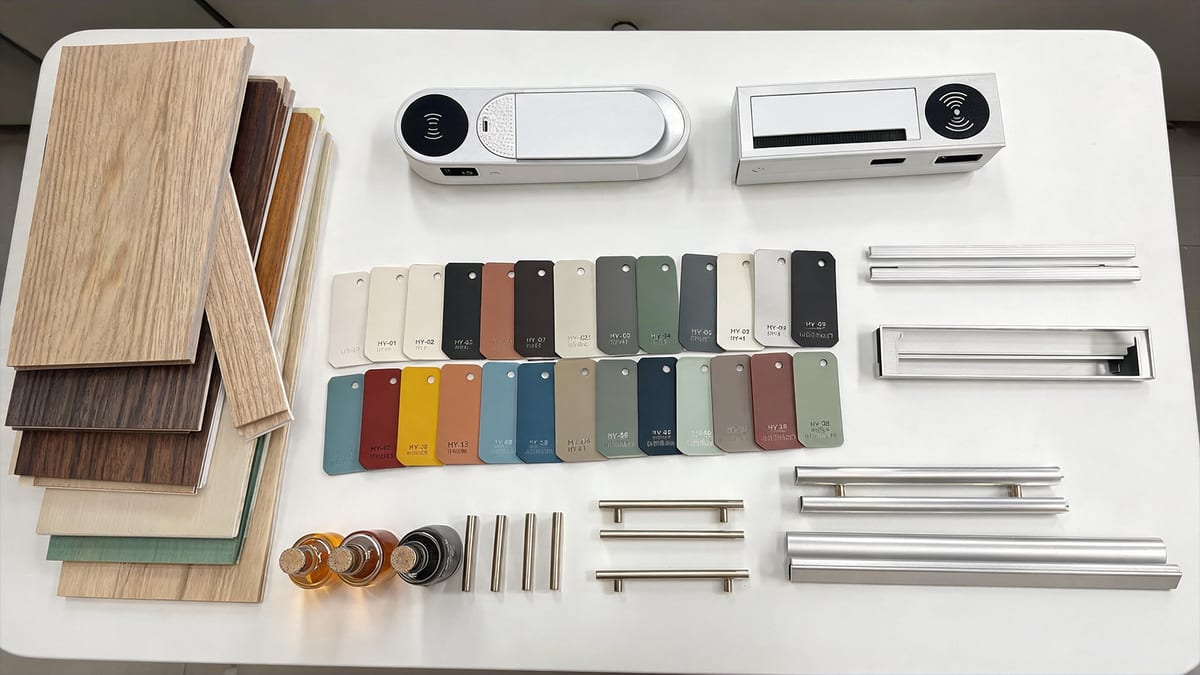
For many office furniture products, the next validation step does not need to be a complete desk.
Small material samples can answer important questions at relatively low cost.
At Xusheng, new dealers can discuss samples such as:
● board colour cards;
● decorative finish samples;
● fabric cards;
● screen materials;
● selected hardware samples.
This is particularly useful when the dealer is choosing colours for a local collection.
A finish viewed on a monitor can change because of photography, lighting and screen settings.
A physical board sample allows the dealer to evaluate:
● colour;
● grain;
● surface texture;
● gloss level;
● compatibility with other finishes.
Hardware samples can also help when a component is commercially important to the range.
This stage is especially useful for dealers developing a private-label collection, because the selected finish may later appear across desks, workstations, meeting tables and storage.
A small material decision can become a large inventory decision once the same finish is applied across an entire furniture system.
That is why material confirmation should happen early.
5. Stage Four: Order a Product Sample With a Clear Test Plan
A sample should not simply answer:
“Do I like this desk?”
It should answer a defined set of commercial questions.
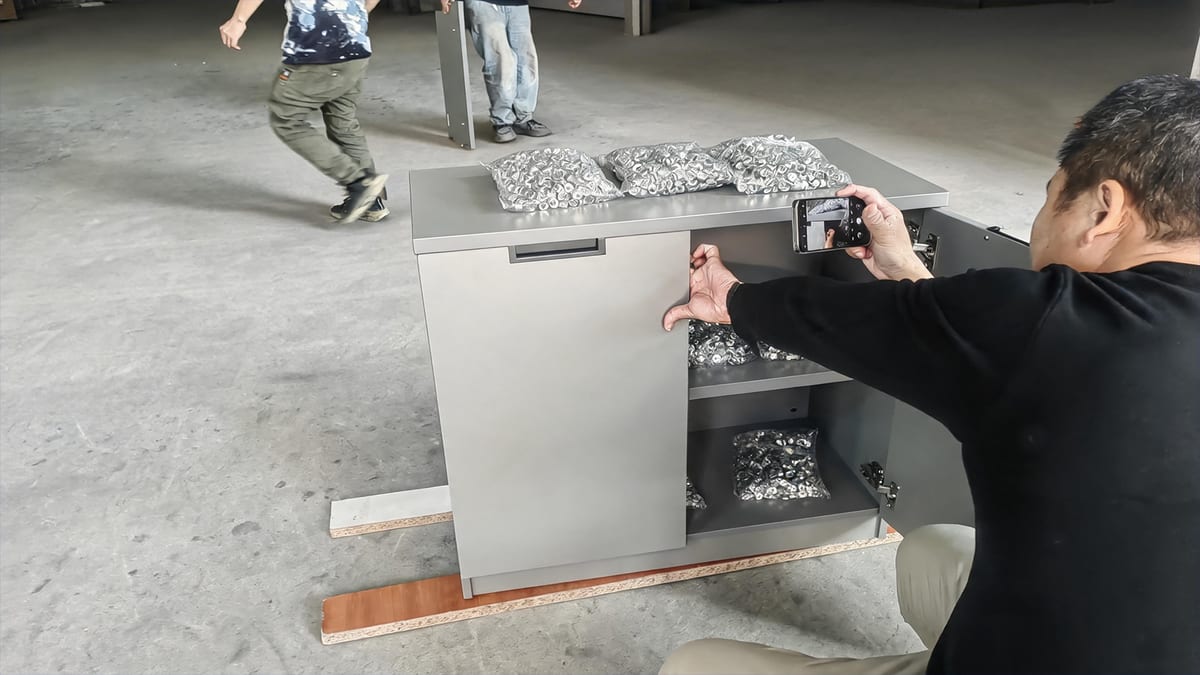
Before ordering the sample, decide what you need to validate.
For an office desk, that might include:
Materials
Does the board match the agreed grade, thickness, colour and finish?
Dimensions
Does the finished product match the confirmed drawing and required local dimensions?
Structure
Does the frame feel appropriate for the intended commercial use?
Edge Finishing
Are the edges clean, consistent and properly finished?
Hardware
Do drawers, locks, hinges, connectors and cable-management components operate as expected?
Assembly
Can the product be assembled clearly and efficiently using the supplied parts and instructions?
Appearance
Does the real product have the same overall commercial positioning as the images used to select it?
Packaging
Can the product survive export handling without excessive damage risk?
The sample should become a reference, not merely a demonstration piece.
Once it is approved, record the important specification.
That can include:
● product model;
● dimensions;
● board specification;
● finish/colour;
● edge banding;
● frame specification;
● hardware;
● accessories;
● packaging;
● agreed modifications.
This creates the basis for the next question:
Can the supplier reproduce what I have just approved?
6. Do Not Test Only the Best-Looking Product
One common first-order mistake is choosing only the supplier’s flagship product for sampling.
That can give the dealer an incomplete picture.
If your intended range includes:
Executive Desk + Workstation + Meeting Table + Storage
you do not necessarily need a full sample of every SKU.
But your validation should cover the important structural differences within the range.
For example:
● one representative desk;
● one workstation configuration;
● one storage item;
● key finish and hardware samples.
Why?
Because a good executive desk sample does not automatically prove that a four-person workstation packs efficiently.
A good workstation does not automatically prove that filing cabinets have suitable hardware.
The goal is to test the commercial system you intend to sell, not simply the easiest product for the supplier to present.
7. A Sample Tests the Product; a Trial Order Tests the Supplier
This is where the first-order strategy becomes more important.
A manufacturer can give considerable attention to one sample.
Bulk production is different.
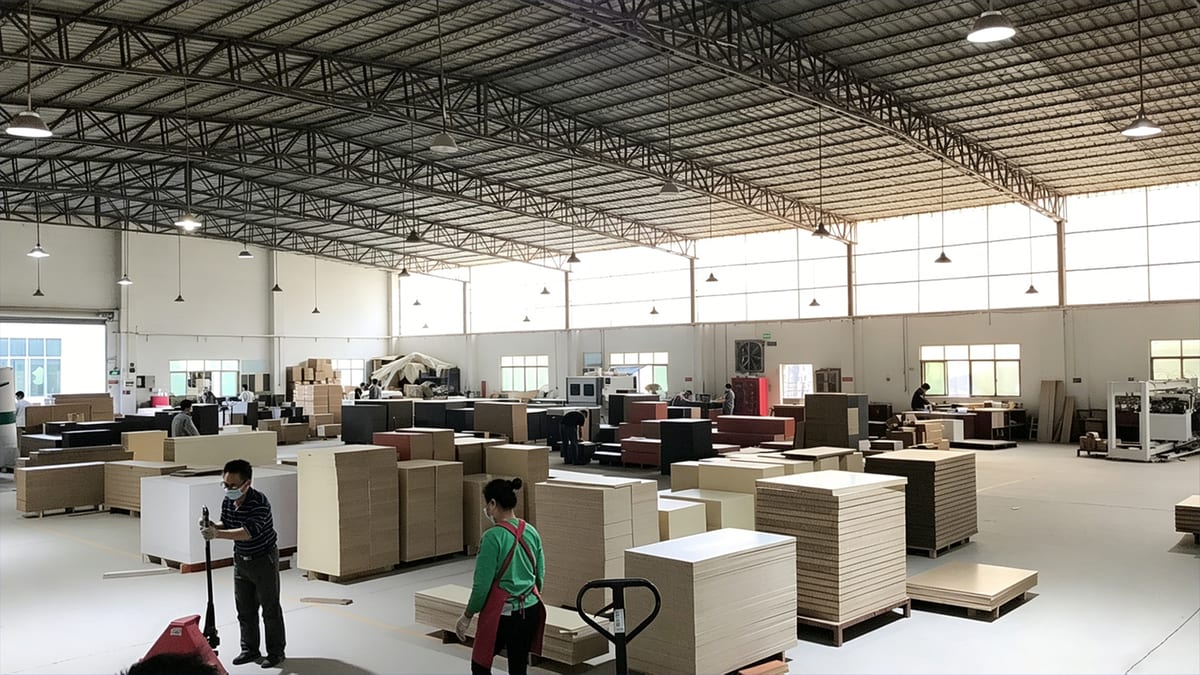
It involves:
● repeated material preparation;
● production scheduling;
● multiple panels;
● hardware quantities;
● repeated machining;
● packaging;
● labelling;
● order coordination;
● QC across multiple units.
That is why an excellent sample does not automatically prove bulk-production consistency.
We describe the next requirement as Sample-to-Bulk Consistency:
Sample-to-Bulk Consistency is the degree to which mass-produced furniture follows the approved sample in materials, dimensions, finish, structure, hardware and assembly.
The sample asks:
Can you make this product correctly once?
The trial order asks:
Can you repeat it correctly?
That is a much more useful supplier test.
8. When Should a Dealer Use a Small Trial Order?
A small trial order can be useful when:
● the supplier is completely new to you;
● you are entering a new product category;
● the product is being customised;
● the local market is uncertain;
● you want to test several models;
● you do not yet have enough sales data for a larger inventory commitment.
However, “small” does not mean one universal quantity.
Office furniture MOQ depends on the model, material, dimensions and manufacturing requirements.
At Xusheng, MOQ is confirmed by model in the quotation. Around 30 units may be common for some products, but it should not be treated as a universal MOQ across every category.
A dealer may also combine different product categories where the applicable MOQ for each selected model is met.
The objective is not:
Order as little as possible.
It is:
Commit enough to test the business without creating unnecessary inventory exposure.
9. New Dealers Should Test a Product Mix, Not Build a Random Container
Another common mistake is assuming that a first container should contain as many different models as possible.
More variety can feel safer because the dealer is “testing the market”.
But excessive variety creates another problem:
too little meaningful stock of anything.
It can also reduce loading efficiency and make replenishment analysis more difficult.
A better approach is to build the first order around a deliberate product logic.
For example:
Core Product
A desk or workstation expected to generate regular sales.
Supporting Products
Storage, mobile pedestals or meeting furniture that extend the core product into a usable collection.
Test Products
A limited number of additional models used to evaluate new price points or design directions.
This gives the dealer both:
depth in the products most likely to sell
and
controlled experimentation in products that still need validation.
For a new dealer, the first container should not look like a random catalogue sample.
It should look like the beginning of a product range.
Xusheng already discusses this broader product-selection question in What Office Furniture Products Should New Dealers Import from China?
[What Office Furniture Products Should New Dealers Import from China? — EXISTING XUSHENG ARTICLE]
10. Use the Trial Order to Test the Factory’s QC System
A trial order gives the dealer an opportunity to see how the supplier manages production beyond a single sample.
At Xusheng, our checks cover the order from incoming materials through production, trial assembly, finished-product inspection, packaging and loading.
For example, incoming boards can be checked for specification, thickness, finish and other relevant requirements before processing.
During cutting, edge banding and drilling, production should follow the confirmed order information and drawings.
One particularly useful step occurs after finished products have already been packed.
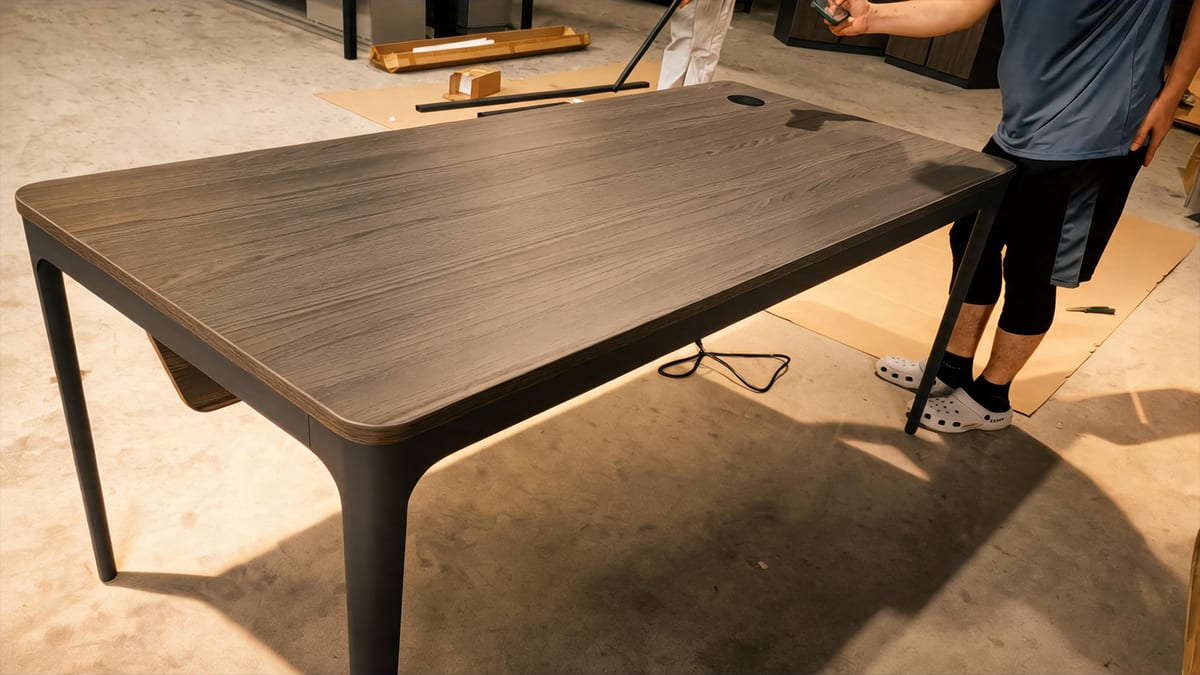
We randomly select finished packages, open them and assemble the products again in the condition in which the dealer will receive them.
This can reveal problems involving:
● missing hardware;
● incorrect components;
● hole positions;
● identification;
● packaging;
● assembly;
● product dimensions.
If a problem appears in one package, additional units of the same model can be checked to determine whether it is isolated or repeated.
The principle is simple:
The dealer should not be the first person to discover whether the furniture can be assembled from the carton.
For a broader look at factory evaluation and manufacturing verification, see How to Choose an Office Furniture Manufacturer in China: What Commercial Buyers Should Verify Before Placing an Order.
[How to Choose an Office Furniture Manufacturer in China: What Commercial Buyers Should Verify Before Placing an Order — EXISTING XUSHENG ARTICLE]
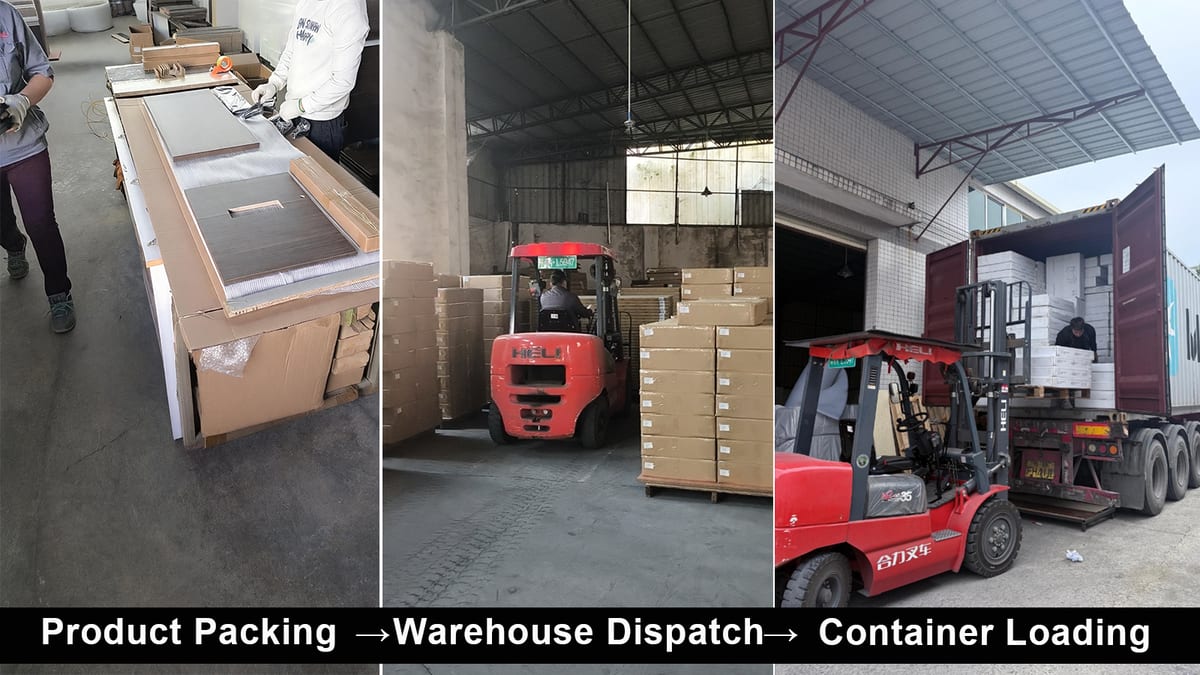
11. Check the Packaging as Carefully as the Furniture
For imported furniture, packaging is part of product performance.
The dealer should check:
● carton strength;
● internal protection;
● corner protection;
● separation between panels;
● hardware packaging;
● product labels;
● carton identification;
● shipping marks;
● installation information.
This is particularly important for KD office furniture.
A product can leave the production line in perfect condition and still create a dealer problem if:
● panels rub together during transport;
● fittings are missing;
● cartons are difficult to identify;
● similar components are mixed;
● installers cannot determine which parts belong together.
For new dealer relationships, packaging should therefore be included in the approval process rather than left until the final days before loading.
12. Test Communication Before You Test Delivery Speed
New buyers understandably ask:
How fast can you deliver?
But during the first order, communication quality is often a more useful supplier signal than an unusually aggressive lead-time promise.
Pay attention to what happens when:
● a specification changes;
● a drawing needs confirmation;
● a colour is unclear;
● a component is unavailable;
● a production issue appears;
● you ask for an update.
Does the supplier hide uncertainty or explain it?
Does it confirm changes in writing?
Does it ask before making a substitution?
Does it provide production information when required?
At Xusheng, a standard commercial order is generally planned at around 45 days after final confirmation, while certain orders may be accelerated to around 30 days depending on the product and production conditions.
But a realistic 45-day commitment is more useful than an unrealistic 25-day promise that later becomes 50 days.
A reliable lead time is more valuable than an impressive lead time that cannot be maintained.
The first order should therefore test not only speed, but predictability.
13. Do Not Use the First Order to Test Too Many Unknowns at Once
Imagine a new dealer chooses:
● a new supplier;
● a completely new product;
● a custom structure;
● a new finish;
● private-label packaging;
● several non-standard dimensions;
● a very low target price;
● an urgent delivery schedule.
Every individual requirement may be possible.
But together they create a first order with too many variables.
If something goes wrong, it becomes difficult to identify the cause.
Was the product wrong?
Was the custom structure wrong?
Was the material unsuitable?
Was production rushed?
Was the price target unrealistic?
For the first transaction with a new manufacturer, controlled complexity is usually more useful than maximum customisation.
Start by validating the supplier’s established production capability.
Then expand customisation as both sides build experience.
This is particularly important for dealers planning to develop their own brand.
Private label should become a long-term programme, not simply a logo added to an untested product. Xusheng Private Label Office Furniture Manufacturer in China guide explains how sampling, branding, MOQ, mixed-container planning and future range expansion fit together.
[Why Product Continuity Matters for Office Furniture Dealers — EXISTING XUSHENG ARTICLE]
14. Build a First-Order Validation Scorecard
Before increasing the next order, evaluate what actually happened.
A simple scorecard can help prevent a positive sales relationship from hiding operational weaknesses.
Dealer First-Order Validation Scorecard
Validation Area | What to Check | Result | Why It Matters |
|---|---|---|---|
Product Match | Real product matches approved specification | Pass / Review / Fail | Confirms whether what you ordered is what you received |
Finish & Colour | Approved colour/finish reproduced correctly | Pass / Review / Fail | Important for showroom and future matching |
Dimensions | Key dimensions follow approved drawing | Pass / Review / Fail | Affects installation and project use |
Structure | Product feels appropriate for intended commercial application | Pass / Review / Fail | Tests practical product suitability |
Hardware | Correct hardware supplied and operates properly | Pass / Review / Fail | Reduces installation and after-sales issues |
Assembly | Product assembles correctly from supplied parts | Pass / Review / Fail | Tests real dealer/installer experience |
Packaging | Product arrives adequately protected | Pass / Review / Fail | Tests export readiness |
Labelling | Cartons and parts can be identified easily | Pass / Review / Fail | Important for warehouse and installation |
Sample-to-Bulk Consistency | Bulk follows approved sample/specification | Pass / Review / Fail | Tests production repeatability |
Communication | Changes and issues handled clearly | Pass / Review / Fail | Tests supplier reliability |
Lead-Time Reliability | Actual delivery broadly follows confirmed plan | Pass / Review / Fail | Helps future inventory planning |
Problem Resolution | Supplier responds appropriately to confirmed issues | Pass / Review / Fail | Tests relationship after payment |
Market Response | Product sells at intended positioning | Strong / Mixed / Weak | Tests the dealer’s product decision |
Reorder Potential | Product is worth replenishing | Yes / Review / No | Determines whether it should become a core SKU |
How to Use the Scorecard
The objective is not to demand perfection from the first transaction.
It is to separate three outcomes:
1. Supplier problem
The agreed specification was not followed.
2. Product problem
The product itself does not perform as required.
3. Market problem
The product is correctly made but does not fit local demand.
Those require completely different decisions.
Without this distinction, a dealer may replace a good supplier because the wrong product was selected — or keep a poor supplier because the product happened to sell.
A first-order test is useful only when you know what the result is actually testing.
15. Test What Happens When Something Goes Wrong
This may sound counter-intuitive, but a first order with one small problem can sometimes reveal more about a supplier than a completely problem-free sample.
The important question is:
What does the supplier do next?
For confirmed product issues, Xusheng’s normal process begins with the dealer providing photographs or video so the problem can be identified.
We then check the original order and production information, confirm the affected parts or quantities and determine an appropriate solution.
Where replacement panels, components or products are required for a confirmed product issue, replacement production can be arranged according to the circumstances of the order.
The principle is to address the product problem first and then deal with any wider commercial impact appropriately.
For a dealer evaluating a new supplier, watch for:
● speed of acknowledgement;
● willingness to investigate;
● clarity of responsibility;
● practical replacement solution;
● communication until resolution.
A supplier relationship is not fully tested when everything is easy.
It is tested when something requires ownership.
16. The First Reorder Is a Different Test From the First Order
Many buyers consider the supplier validated once the first shipment arrives successfully.
For a dealer, there is another important test:
Can the supplier support the second order?
The first order tests execution.
The reorder begins testing continuity.
Can you obtain:
● the same finish;
● the same dimensions;
● compatible hardware;
● replacement parts;
● additional configurations;
● matching storage;
● related meeting furniture?
This becomes increasingly important once the dealer has invested in:
● showroom displays;
● photography;
● catalogues;
● online listings;
● sales training;
● customer relationships.
If a product performs well in the market, the dealer should be able to build on that success rather than restart sourcing from zero.
This is why our first-order framework does not end at:
Bulk Order
It ends at:
Replenishment
For a deeper explanation of this risk, read Why Product Continuity Matters for Office Furniture Dealers.
[Sourcing Office Furniture from China: The Complete Guide for Dealers — EXISTING XUSHENG ARTICLE]
17. When Should You Move to a Full Container?
There is no universal point at which every new dealer should move from samples or trial quantities to a 20GP or 40HQ order.
The decision should depend on evidence.
A larger commitment becomes more reasonable when:
● the real products have been verified;
● materials and finishes are approved;
● representative samples have performed well;
● specifications are documented;
● the supplier has demonstrated acceptable communication;
● packaging has been reviewed;
● the product fits the dealer’s market;
● quantities can be planned without excessive inventory risk;
● the dealer has a clear replenishment strategy.
A full container should therefore be the result of increasing confidence.
Not the method used to discover whether confidence was justified.
Commitment should increase as evidence increases.
18. A Practical First-Order Path for New Dealers
The complete process can be summarised like this:
Stage | What You Are Testing | Dealer Decision |
|---|---|---|
1.Catalogue | Product relevance | Is this range worth investigating? |
2.Real Product Evidence | Product reality + supplier knowledge | Does the real product justify further evaluation? |
3.Material Samples | Colours, finishes, materials | Are these suitable for my market? |
4.Product Sample | Physical product quality | Does the product meet my requirements? |
5.Small Trial Order | Production repeatability + market response | Can the supplier repeat it and can I sell it? |
6.Bulk Order | Operational reliability | Can this become a scalable supply relationship? |
7.Replenishment | Supply continuity | Can I safely build a long-term range around it? |
Notice what changes at each stage.
The dealer is not simply ordering more furniture.
The dealer is answering a different business question.
That is why we recommend thinking about the process as progressive validation, rather than simply moving from a small order to a large one.
19.Red Flags Before Increasing Your Order
Before increasing your commitment, investigate further if:
● specifications remain vague;
● the supplier avoids confirming materials in writing;
● real product evidence does not match catalogue presentation;
● sample specifications are not documented;
● requested changes appear in the product without confirmation;
● the supplier repeatedly promises unrealistic lead times;
● packaging is treated as an afterthought;
● bulk specifications differ from the approved sample;
● quality issues are explained away rather than investigated;
● replacement support is unclear;
● future availability cannot be discussed realistically.
One red flag does not automatically mean the supplier should be rejected.
But unresolved uncertainty should not be rewarded with a larger commitment.
20.How Xusheng Approaches a New Dealer Relationship
When a new dealer contacts Xusheng, our first objective is not simply to send the largest catalogue possible.
We first try to understand:
● the dealer’s country and market;
● company type;
● sales channels;
● target customers;
● product categories;
● target price level;
● expected quantities;
● preferred dimensions and finishes;
● current best-selling products;
● project requirements where applicable;
● private-label requirements.
That information helps determine which products are actually relevant.
From there, the relationship can progress through product information, real product evidence, colour and material samples, physical product samples, trial quantities and larger orders according to the dealer’s situation.
Not every dealer needs exactly the same path.
An established importer with a clear specification and existing sales data may move faster.
A new dealer entering office furniture for the first time may need more product and market validation before committing inventory.
The principle remains the same:
The amount of purchasing commitment should match the amount of evidence available.
21.The First Container Should Be the Beginning, Not the Goal
It is easy to treat the first container as the milestone that proves a new supplier relationship has succeeded.
For a dealer, that is too early.
A better sequence is:
Sample → Trust → Range → Replenishment → Growth
The first shipment matters.
But the stronger sourcing decision is the one that still works when:
● the first stock begins to sell;
● a customer wants more;
● a project expands;
● another product category is needed;
● replacement parts are required;
● the dealer wants to build a larger range.
That is why a new dealer should not ask only:
“How can I place my first order?”
The better question is:
“How can I use my first order to decide whether this supplier deserves my second, fifth and tenth order?”
For the complete sourcing framework — including supplier verification, specifications, MOQ, QC, packaging, logistics, replenishment and long-term supplier selection — continue with Sourcing Office Furniture from China: The Complete Guide for Dealers.
[Private Label Office Furniture Manufacturer in China — EXISTING PILLAR PAGE]
Planning Your First Office Furniture Order?
If you are evaluating Xusheng for the first time, you do not need to begin by selecting an entire container from our catalogue.
Tell us:
Your Market + Customer Type + Product Categories + Target Price Level + Expected Quantity + Preferred Finishes
We can then discuss suitable products, real product references, material samples, product samples, MOQ and a practical first-order product mix.
Primary CTA:
Discuss Your Sourcing Plan
Secondary CTA:
Explore Xusheng Furniture Systems
Frequently Asked Questions
Should a new office furniture dealer order a full container first?
Not necessarily. The appropriate starting quantity depends on the dealer’s market knowledge, product specification, MOQ, supplier experience and inventory strategy. New relationships can often be validated progressively through product evidence, material samples, physical samples and suitable trial quantities before a larger commitment.
What should I check in an office furniture sample?
Check materials, dimensions, finish, edge banding, structure, hardware, cable management, assembly, packaging and whether the product matches the agreed specification. The approved sample should then become a reference for bulk production.
Is one office desk sample enough to verify a furniture supplier?
It can verify important aspects of that desk, but it does not prove the supplier’s entire product range or bulk-production consistency. If your planned range contains structurally different products, validate representative products or critical components as well.
What is Sample-to-Bulk Consistency?
Sample-to-Bulk Consistency is the degree to which mass-produced furniture follows the approved sample in materials, dimensions, finish, structure, hardware and assembly.
What is a reasonable MOQ for a first office furniture order?
There is no universal MOQ. It varies by model, material, dimensions and manufacturing requirements. At Xusheng, MOQ is confirmed by model in the quotation; around 30 units may be common for some products, but this should not be treated as a standard for every product.
Can different office furniture products be mixed in one container?
Yes, mixed-product loading can be planned for suitable orders when the applicable MOQ for each selected model is met. Dealers should also consider carton dimensions and loading efficiency rather than maximising SKU count alone.
Should a new dealer customise products on the first order?
Some customisation can be appropriate, especially for dimensions, finishes or local market requirements. However, introducing too many untested variables at once can make first-order validation more difficult.
How do I know when a supplier is ready for a larger order?
Look for evidence: accurate samples, documented specifications, acceptable sample-to-bulk consistency, reliable communication, appropriate QC, suitable packaging, realistic delivery planning, market response and clear replacement/replenishment support.
What should happen after a successful first order?
Review product performance and customer feedback, identify successful SKU, evaluate the supplier’s execution, then plan replenishment and carefully expand the product range. The objective is to turn validated products into repeatable business rather than continuously restarting with unrelated products.
Looking for a supplier?
Need a product, sample, or project quote?
Use the catalog to choose products, then send the list for manufacturing, dealer, OEM / ODM, or project support.