
How to Verify an Office Furniture Factory in China Before Placing an Order
Learn how dealers can verify a Chinese office furniture factory through real orders, specifications, production, QC, packing, capacity, traceability and live inspection before committing to an order.
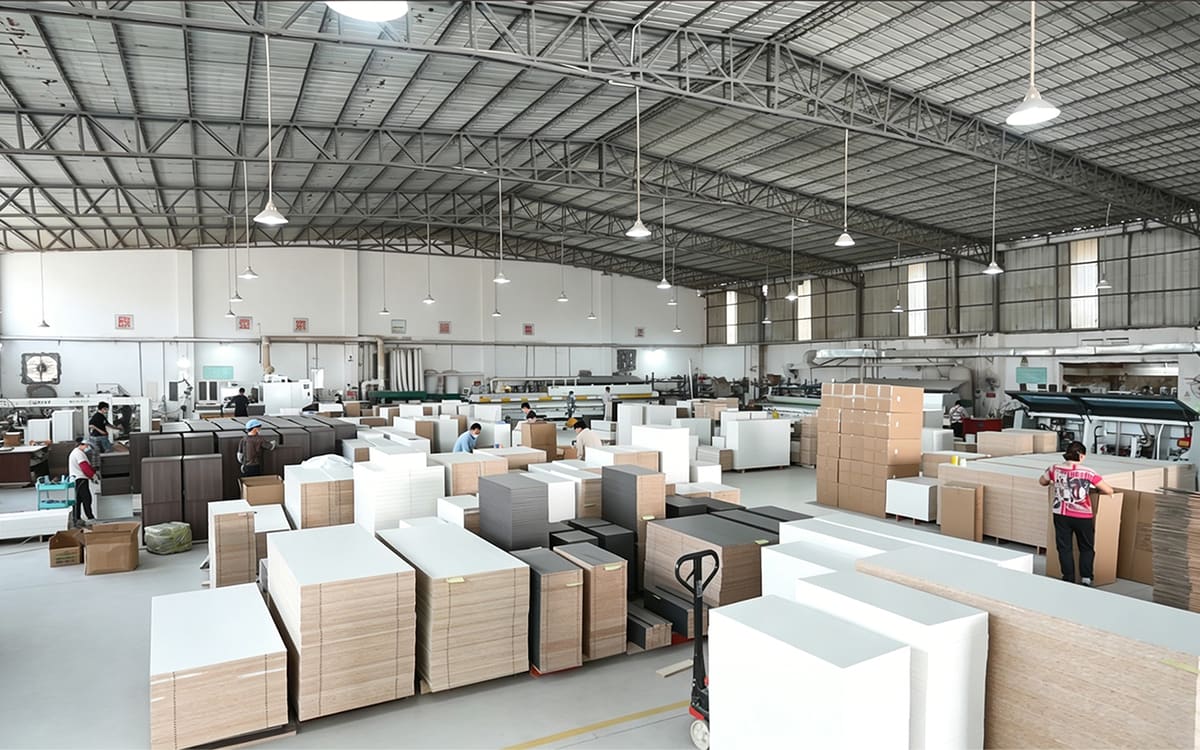
How to Verify an Office Furniture Factory in China Before Placing an Order
Finding an office furniture factory in China is not difficult. Verifying whether that factory can reliably handle your orders is a different matter.
For an overseas office furniture dealer, importer or project supplier, a factory visit should answer much more than one question:
“Is this a real factory?”
Machines, workers and a production building can prove that manufacturing takes place there. They do not necessarily prove that the supplier can control your specifications, maintain the same quality in bulk production, manage component suppliers, meet an agreed delivery date or reproduce the same furniture when you reorder it years later.
After working with overseas office furniture dealers and project buyers, we believe a more useful question is:
What does this factory actually control in my order?
That changes how you verify a supplier.
Instead of simply walking through a production line, follow your product through the business: from specifications and materials to production, QC, packing, shipment and future repeat orders.
This guide explains how office furniture dealers can do that before placing an order with a Chinese manufacturer.
1. Start by Verifying the Company, Not Just the Website
A professional website, large product catalogue and polished showroom are useful, but they should not be the end of your verification.
Before placing a meaningful order, establish who you are actually buying from.
You can request and cross-check documents such as:
● Business registration information
● ISO 9001
● ISO 14001
● FSC certification where applicable
● Product test reports
● Formaldehyde and material-related reports
● Structural or BIFMA-related testing where applicable
● Surface or scratch-resistance testing
● Edge-banding or material-related reports
● Export and shipment records
● Relevant supplier or material certificates
However, collecting PDF is not the objective.
Look at the company name on the document, what was tested or certified, the scope of the certification and whether the document is actually relevant to the furniture you intend to purchase.
A certificate should be treated as one piece of evidence, not as a substitute for verifying the actual manufacturing process.
2. Ask What the Factory Manufactures, Manages and Sources
One of the most useful questions during supplier verification is:
“Which parts of this product do you actually manufacture?”
The answer does not need to be “everything”.
Office furniture is a supply system. Boards, steel frames, hardware, edge banding, packaging, chairs and other components may come through different parts of that system.
What matters is whether the supplier understands and controls it.
At Xusheng, our core office furniture system covers products including executive desks, manager desks, workstations, panel desks, meeting and discussion tables, filing cabinets, mobile pedestals, reception desks, office partitions, coffee tables and storage.
Some metal components are produced at another factory within our manufacturing network. Other categories, such as office chairs and sofas, can be sourced through long-term specialist suppliers when a project requires them.
We therefore distinguish between three things:
What we manufacture. What we manage within our manufacturing network. What we source to complete a customer's office furniture solution.
Dealers should ask other potential suppliers to make the same distinction.
A supplier does not need to manufacture every screw, chair and metal component under one roof. But it should be able to tell you clearly where critical components come from, what specifications apply and who is responsible when something does not meet the approved requirement.
3. Do Not Just Tour the Factory — Follow a Real Order
A factory tour becomes much more useful when you stop looking only at machines.
Look at what is actually moving through them.
When visiting Xusheng, customers can see real orders being processed through different stages of production rather than only viewing a demonstration prepared for visitors.
Depending on the production schedule at the time of the visit, this can include:
Cutting → Edge Banding → Drilling → Trial Assembly → QC → Packing → Finished Goods Storage → Container Loading
Customers can also inspect material and component storage and see orders currently being prepared for shipment.
This matters because a machine only proves that the factory owns a machine.
A real order tells you much more.
Ask:
● What product is currently being produced?
● What specification is the factory following?
● How is the order identified?
● Where is quality checked?
● What happens if a component is wrong?
● How is the finished product matched back to the customer's order?
The objective is not simply to watch furniture being made.
It is to understand whether the factory has a repeatable system behind what you are seeing.
4. Take Your Own Order Specification onto the Production Floor
A desk can look correct and still be commercially different from what you ordered.
Two similar-looking office desks can use different board thicknesses, steel specifications, edge banding, hardware and construction methods. These differences can affect price, stability, durability and future replacement.
That is why visual inspection alone is not enough.
When verifying an order at Xusheng, a dealer can use the approved order information to check items such as:
● Board thickness
● Edge-banding thickness
● Desktop dimensions
● Overall dimensions
● Steel frame dimensions
● Steel thickness
● Colour and finish
● Hardware specification
● Drilling and hole positions
● Product structure and connection methods
● Packing specification
● Logo, label and private-label requirements
These can be compared directly against the order, drawing or previously confirmed specification.
This is an important principle when comparing office furniture that looks similar but is priced differently.
Do not ask only:
“Does this desk look like the sample?”
Ask:
“Is this the same specification we approved?”
5. Verify the Sample — Then Ask How Bulk Production Will Match It
A good sample is useful evidence, but it is not enough.
The bigger question is whether the supplier can reproduce that sample when the order changes from one piece to dozens or hundreds of pieces.
Before a first commercial order, dealers should verify:
● Materials
● Dimensions
● Colour
● Hardware
● Structure
● Assembly
● Stability
● Surface finish
● Packing method
Then ask how those specifications will be transferred into bulk production.
At Xusheng, customers can review real production orders, production processes, trial assembly, inspection records, finished packing and shipment evidence. Products can also be developed against customer specifications, drawings or samples.
For a new dealer, this is why a controlled sample or trial order can be much more useful than immediately discussing a large annual purchasing commitment.
How New Office Furniture Dealers Should Test Their First Office Furniture Order explains this next verification stage in more detail.
6. Watch the Product Being Assembled
Flat-packed furniture can hide problems surprisingly well.
A packed panel may look fine until holes do not align. A frame may look acceptable until the desk is assembled and becomes unstable. A cabinet door may only reveal alignment problems after installation.
That is why trial assembly is valuable evidence.
When possible, ask the factory to assemble the product while you are there.
Check:
● Hole alignment
● Connection points
● Hardware
● Stability
● Panel fit
● Door and drawer alignment
● Assembly logic
● Finished dimensions
For flat-packed commercial furniture, the ability to assemble correctly is part of the product specification.
A dealer should not discover an assembly problem for the first time after hundreds of cartons have arrived in another country.
7. Verify What QC Actually Does When It Finds a Problem
Almost every supplier will tell you that it has quality control.
A better question is:
“Show me what happens when QC finds something wrong.”
At Xusheng, quality checks can cover incoming materials, boards, hardware, edge banding, drilling, dimensions, trial assembly, finished products and packing. Inspection records and checklists are also part of the control process.
But the important part is what happens next.
Our principle is:
Identify → Record → Correct → Recheck → Release
If a product or component does not meet the requirement, it is corrected or replaced before moving to the next stage, and the issue is recorded.
We do not deliberately leave known problems until the end of production.
There is a practical reason for this. Correcting problems when they are found reduces the risk of forgetting them later and helps prevent avoidable shipment delays.
Recording the issue is equally important.
A quality record gives the team something to look for if the same problem appears again. Over time, this helps turn individual QC findings into production knowledge.
For a dealer, therefore, the question is not whether a factory claims to have QC.
Ask:
Can the factory show how a quality problem is identified, corrected, recorded and prevented from simply passing into the shipment?
8. Check the Packing Process, Not Just the Finished Furniture
For export furniture, manufacturing quality is only part of the job.
The product still has to survive handling, container loading, international transport, unloading and local installation.
During factory verification, inspect actual packed orders.
Look at:
● Carton construction
● Internal protection
● Edge and corner protection
● Component separation
● Hardware packing
● Product identification
● Labels and marks
● Private-label requirements
● Packing dimensions
At Xusheng, packing is also another human inspection point. If the packing team notices a product or component problem, it can be reported rather than simply sealed inside the carton.
Dealers can also inspect finished packed goods in the warehouse and observe container loading when it coincides with the visit.
The objective is simple:
Verify the product that will actually leave the factory—not only the furniture displayed in the showroom.
9. Verify the Supplier Behind the Supplier
Even when a factory manufactures the main furniture itself, it will still depend on other suppliers.
That makes supplier management part of factory verification.
Ask what happens if:
● A hardware supplier's quality declines
● A material supplier becomes unreliable
● A colour is discontinued
● A component is no longer available
● A supplier suddenly raises its price
● A replacement component does not exactly match the previous one
Xusheng works with relatively stable long-term suppliers for key materials and components. We do not change a critical supplier simply because another source offers a lower price.
If quality declines, corrective action is requested. If the problem remains unstable, the supplier can be replaced and the specification is checked again.
If an existing colour or hardware item is discontinued, we look for a compatible alternative or, where appropriate, an upgraded replacement.
A replacement should not simply change a dealer's established product without consideration of the approved specification.
Where an appropriate upgrade creates additional cost, Xusheng can absorb that cost rather than automatically reducing the specification of an established product.
This is where factory verification begins to connect directly with why product continuity matters for office furniture dealers.
The factory you select today may determine whether the product you sell today can still be supported several years from now.
10. Ask How the Factory Preserves Your Original Specification
For a dealer, the first order is only the beginning.
If a desk sells well, you may reorder it months later. If it becomes part of your standard range, you may still need matching products years later.
That raises another verification question:
What happens to my specification after the first shipment?
At Xusheng, historical order information is retained for repeat-order checking and traceability. Depending on the order, this can include:
● Original order information
● Dimensions and specifications
● Colours and materials
● Hardware and components
● Drawings and CAD information
● Packing specifications
● Logo and label requirements
● Private-label details
● Previous order records
If a material, colour or hardware item later becomes unavailable, those records provide a reference for finding the closest compatible or upgraded solution.
This does not mean that every material in the market will remain available forever.
It means there is a specification history against which a future change can be evaluated.
That difference is important.
Why Product Continuity Matters for Office Furniture Dealers explains why this becomes increasingly valuable as a dealer builds repeat business around a furniture range.
11. Do Not Verify Capacity with One Big Number
Dealers often ask factories:
“What is your monthly capacity?”
The answer can be useful, but it can also be misleading.
Producing 500 simple desks is not necessarily equivalent to producing 500 executive desks, workstations, cabinets or customized project configurations.
Product mix matters.
At Xusheng, we prefer to evaluate capacity against the actual order rather than use one headline monthly figure to answer every enquiry.
For a larger order or project, we consider:
● Product type
● Quantity
● Configuration
● Customization
● Current production schedule
● Required delivery date
● Packing requirements
● Shipment plan
We then assess whether the requested schedule is realistic.
Our standard lead time is generally around 45 days after the order details are confirmed, although some orders can be completed in around 30 days depending on the circumstances. Samples can be prioritized.
More importantly, if a requested delivery date is not realistically achievable, we would rather give a conservative estimate than promise it simply to secure the order.
For dealers, this suggests another useful verification question:
“How did you calculate whether my order can fit your production schedule?”
That answer can be more informative than a large monthly capacity figure.
12. Verify Container Planning as Part of Delivery Control
Factory verification should continue beyond production.
Ask how the supplier plans the shipment.
Xusheng can plan container loading according to the actual order mix, including both 20HQ and 40HQ shipments. Mixed-product containers are also possible, subject to the MOQ and order requirements of individual models.
Before loading, the combination of cartons and products can be assessed so that the available container space is used more effectively.
This matters particularly for dealers who are building a product range rather than importing one SKU.
A container may include desks, meeting tables, cabinets, mobile pedestals or other products serving different parts of the same office furniture system.
That is where product-based vs system-based office furniture sourcing can lead to very different purchasing decisions.
13.You Can Verify a Factory Without Flying to China
An in-person factory visit provides valuable information, but it is not the only verification method.
If travelling to China is not practical, request multiple forms of evidence.
At Xusheng, verification can include:
● Live factory video
● Factory photographs and videos
● Production equipment footage
● Real orders in production
● Production-process evidence
● Trial assembly
● QC records
● Finished packing
● Loading photographs or videos
● Third-party inspection
● Buyer-appointed inspection
Customers can also arrange independent organizations or their own representatives to inspect the factory or order.
The key word is live.
A polished factory video can introduce a manufacturer, but it cannot answer every verification question.
During a live video inspection, ask the salesperson to move between production areas, show an actual order, open a packed product where appropriate, show the relevant process and explain what is happening.
The purpose is not to catch the factory out.
It is to reduce uncertainty before you commit capital to an overseas supplier.
14. A Real Example: From Factory Verification to a 40HQ Order
A recent project customer from the Dominican Republic wanted to understand both our product quality and our manufacturing operation before committing to the order.
Based on the customer's requirements, Xusheng first prepared a sample.
When the customer visited, the verification did not stop at the showroom.
The customer reviewed the sample, visited the showroom, walked through the factory and looked at the packing process. On the production floor, the customer was also able to observe real production directly.
One particularly useful step was seeing the product unpacked and assembled on site.
That allowed the customer to look beyond a finished display product and see how the furniture was packed, constructed and assembled.
After the verification process, the customer placed a 40HQ order for the project.
That first order has now been completed. As it is still a recent project, it would be premature to describe it as a long-term partnership. We look forward to seeing whether it develops into further project cooperation.
The lesson for a new dealer is not that every factory visit should immediately result in a container order.
It is that a good verification process should progressively remove uncertainty:
Sample → Factory → Production → Packing → Assembly → Commercial Order
15. Factory Verification Red Flags for Office Furniture Dealers
Based on our experience working with overseas customers, several situations deserve further investigation.
Plenty of products online, but little real production to show
A large catalogue does not automatically demonstrate manufacturing capability.
The supplier avoids showing current orders
Customer confidentiality should always be respected, but a manufacturer should normally be able to demonstrate that genuine production
activity is taking place without revealing confidential customer information.
The sample looks good, but nobody can explain bulk consistency
Ask how the approved sample becomes the production specification.
The supplier discusses price but avoids specifications
If board thickness, edge banding, steel, hardware and construction remain unclear, you do not yet know exactly what you are buying.
Every delivery request receives an immediate “yes”
A realistic production schedule requires assessment. An unusually short promised lead time is not automatically evidence of stronger capacity.
QC exists in the presentation but is difficult to find in the process
Look for actual inspection activity, records, corrective action and rechecking.
Problems are fixed but never recorded
Without records, recurring problems are harder to identify and prevent.
Materials and hardware change frequently
Uncontrolled substitutions can become a serious problem when dealers need repeat orders.
The quotation is prepared without understanding the order
Country, product, quantity, specification, packing, customization and project timing can all affect an office furniture quotation.
Remote verification is limited to prepared promotional videos
If you cannot visit, request live verification or independent inspection where appropriate.
None of these points alone automatically proves that a supplier is unreliable.
They are signals that should lead to more questions before money and customer commitments are placed at risk.
16. A Practical Factory Verification Checklist
Before approving a new office furniture supplier, try to answer these questions:
Verification Area | What the Dealer Should Confirm |
|---|---|
Company | Who am I actually contracting with? |
Manufacturing | What does the factory really manufacture? |
Supply Network | What is made elsewhere and who controls it? |
Specifications | Can the factory show exactly what I approved? |
Sample | Can the same specification move into bulk production? |
Production | Can I see real orders being manufactured? |
Assembly | Does the packed furniture assemble correctly? |
QC | What happens when something fails inspection? |
Records | Is the problem corrected and recorded? |
Packing | Will the actual shipment be properly protected? |
Capacity | Has my specific order been assessed against the production schedule? |
Delivery | Is the promised lead time realistic? |
Container | Can the supplier plan my actual product mix efficiently? |
Traceability | Will my original specification still be available when I reorder? |
Continuity | What happens if a material or component is discontinued? |
Remote Verification | Can the supplier support live or independent inspection? |
You do not need every supplier to operate in exactly the same way.
You need enough evidence to understand where your order is controlled and where your risks remain.
17. The Better Question Is Not “Are You a Factory?”
When dealers first source office furniture from China, confirming that a supplier has genuine manufacturing capability is important.
But it is only the first layer.
The more useful verification process asks:
Can I verify my specification?
Can I see how it becomes a real product?
Can I see what QC does when something goes wrong?
Can the supplier control the components it does not manufacture directly?
Can it preserve my original specification for a future reorder?
Can it realistically deliver the quantity and product mix I need?
And ultimately:
Does this supplier actually control my order?
That is the question that connects factory verification to the wider process of sourcing office furniture from China.
For an office furniture dealer, the objective is not simply to find a factory capable of producing the first container.
It is to build enough evidence to decide whether that supplier deserves responsibility for the orders that may follow it.
Verify Xusheng Before Your First Order
If you are evaluating Xusheng as an office furniture supplier, you do not have to rely only on our website or catalogue.
You can visit our factory, arrange a live video inspection, review production and QC evidence, inspect a sample, appoint your own inspector or arrange independent third-party verification.
Bring your specifications.
Ask us to explain what we manufacture, what we manage and what we source.
And when possible, verify the product against the order you actually intend to place.
Send us your product list, drawings, target specifications and estimated quantity to start the verification process before requesting your first commercial order.
choose an office furniture supplier for the next 5–10 years
Primary CTA:
Discuss Your Sourcing Plan
Secondary CTA:
Explore Xusheng Furniture Systems
FAQ
Frequently asked questions
01How can I verify an office furniture factory in China?
Start by checking the company's legal identity and relevant documentation, then verify real manufacturing activity, current orders, production processes, product specifications, QC, packing and shipment capability. If you cannot visit personally, use live video verification or an independent inspection.
02Should an office furniture manufacturer produce every component in-house?
Not necessarily. What matters is transparency and control. Ask what the supplier manufactures directly, what is produced elsewhere within its manufacturing network and what is sourced from specialist suppliers.
03What should I check during an office furniture factory visit?
Do not only inspect machines and showrooms. Compare a real product against its approved specification, observe production and trial assembly, review QC and packing, and ask how defects and future repeat orders are managed.
04How do I know whether the bulk order will match my sample?
Confirm the sample specification in detail and ask how those specifications are transferred into production. Check materials, dimensions, steel, hardware, colour, construction and packing rather than relying only on appearance.
05Can I verify a Chinese furniture factory without visiting China?
Yes. Live video inspections, production evidence, QC records, samples, buyer-appointed inspectors and independent third-party inspections can all reduce sourcing uncertainty remotely.
06Why does product traceability matter when choosing a furniture factory?
Dealers often reorder successful products. Historical specifications, drawings, colour, hardware and packing records make it easier to check repeat orders and manage changes when a material or component later becomes unavailable.
07Is factory size the best way to judge production capacity?
No. Capacity depends on product type, quantity, customization and the factory's current production schedule. Ask the supplier to assess your specific order and explain how the proposed lead time was calculated.
08What is the biggest mistake dealers make when verifying a factory?
Stopping after confirming that the factory exists. The more important question is whether the supplier can control the specifications, production, QC, packing, delivery and continuity of your actual order.
Looking for a supplier?
Need a product, sample, or project quote?
Use the catalog to choose products, then send the list for manufacturing, dealer, OEM / ODM, or project support.